Category: Artists
-
From the Archive: EL 82
Originally published in Excelsior, Ano XXIX (Numero 928), Febrero 29, 1932 Five decades ago, on the first day of March of that year so sorrowfully remembered in the history of the capital—because during its course it was first visited by the terrible traveler from the Ganges, which spread death and the most dreadful devastation among…
-
Monthly art history article for Philippines Graphic
I’ve started writing a semi-regular art history feature for Philippines Graphic. Founded in 1927 by Ramon Roces, the magazine remains one of the country’s oldest periodicals still in print. My article this month traces the lesser-known history of Spoliarium by Juan Luna in Rome and Barcelona, where it was first exhibited alongside Catalan artists. Get…
-
Félix Pardo de Tavera y Gorricho (Manila, 1859 – Paris, 1932)
While looking into possible Filipino connections in the circle of Auguste Rodin, I began tracing the life and career of Félix Pardo de Tavera y Gorricho (Manila, 1859 – Paris, 1932). Because he belonged to a family of exceptionally accomplished ilustrados—the educated elite of nineteenth-century Manila—he is sometimes mistaken for one of his more famous…
-
Women Pioneers of Philippine Art
In celebration of International Women’s Day, allow me to introduce three pioneering and remarkable women in Philippine Art. By the late 19th century, women began carving their place in formal art education led by the trailblazing Pelagia Mendoza y Gotianquin (1867-1939). Born in Pateros, Mendoza grew up demonstrating exceptional talent in artistic pursuits such as…
-
A Filipino painter you should know: Eduardo Arandia Salgado
The following article expands the original posted here: https://libguides.nybg.org/c.php?g=1465030 Eduardo Arandia Salgado (1910–1987) was a Filipino painter and botanical illustrator born in Manila. He studied painting at the University of the Philippines, completing advanced courses between 1931 and 1932 under the direction of Fabian de la Rosa and Fernando Amorsolo. Trained in a classical style,…
-
Antonio Garcia Llamas (1912–1999)
Antonio Garcia y Llamas (1912–1999) was a Filipino painter, muralist, and teacher who worked between Manila, Jakarta, and Madrid. Little is written about Garcia but his work aligns with the Philippine academic tradition in twentieth-century Philippine painting. He was born in Manila on 16 May 1912 and received his early education at the Colegio de…
-
Manila Beans in a Medici Recipe Book
When I visited Florence over the summer, I was surprised by how many Filipinos I met. Some were priests. Others ran restaurants or worked as artists. Hearing Tagalog in Tuscan streets made me think about older connections between Manila and Europe. I began wondering how Manila was imagined by the rest of the world during…
-
The Chapel in the Six Circuits of Hell
In his Kapilya installation for Art Fair Philippines, Max Balatbat assembles a makeshift chapel of salvaged wood and rusted rebar. This is supposed to represent the look of faith forged from marginal lives that the art writer Carla Gamalinda has compared to the one studied by Rey Ileto’s Pasyon at Revolution. A pendulum whip swings…
-
Modernist Morophilia
Thank you to my colleagues at the Ateneo, especially Charlie Samuya Veric, for making this possible. This lecture on January 19 2026 will be inside Ateneo Katipunan Campus at the NGF Conference Room, located on the ground floor of Horacio De La Costa Hall. During my dissertation research, I came to see how many of…
-
The afterlives of Rizal’s A orillas del Pasig
A orillas del Pasig circulated in late nineteenth-century Manila as music sung in drawing rooms and printed as sheet music. Its most familiar version, A orillas del Pasig: Danza Filipina para Canto y Piano, features lyrics credited to José Rizal and music composed by his Ateneo Municipal classmate Blas Echegoyen. Hardly anyone remembers that the…
-
Coulisse ala Philippine
I was reminded of a term I’ve seen before but never fully grasped during an art history lecture by Andrew Moisey on staffage in photography: the coulisse (pronounced koo-LEES). Developed by Claude Lorrain and Nicolas Poussin in 17th-century Rome, it refers to the dark “wing” of trees or architecture placed on one side of a…
-
Ang Mutya ng Epiro: Isang Maagímat na Pagbása sa Florante at Laura ni Balagtas at Marca Demonio ni Amorsolo
Disyembre 13, 2025, Sabado 3-4 PM Unibersidad ng Pilipinas-Diliman Tatalakayin ng presentasyong ito ang dalawang anyo ng alegorikong substitusyon. Una, ang pagpapalit ng Pilipinas bilang Epiro sa Florante at Laura ni Balagtas. Dito inilalarawan ang isang kalis bilang sandata ng kabutihan at sagisag ng banal na katarungan. Ikalawa, ang Kris Joloano na muling lumitaw sa imahen ni San Miguel Arkanghel sa Noli…
-
La Bulaqueña: What We Know About The Louvre Abu Dhabi’s Latest Attraction
The following notes draw from the wealth of information shared by scholars, collectors, archival researchers, and art history networks following the loan of La Bulaqueña (1895) to the Louvre Abu Dhabi (June 2025). It brings together insights from literature, oral histories, institutional records, and recent findings that have come to light in the wake of…
-
Pearls in Jean Fouquet’s Melun Madonna
Painted ca. 1452–58 as the right wing of the Melun Diptych, Madonna and Child Surrounded by Seraphim and Cherubim by Jean Fouquet constitutes a singular contribution to the visual culture of the French court. Executed in oil on panel, the painting presents a Marian figure suspended between celestial abstraction and courtly specificity. Seated on a…
-
Goya’s Fight with Cudgels
Two men, isolated in a barren landscape, beat each other with heavy sticks. There’s no clear reason, no visible audience, and—crucially—no way out. Their legs vanish below the frame, long assumed to be submerged in mud. Later photographs taken before the painting’s transfer to canvas suggest they may have been standing in tall grass. Either…
-
Felix Hidalgo, Un Rio
The enigmatic painter Felix Resureccion Hidalgo captures a river veiled in the quiet of early evening. The viewer’s gaze glides over the water’s surface, mirroring the way our eyes perceive the fading light by fluidly dissolving into darkness. The glow trembles in the foreground, absorbed by the landscape rather than resisted, as if the deepening…
-
Juan Adán Morlán (1741–1816)
Juan Adán Morlán (1741–1816) is one of the defining sculptors of Spanish Neoclassicism, a figure whose artistic achievements were often intertwined with personal controversies and professional disputes. Born in Tarazona, Aragón, and baptized on March 1, 1741, Adán’s early life was rooted in a family of carpenters. His father’s craft provided the young Adán with…
-
Marca Demonio de las Comparaciones: Die anachronistische Substitution des Kris Joloano in Rizal und Amorsolo
Diese Studie untersucht die anachronistische Präsenz des Kris Joloano in José Rizals Noli Me Tangere (1887) und Fernando Amorsolos Marca Demonio, dem Etikett für den Ginebra San Miguel-Likör, das 1917 geschaffen wurde. Aufbauend auf Nagels und Woods Untersuchung von Anachronismen während der Renaissance positioniert die Analyse die neugierige Einfügung eines Kris Joloano als zeitliche Brücke,…
-
Edades and the fabricated history of his Armory Show conversion to Modern Art
Nicola Kanmany John’s dissertation has critically examined the narrative surrounding the Filipino artist Victorio Edades’s Armory Show conversion to Modern Art. Edades is often regarded as the “father of Philippine modernism” and Kanmany John’s findings challenges the claim that a Seattle exhibition inspired by the 1913 Armory Show of New York fundamentally shifted Edades’ artistic…
-
La Perla de Lucban
This portrait, titled La Perla de Lucban (The Pearl of Lucban), is characteristic of the foto-óleo technique, where paint is applied directly onto a black-and-white photograph to bring depth and color to the subject. Created in 1891 by the Filipino artist Fabian de la Rosa, this piece captures Maria Isabel Nepomuceno de Ordoveza, who had…
-
Damian Domingo’s portrait: A note on materiality
Fig. 1 Damian Domingo, self-portrait, gouache on oval-shaped ivory sheet, 6.1 cm x 4.8 cm, 1826. Source: Ayala Museum. What is known of Domingo’s physical appearance comes from a miniature painted on an ivory sheet in 1826, which is also the oldest known self-portrait made in the Philippines. All catalogs and previous scholarship on the…
-
Keyword: Primitivism
For a fictional volume called Keywords for Southeast Asian Studies Abstract This article focuses on the historiography of Primitivism in Southeast Asian Studies, understood as the interest shown in non-Western cultures by the European avant-garde. Emerging with the development of anthropology, this movement instigated a protracted debate between ethnology and aesthetic studies. I present examples…
-
Rodel Tapaya/ Three Paintings for Macao Biennale
Dogs have figured in Rodel Tapaya’s works since his first foray into visually translating the myths and legends of the Philippines. From Donsadat and the Magic Dog (2009) to Cane of Kabunian, numbered but cannot be counted (2011), man’s best friend is depicted as the vicar of divine representation and an intermediary between man and…
-
Rodel Tapaya/ Can’t See the Forest for the Trees
Rodel Tapaya Can’t See the Forest for the TreesJack Bell Gallery (London, UK)May 2023 In this series of portraits filled with lush flora and fauna, Rodel Tapaya signals an intellectual turn to the ecocentric, spotlighting nature as the primary actor in the folklore that fuels his artistic imagination. The composition recalls a peculiar Southeast Asian artifact:…
-
Machete of Paete and other Petrified Idols of Underdevelopment
Machete Poster and sculpture by Paloy Cagayat. Photo: Lakan Sining. The town of Paete, Laguna in the Philippines is an artisanal community famous for its living tradition of wood carving of religious santos. In 1580, the town came under the administration of Spanish friars Juan de Plasencia and Diego de Oropesa, who encountered a native…
-
Protected: David Medala/ Parables of Friendship
There is no excerpt because this is a protected post.
-
Protected: Andi Taku E Sana, Amung Taku Di Sana / All of us Present, This is our Gathering
There is no excerpt because this is a protected post.
-
“Jennifer’s Butt” by Frances Negrón-Muntaner
Frances Negrón-Muntaner talks about the way both Selena’s and Jennifer Lopez’s rear ends are viewed by fellow audiences under circumstances that feared the racialized body before popular culture decided that a massive gluteus was cinematically desirable.[1] Latin-American teenagers perceived the uncanny doubling of Selena and Jennifer Lopez as tethered to their somatic features; a unique…
-
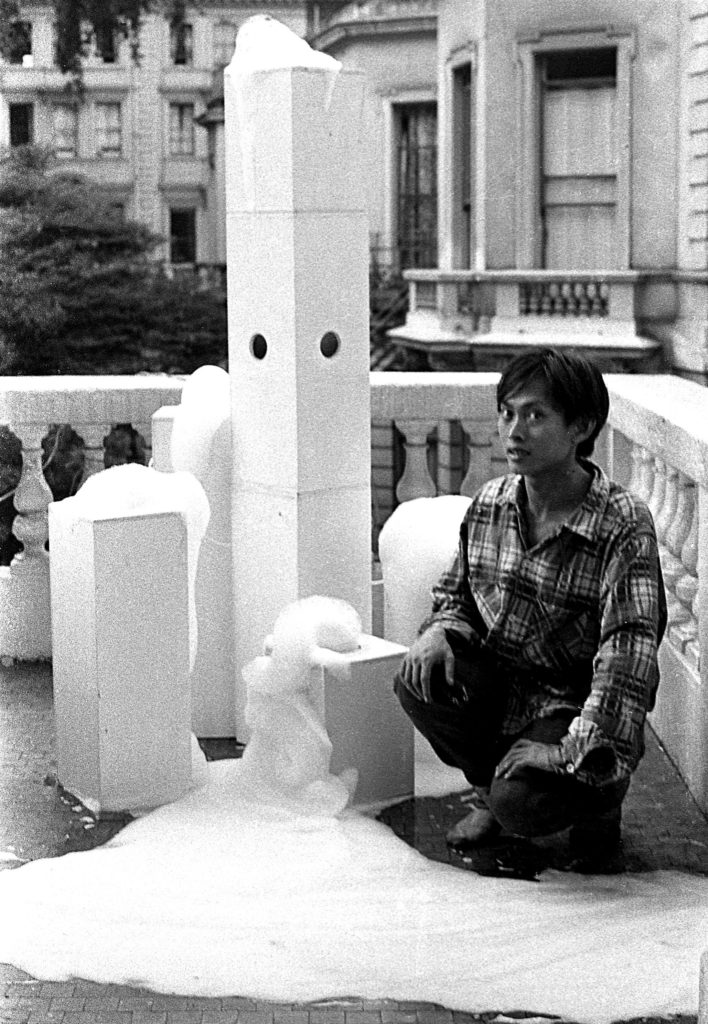
David Medalla (1938-2020)
Peripatetic Filipino artist David Medalla, a pioneer of kinetic sculpture and participatory art performance, died in Manila on Monday, December 28. He was 82. He developed an early reputation as a poet and wünderkind during the immediate post-war period, and was recommended by American poet Mark van Doren to study Literature at Columbia University in…
-
The Outsider Speaking for the Other
A serial reading of Andre Breton, Sigmund Freud, Frantz Fanon, Rosalind Krauss and Hal Foster, might give the impression of a direct intellectual lineage. That’s not what I’m going to do here. I’d like to think of this as a commentary from the sidelines; of what would have been possible had these thinkers sat…
 Geronimo Cristobal