Thank you to my colleagues at the Ateneo, especially Charlie Samuya Veric, for making this possible.
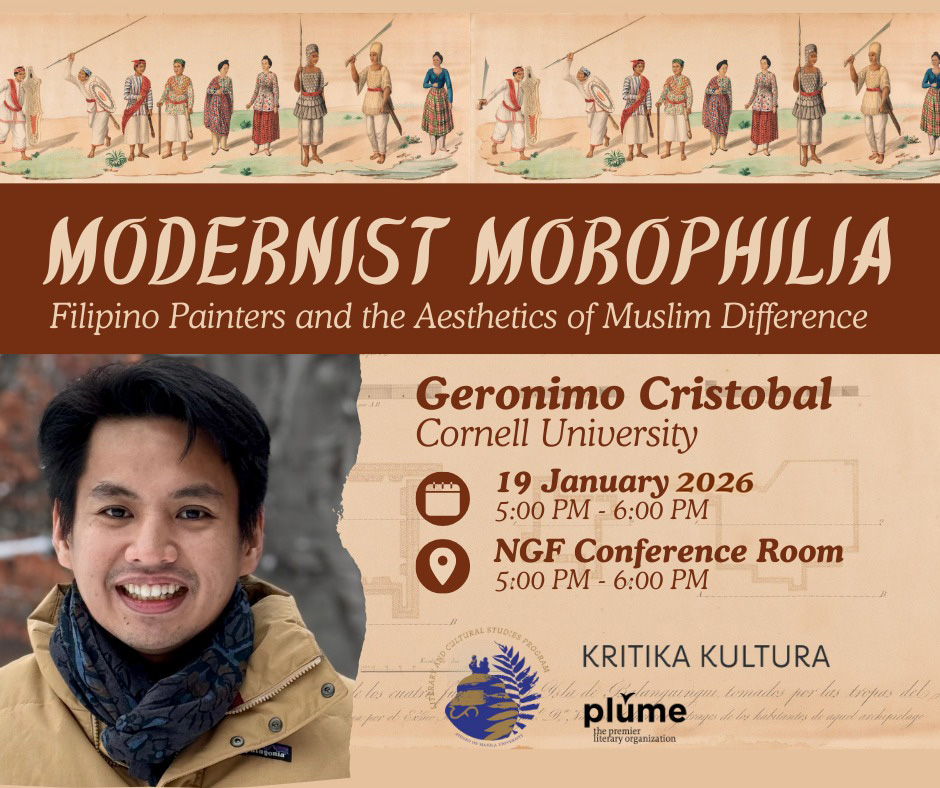
This lecture on January 19 2026 will be inside Ateneo Katipunan Campus at the NGF Conference Room, located on the ground floor of Horacio De La Costa Hall.
During my dissertation research, I came to see how many of the Philippines’ most celebrated modernist painters turned repeatedly to Islamic themes and Muslim subjects—often in ways that demand a rewriting of Philippine art history from the standpoint of the Moro and from Sulu and Mindanao, long central yet marginalised within the project of nationalist culture.
Register for ease of entry into Ateneo Campus.
***
Start your 2026 with an LCSP lecture!
Please register at this link: https://go.ateneo.edu/LCS-GerCristobal
On January 19, the Literary and Cultural Studies Program, in collaboration with Kritika Kultura and PLUME, invites you to Geronimo Cristobal’s lecture, “Modernist Morophilia: Filipino Painters and the Aesthetics of Muslim Difference,” happening from 5:00–6:00 PM at the NGF Conference Room Horacio de la Costa Hall, Ateneo de Manila University.
The lecture reframes Orientalism as a dynamic discourse shaped by the positions and artistic practices of Filipino painters within broader systems of imperialism. It explores how 19th- and 20th-century Filipino artists depicted Muslim communities and how these representations contributed to an evolving aesthetic—one that opens new ways of understanding modernity and imagining a more plural and inclusive Philippine future.
BIONOTE
Geronimo Cristobal is a PhD candidate in the History of Art and Archaeology at Cornell University.
This lecture examines how Filipino painters in the 19th and 20th centuries imagined, constructed, and contested the figure of the Moro within the evolving landscape of Philippine modernism. Instead of viewing Orientalism as solely a European project, the talk reframes it as a mobile discourse shaped by colonized artists negotiating their place within imperial hierarchies. Through the works of José Lozano, Félix Martínez, Galo Ocampo, Botong Francisco, and Irineo Miranda, the presentation traces how images of Muslim Filipinos shifted between ethnographic distance and cultural affinity. These painters rendered the Moro as adversary, performer, and kin, forming an aesthetic vocabulary inflected by nationalism, regional distinctions, and the desire for a more plural Philippine future. Read alongside theallegorical writings of José Rizal and Francisco Balagtas, these paintings reveal how representations of Muslim peoples became a key site for rethinking modernity and reshaping the nation’s cultural horizon.
This lecture is open to the public.
The video recording of the lecture is now available through this link.
The lecture, titled Modernist Morophilia: Filipino Painters and the Aesthetics of Muslim Difference, was introduced by Camilo of the Literary and Cultural Studies Program, who framed it as an examination of how Filipino painters of the nineteenth and twentieth centuries imagined, constructed, and contested the figure of the Moro within Philippine modernism. Rather than treating Orientalism as an exclusively European discourse, the lecture proposed understanding it as a mobile and adaptable visual language appropriated by colonized artists negotiating their own positions within imperial hierarchies. Through the works of José Honorato Lozano, Félix Martínez, Galo Ocampo, Carlos “Botong” Francisco, Irineo Miranda, and others, the presentation traced how representations of Muslim Filipinos oscillated between ethnographic distance and cultural affinity, rendering the Moro alternately as adversary, performer, noble, and kin. These images, read alongside the writings of José Rizal and Francisco Balagtas, reveal how Muslim subjects became central to broader debates about modernity, nationhood, and the cultural future of the Philippines. The speaker, Geronimo Cristóbal of Cornell University, situated the lecture within a larger dissertation project examining the overlapping histories of shellcraft, pearls, Islamic art, and the formation of Philippine artistic modernity. He emphasized that Philippine modern art should not be confined within the boundaries of area studies but understood as a crucial site for exploring global modernisms, from Bauhaus pedagogy and muralism to abstraction and conceptual practice.
Cristóbal explained that his current research emerged from a realization that many of the Philippines’ most celebrated modernist artists repeatedly turned to Islamic themes and Muslim subjects, despite rarely being discussed within histories of Islamic art. He argued that Philippine art history requires rewriting from the standpoint of the Moro, Sulu, and Mindanao, regions long central yet often marginalized within nationalist narratives. The lecture therefore focused on the Moro as a recurring figure in Philippine visual culture. The term itself, inherited from Spanish colonialism, collapsed numerous Muslim communities into a single category. Cristóbal’s concern was not simply how the Moro was depicted but how the figure functioned as an aesthetic problem for Christian Filipino artists working under and after colonial rule. If nineteenth- and twentieth-century Philippine art helped imagine a national community, he suggested, it frequently did so through the construction of an internal Other. The Moro became a screen onto which artists projected admiration, anxiety, nostalgia, aspirations toward plurality, and desires for national coherence. These impulses did not cancel one another out but instead coexisted within the image itself, producing much of its visual and ideological power.
To frame this argument, Cristóbal turned to the concept of internal Orientalism. While Edward Said’s formulation of Orientalism described a European discourse that produced the East as an object of knowledge and domination, the Philippine case involved a more complicated circulation of visual strategies. Colonial subjects themselves adopted and adapted Orientalist modes of representation. Christian Filipino elites seeking cultural authority under Spanish and American rule deployed many of the same visual conventions once used by Europeans. Muslim Mindanao consequently became an internal frontier within the emerging nation, a space simultaneously included and excluded. Representation served as one means of managing this difference. Images appeared to celebrate diversity while often reducing Muslim subjects to recognizable visual types. Cristóbal identified three recurring roles: the warrior, the noble, and the performer. These archetypes helped produce a coherent image of Filipino modernity while containing Muslim difference within carefully controlled aesthetic frameworks. Such images often seemed inclusive, yet their inclusiveness operated primarily through display rather than through political recognition.
The colonial origins of this visual system can be seen in José Honorato Lozano’s People and Forts of Balangigi, commissioned by Governor-General Narciso Clavería after the Spanish campaign against Balangigi in the late 1840s. The painting combines ethnographic observation with military documentation. Figures differentiated by costume, weaponry, and posture occupy the upper register, while the lower section presents architectural plans of captured fortifications. People, territory, and built environment are folded into a single system of imperial knowledge. Although the historical campaign involved the destruction of villages, the burning of more than 150 vessels, the capture of hundreds of people, and what Cristóbal characterized as genocidal violence, Lozano’s image avoids any direct representation of bloodshed. Instead, conquest appears orderly, rational, and complete. Muslim life becomes visible only insofar as it can be incorporated into colonial administration and military triumph. This visual logic would profoundly shape later representations of Muslim Filipinos, even among artists who sought to challenge colonial authority.
Cristóbal argued that the roots of these representational habits extended beyond painting into popular performance traditions. The moro-moro, also known as the comedia or komedya, staged endless variations of a familiar narrative: Christians defeat Muslims, convert them, or otherwise subordinate them. Such performances trained audiences to read costume, gesture, and bodily appearance as moral signs. Before the age of mass media, clothing functioned as a public text through which social, religious, and political identities could be immediately recognized. The moro-moro created a ready-made repertoire of visual cues through which Muslim figures could be identified as antagonists, spectacles, or symbols. While writers such as Francisco Balagtas complicated these conventions by presenting Muslim characters capable of ethical action and heroism, the broader theatrical tradition established patterns of recognition that later migrated into painting and visual culture. These literary and theatrical precedents opened the possibility of imagining the Moro not merely as an enemy but also as a potential compatriot, even if such inclusiveness remained incomplete and conditional.
The persistence of these structures can also be observed in cartographic and devotional imagery. Cristóbal discussed an eighteenth-century map in which Muslim-associated figures—Persians, Malabars, and other Asian peoples—appear along the margins of the composition. Although integrated into the cartographic representation of the archipelago, they remain contained within a Spanish ethnographic framework. Similarly, José Rizal observed that the sword wielded by Saint Michael in certain Philippine religious images resembled a kris rather than a European weapon. For Rizal, this detail revealed how Christian iconography appropriated Muslim material culture. The archangel defeats evil using an object associated with Islamic power, transforming the kris from a sign of Muslim authority into a symbol of Christian victory. Such examples illustrate how Muslim identities and Islamic forms were often incorporated into dominant visual systems while simultaneously being subordinated to them.
A decisive transformation occurred in the late nineteenth century with the rise of the tipo del país. Cristóbal focused on Félix Martínez’s Moro de Joló and Mora de Joló (1886), small watercolors now preserved in Madrid. These images emerged from an imperial demand for ethnographic types that could be collected, classified, and displayed. Martínez, a Manila-born artist trained within the colonial academic system, was not a European outsider but a colonial subject who had mastered the visual language of empire. His Moro figures are rendered with dignity and precision. Their carefully tailored garments, weapons, and posture distinguish them from the lowland Christian indio. Yet admiration remains constrained by the logic of typology. The figures possess no individual histories and exercise no agency. They function instead as ethnographic specimens whose significance derives from their difference. Cristóbal described these works as “ethnographic portraits”—painted rather than photographed, but nevertheless participating in the same classificatory project. In Martínez’s hands, the Moro becomes a figure through which Christian Filipino identity could define itself.
This visual regime intensified under American rule. The establishment of the Moro Province in 1903 formalized Muslim difference through separate systems of governance. The state itself drew the boundaries of belonging before artists ever picked up their brushes. Events such as the Bud Dajo massacre of 1906 generated photographs, postcards, and other images that translated violence into spectacle. One widely circulated postcard featuring a young Moro woman known as “Miss Jolo” invited sympathy from American audiences while erasing the violence that produced her circumstances. Such images demonstrate how compassion itself could become a mechanism of control. They transformed Muslim suffering into an object of consumption while preserving the structures of power that generated it. By the early twentieth century, the visual vocabulary of Muslim representation was therefore inseparable from broader systems of administration, military intervention, and colonial governance.
The American colonial period introduced new forms of managing Muslim difference, but it also generated new cultural strategies for incorporating Muslim figures into national narratives. One example discussed by Cristóbal was Severino Reyes’s little-known zarzuela Mindamora, first staged in Tagalog in 1904. While overshadowed by Reyes’s more famous theatrical works, Mindamora is significant because it attempted to cultivate sympathy for a Muslim protagonist among largely Christian audiences. The play centers on a romantic relationship between a Muslim woman and a Christian man, presenting the possibility of reconciliation across the Moro-Christian divide. Yet the terms of this reconciliation are carefully structured. Difference is not preserved as a political reality but translated into familiar theatrical forms that render it emotionally accessible and aesthetically pleasing. Song, costume, dance, and romance allow audiences to identify with the Moro character while simultaneously containing her within conventional narratives of assimilation and harmony. Inclusion thus operates through feeling rather than through political equality. Sympathy becomes a mechanism through which Muslim difference is recognized, managed, and ultimately neutralized.
A markedly different approach appears in Victorio Edades’s Mora Girl. Unlike earlier colonial images that emphasized ethnographic classification or spectacle, Edades presents his subject as an individual possessing interiority and psychological depth. The figure is quiet, introspective, and detached from overt narrative. Costume remains important, but it no longer functions primarily as an ethnographic marker. Instead, color, mood, and presence dominate the composition. Cristóbal connected this shift to Edades’s engagement with Fauvism, whose intense and expressive use of color privileged subjective experience over realism. The reds and greens of Mora Girl do not describe cultural identity so much as emotional atmosphere. In this respect, the painting embodies a form of morophilia distinct from earlier colonial frameworks. The Moro figure is no longer presented as a type to be classified or managed but as a human subject worthy of aesthetic and psychological attention. Edades’s modernism thus creates space for a different kind of encounter with Muslim identity, one grounded less in ethnography than in affect.
The lecture’s most sustained visual analysis centered on Irineo Miranda’s celebrated portrait Maguindanao Princess, painted in the early 1950s. Cristóbal invited his audience to examine the work closely, drawing attention to its luxurious fabrics, pearl jewelry, attendant figure, and regal bearing. The painting differs fundamentally from earlier depictions of Moro subjects because it portrays a specific historical individual rather than an ethnographic type. The sitter was later identified as Santanina Rasul, who would become the first Muslim woman elected to the Philippine Senate. Although the identity of the sitter remained undisclosed when the painting was first exhibited, the portrait records an actual sitting at the University of the Philippines School of Fine Arts, after which Miranda imaginatively completed the setting and surroundings. The jewelry depicted was real, as were many of the details of costume. By anchoring the image in a historical person rather than an abstract category, Miranda transformed the representational logic of Moro portraiture. The figure is neither adversary nor spectacle. She occupies the position of aristocratic authority, projecting dignity, confidence, and composure. Unlike many earlier images, which defined Muslim identity through difference, Maguindanao Princess presents Muslim femininity as fully compatible with public leadership and national representation.
Cristóbal contrasted Miranda’s portrait with Fabian de la Rosa’s Muslim Lady Reclining. Whereas de la Rosa constructs Muslim femininity through an intimate and highly interiorized setting that emphasizes leisure, sensuality, and repose, Miranda’s sitter occupies a more public and authoritative space. She sits upright in a posture associated with ceremonial dignity rather than private contemplation. This distinction has broader political implications. Rasul herself later adopted a similar visual vocabulary in her public life, frequently appearing in Muslim dress and presenting her identity as a source of legitimacy rather than marginality. Through Miranda’s painting, Muslim womanhood becomes not a peripheral curiosity but a symbol of national modernity. Cristóbal therefore described the work as one of the rare moments in Philippine art where Muslim identity stands not at the margins of the nation but at its symbolic center.
Elsewhere in Miranda’s oeuvre, however, the Moro occupies a more ambiguous position. In certain landscapes, Muslim identity appears only indirectly through the presence of a vinta gliding across the distant horizon. The boat functions as a visual shorthand for Mindanao and the Sulu archipelago. Yet its placement within the composition is telling. While the foreground remains anchored in a lowland Christian pastoral world, the Muslim figure is displaced to the margins, absorbed into the scenery rather than occupying the social center of the image. Cristóbal suggested that this recurring strategy operates almost as a metaphor for the place of Muslim communities within Philippine nationalism: visible, acknowledged, and aesthetically valued, yet often relegated to the background.
A more radical shift occurs in Galo Ocampo’s Moro Dance (1946), painted in the year of Philippine independence. Here the Muslim figure is no longer ethnographic subject, aristocratic exemplar, or distant presence. Instead, she becomes the compositional and energetic center of the painting. There is no visible audience, no framing device, and no narrative opposition. Ocampo employs flattened space, saturated color, and rhythmic bodily movement to create a distinctly modernist image. Drawing loosely upon dance traditions associated with Sulu and Tawi-Tawi, particularly the pangalay, he translates movement into formal structure rather than anecdotal description. The Moro woman generates the visual order of the painting itself. In representational terms, this marks a significant reversal. If earlier artists defined the nation through opposition to Muslim subjects, Ocampo places Muslim embodiment at the center of modernist experimentation. The work remains indebted to Orientalist conventions, but it transforms them. Rather than serving as an ethnographic curiosity, the Moro becomes a vehicle through which Philippine modernism develops its own aesthetic language.
Cristóbal cautioned, however, that such transformations did not necessarily escape Orientalism altogether. The visual language pioneered by artists such as Ocampo often migrated into tourism posters, cultural promotion campaigns, and nationalist imagery. Bright colors, stylized costumes, and flattened forms rendered Muslim life attractive and consumable. Difference became spectacle, marketed through images of beauty, color, and exotic appeal. The Moro remained highly visible, but that visibility increasingly served commercial and symbolic purposes rather than political recognition. Modernist morophilia, in other words, frequently aestheticized Muslim identity even as it appeared to celebrate it.
Cristóbal then turned to Juan Luna, whose engagement with Islamic visual culture was more subtle but no less significant. In Luna’s self-portrait from Rome, the canvas appears mounted against an Ottoman or Turkish textile rather than a neutral backdrop. This detail situates the artist within broader currents of nineteenth-century Orientalism. Cristóbal noted that Luna moved within the same Parisian artistic circles as figures such as Jean-Léon Gérôme and Benjamin Constant, painters deeply invested in Orientalist subjects and imagery. Archival photographs reveal Luna’s inclusion within the same social and artistic networks. Rather than claiming that Luna was himself an Orientalist painter in the conventional sense, Cristóbal suggested that he participated in a visual culture saturated with Islamic motifs, objects, and fantasies. Such influences formed part of the intellectual environment through which Philippine artists encountered modernity.
This perspective informed Cristóbal’s reinterpretation of Luna’s El Pacto de Sangre. Traditionally read as a straightforward depiction of equality between Spaniards and indigenous leaders, the painting can also be understood through conventions of nineteenth-century academic history painting. Cristóbal focused on the Rückenfigur, the back-facing figure commonly used in European art to position viewers within a scene. In El Pacto de Sangre, Sikatuna’s posture functions not as a sign of inferiority but as a surrogate for the viewer. By identifying with his perspective, audiences are invited to witness the covenant itself. Such compositional strategies would have been immediately legible to nineteenth-century viewers trained in academic conventions. Luna therefore appropriated imperial visual languages in order to articulate alternative understandings of colonial encounter and political community.
Cristóbal further complicated assumptions about José Rizal’s relationship to Islam by presenting an unfinished drawing from the Newberry Library depicting objects Rizal reportedly found during his exile in Dapitan. The sketch includes a ring, medal, and floral motifs that Rizal associated with early Muslim converts to Christianity. Such materials often entered into traditions of anting-anting and talismanic practice. The drawing reveals Rizal’s ethnographic curiosity and suggests that Islamic material culture occupied a more significant place in his intellectual world than is often recognized. These objects challenge simplistic narratives that position Rizal solely within a Christian nationalist framework.
The lecture next turned to Carlos “Botong” Francisco, whose work reveals both the possibilities and limitations of modernist morophilia. Costume designs for Muslim princes and historical figures draw heavily on inherited Orientalist vocabularies: turbans, curved swords, flowing garments, and generalized Islamic motifs. Rather than reconstructing specific historical realities, these images assemble an imagined Islamic past from a repertoire of recognizable signs. In works such as Muslim Betrothal, Francisco employs flattened space, rhythmic composition, and mural scale to transform Muslim life into a timeless and monumental source of national culture. The Moro becomes a civilizational ancestor, incorporated into a broader narrative of Filipino origins. Yet this incorporation often occurs through abstraction and mythmaking rather than historical specificity. Islamic life is celebrated as heritage while being removed from the complexities of contemporary politics and society.
The final section of the lecture broadened the discussion from individual paintings to the larger ideological work performed by modernist representations of Muslim Filipinos. Cristóbal examined several works by Carlos “Botong” Francisco in which Muslim subjects appear as embodiments of cultural origins, resistance, and national heritage. In one imagined portrait of Rajah Soliman, Francisco did not attempt a historical reconstruction based on documentary evidence. Instead, he assembled a visual identity from Islamic-inflected symbols, producing an image that functioned less as portraiture than as nationalist mythmaking. Similarly, in Muslim Betrothal, Francisco translated Muslim life into a modernist visual language shaped by flattened space, compressed depth, rhythmic repetition, and mural scale. Drawing simultaneously on Post-Impressionism, Mexican muralism, and Southeast Asian relief traditions, the work presents the Moro not as an ethnographic subject but as a civilizational source. Muslim identity becomes monumental, timeless, and foundational. Yet this transformation comes at a cost. The specificity of historical Muslim communities gives way to symbolic representations that serve broader nationalist narratives. Islamic Philippine life is absorbed into a modernist search for origins, essence, and cultural authenticity.
This tension becomes even more visible in Francisco’s monumental historical murals. Cristóbal noted that figures such as Rajah Soliman are often remembered simply as precolonial heroes rather than as Muslim rulers. Within nationalist visual culture, Islamic identity is frequently retained only insofar as it supports a larger narrative of resistance against colonialism. The Moro thus shifts from cultural presence to political symbol. Muscular bodies, weapons, heroic gestures, and mural scale align these figures with international traditions of nationalist modernism. In this context, Muslim subjects become ancestors of the nation, absorbed into a heroic genealogy that privileges anti-colonial resistance while often overlooking the distinct histories and political realities of Muslim communities themselves.
Cristóbal then introduced the lesser-known painter Antonio Garcia Llamas, whose work offered a different mode of morophilia. In paintings depicting Muslim communities gathering along the shore amid shells, maritime abundance, and colorful boats, Llamas presents a vision of Muslim life grounded in harmony, labor, and communal interaction. Saturated colors and carefully orchestrated compositions transform everyday activities into picturesque scenes of abundance. Yet these images also reveal the limitations of postwar nationalist multiculturalism. Islam appears primarily through costume, atmosphere, and setting. Political conflict, religious practice, and historical complexity recede into the background. The resulting images align with broader postwar desires to present cultural diversity as harmonious and consumable. Difference is celebrated aesthetically while remaining detached from questions of power or inequality.
Another dimension of this process emerges in Llamas’s portrayals of Muslim women. Cristóbal connected these works to the artist’s close relationship with the Indonesian painter Affandi and to broader Southeast Asian cultural networks. Llamas’s female figures exhibit elongated forms, controlled sensuality, and a visual language indebted to Japanese and Southeast Asian modernisms. Muslim femininity becomes associated with grace, beauty, ornament, and timelessness. Rather than anchoring these figures in the specific histories of Mindanao or Sulu, Llamas situates them within a broader romanticized Malay and Asian aesthetic world that circulated through postwar cultural diplomacy. Here again, Muslim identity is valued, but primarily as an aesthetic resource.
Bringing these various examples together, Cristóbal proposed that Philippine visual culture reveals not a single representation of the Moro but a series of shifting roles. From Félix Martínez’s ethnographic warrior, to the sympathetic heroine of Mindamora, to Miranda’s aristocratic Maguindanao Princess, to Ocampo’s modernist dancer, Muslim subjects moved through different regimes of visibility. At each stage, inclusion expanded, yet that inclusion was mediated through increasingly sophisticated representational frameworks. Internal Orientalism did not disappear. Rather, it adapted. Overtly colonial forms of classification gave way to subtler mechanisms of aesthetic appreciation, psychological depth, multicultural celebration, and nationalist incorporation. The Moro remained highly visible, but visibility itself became one of the principal technologies through which difference was managed.
Cristóbal emphasized that this process extended beyond artistic production into the circulation of images. Returning to Lozano’s People and Forts of Balangigi, he noted that the painting now circulates through auction houses and art markets, acquiring new meanings and economic value. Questions of authorship, patronage, collecting, and institutional display therefore become inseparable from questions of representation. Muslim figures remain the subjects of these images, but the authority to produce, circulate, interpret, and profit from them largely belongs to artists, collectors, museums, and markets. Even works that appear inclusive continue to reflect the priorities of those who control their production and distribution.
The lecture concluded with a series of questions rather than definitive answers. If Philippine modernism relied upon the figure of the Moro to imagine a more plural nation, what forms of plurality were actually permitted? Which forms remained deferred or excluded? Who acquired the authority to aestheticize difference, and who remained confined to serving as its object? For Cristóbal, modernist morophilia demonstrates that the Moro in Philippine art functions less as a historical subject than as a constructed visual role. Across different periods and artistic movements, Muslim figures appear as noble, decorative, heroic, sympathetic, dignified, or abstract. These images often move beyond the overt hostility of colonial representations, yet they frequently do so by transforming Muslim identity into an aesthetic category. To read these works critically is not to reject their artistic achievements but to recognize the ways in which nation-building operated through visual culture. Philippine art did not merely resist empire; it also reorganized forms of seeing from within. The task for contemporary scholars, he suggested, is therefore not to discard these images but to continue asking what they render visible and what they leave just beyond the frame.
The discussion that followed raised questions about the concept of “difference,” the political implications of Orientalism, and Juan Luna’s Battle of Lepanto. Responding to comments from the audience, Cristóbal acknowledged that “difference” might ultimately be an insufficient term and suggested that Philippine art history may need to generate its own conceptual vocabulary rather than relying exclusively on imported theoretical frameworks. He argued that Philippine modern art possesses the potential to contribute new perspectives to global discussions of Orientalism and modernism rather than merely applying existing theories to local material. On the question of Luna’s Battle of Lepanto, he noted that the painting remains a significant example of Orientalist history painting, although it falls outside the scope of his present lecture because it depicts Mediterranean rather than Philippine Muslims. Nonetheless, he suggested that Luna’s engagement with such themes deserves further analysis.
In his closing remarks, Charlie Veric reflected on the lecture’s broader significance. He observed that Cristóbal’s analysis repeatedly highlighted forms of absence within representation. Images such as the postcard of “Miss Jolo” generated sympathy, yet obscured the structures of imperial violence that produced the conditions being depicted. Veric also drew attention to the institutional contexts within which scholarship itself is produced. He noted the role of Cornell University’s Southeast Asia Program, founded during the Cold War, in shaping generations of scholars, including Benedict Anderson and many of the figures whose work informed the lecture. Rather than simply reproducing established narratives, Veric argued, Cristóbal’s work challenges scholars to reconsider how knowledge about the Philippines is produced, circulated, and interpreted, particularly within transnational academic settings. The lecture thus ended not only as an inquiry into the visual history of Muslim difference but also as a reflection on the conditions under which Philippine art history itself is written.
 Geronimo Cristobal