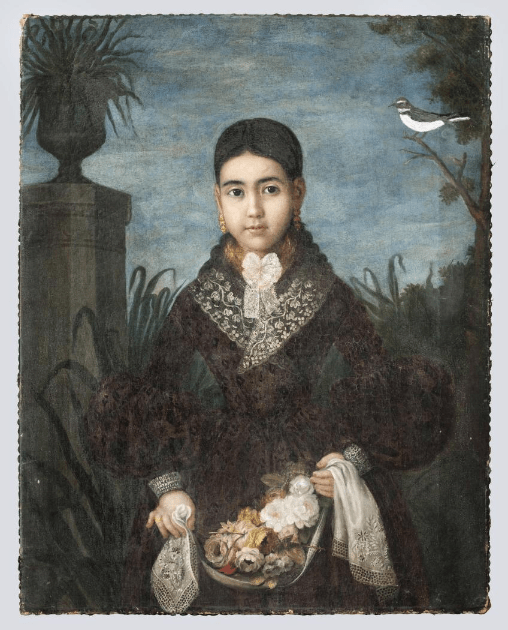
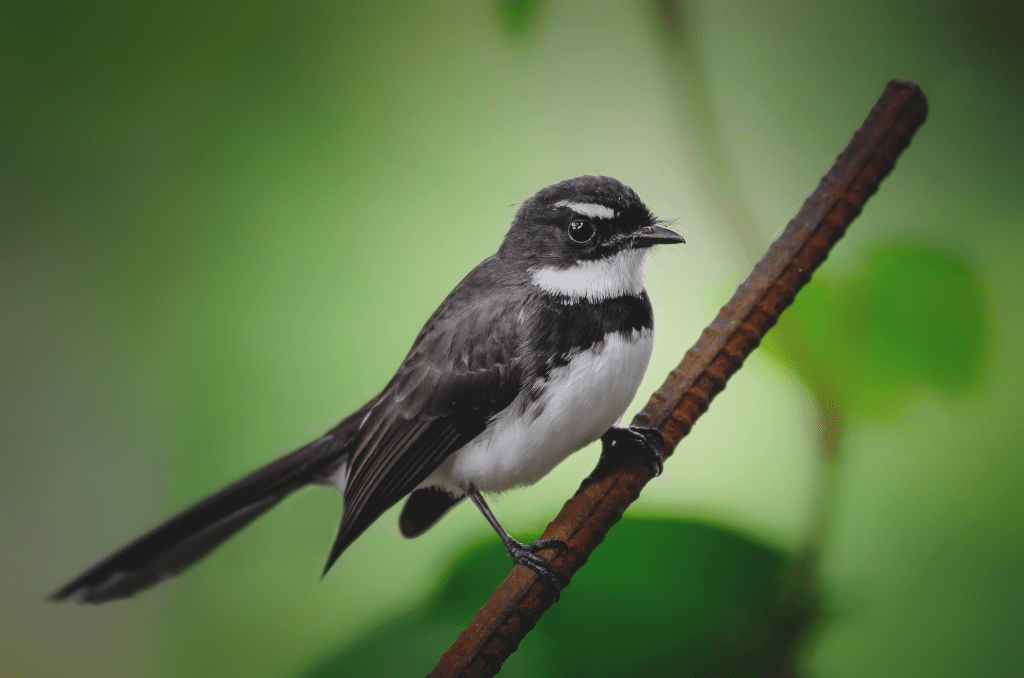
The painting Niña con pájaro y flores (Girl with Bird and Flowers) has been identified as Filipino based on the species of the bird shown in the background. The museum record identifies the bird as a pied fantail, Rhipidura javanica, a species associated with the Philippines and Southeast Asia. It appears on a branch at the upper right of the canvas. Its dark body, white eyebrow, and pale throat marking give the garden setting a specific local reference.
The work is an oil painting on canvas in the Museum of the Americas. It measures 77 by 60 centimeters. The museum dates it to the first half of the nineteenth century and gives the place of production as the Philippines. The artist is not named in the record. The sitter is also unidentified.
The portrait shows a young girl at half length in a garden. Her black hair is parted at the center and arranged in an updo. She faces the viewer directly. She wears a dark dress with puffed sleeves and lace cuffs. A white lace scarf crosses her chest, and a ribbon is tied at her neck. She also wears gold earrings and a ring. Her clothing follows European fashion current in the early nineteenth century. The child’s gesture is highlighting the embroided handkerchiefs on both of her hands as she holds basket of flowers.
A number of museums around the world have several relevant examples of the Philippine-made handkerchief. One example can be found at the Met Museum, dated to the third quarter of the nineteenth century. It is made of piña and cotton. The Met describes its nearly transparent pineapple cloth, supplementary woven motifs, and finely cut muslin appliqué border, identifying the cutwork as sombrado, a technique specific to the Philippines and used on fine pineapple-cloth accessories and garments.
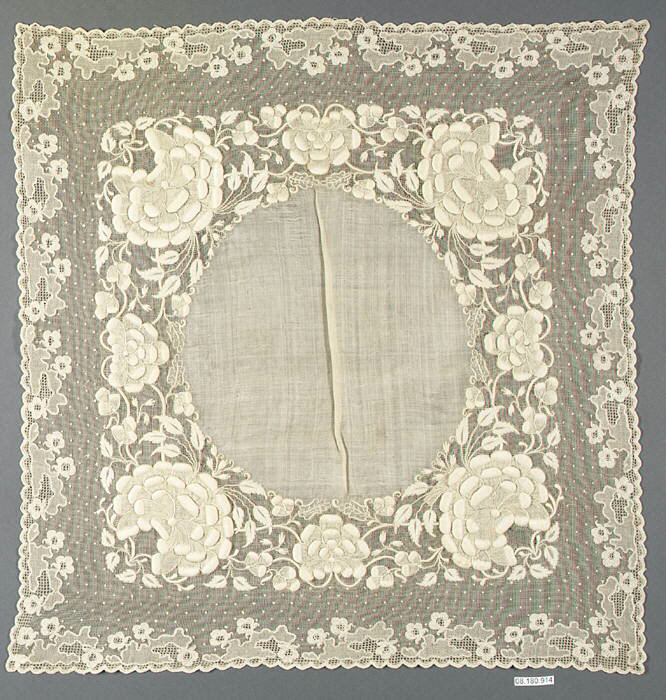
These small textiles point to the importance of fine cloth, lace, and embroidery in nineteenth-century Philippine dress. They also relate the portrait to the textile culture of the period, when delicate fabrics and worked edges formed part of elite self-presentation. In the painting, the handkerchiefs mark refinement and draw attention to the sitter’s carefully posed hands. At the center, she carries a small group of flowers. The museum record identifies roses and what appear to be daisies. The flowers are placed low in the composition, near the lower edge of the painting. Their position draws attention to the sitter’s hands and to the careful arrangement of lace.
The background presents a garden through close details. At the left is a flowerpot set on a pilaster. At the right is the tree branch with the bird. Dense plants fill the space behind the sitter. The setting is not a broad landscape but a compact garden arranged around the child.
The portrait belongs to the history of nineteenth-century painting in the Philippines. It records a child from a family able to commission an oil portrait and present her through fashionable dress and jewelry. The painting also shows how Philippine portraiture could adopt European formats and mark locality through natural details.
 Geronimo Cristobal