
This seventeenth-century ivory plaque in the National Museum of Decorative Arts in Madrid is one of the stranger religious images attributed to the Philippines. The work shows the Nave Typus Religionis, or Ship of Religion, a Counter-Reformation allegory in which the Catholic Church is imagined as a vessel crossing the sea of life while demons, Death, and spiritual enemies attack it from all sides.
The composition may derive from an engraving titled Typus Religionis, made by an unknown artist around the end of the sixteenth or beginning of the seventeenth century, possibly in the Netherlands. That engraving was printed, colored, and varnished so that it resembled a painting, and was placed in the Jesuit college of Billom in France. Its imagery developed from the older theme of the Ship of the Church, traditionally governed by Saint Peter and safely reaching port. Over time, this theme evolved into the Ship of Religion, where the regular life of the religious orders appears inside the vessel, usually arranged beneath the authority of the Pope.
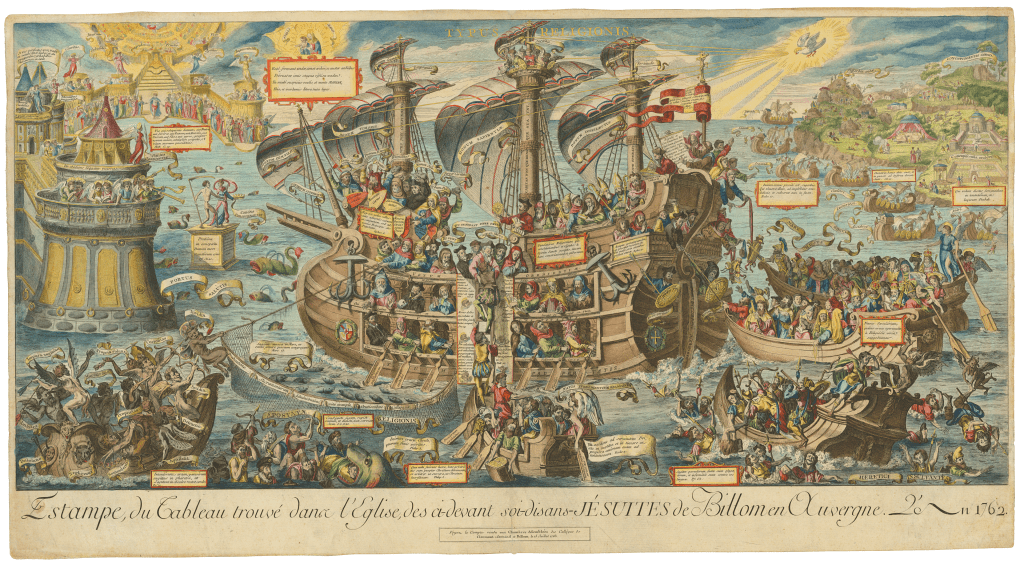
The engraving introduced a controversial variation. In it, the Pope and Henry IV of France appear dragged behind the main ship of faith, suggesting their dependence on the Jesuits for salvation. This detail later became politically dangerous. During the trial that led to the expulsion of the Jesuits from France in 1762, the image was used as evidence of Jesuit disrespect toward both the papacy and the king. Later, under Charles III, the Jesuits were also expelled from Spanish territories, including the Philippines.
The Philippine ivory plaque appears to transform this charged European model into a dense, carved devotional object. A ship fills the plaque from bottom to top. At its center stands Our Lady of Sorrows, with a dagger piercing her chest. She is surrounded by saints, clergy, and religious orders. A king beside her may be Saint Ferdinand, remembered as a protector of religious communities. A decapitated saint nearby may be Saint Denis, the first bishop of Paris, whose church at Montmartre was associated with the early vows of the founders of the Society of Jesus.
The foreground is full of strange details. A male figure drops anchor, possibly Saint Francis Xavier, accompanied by Saint Ignatius of Loyola and other Dominican, Franciscan, or Augustinian figures holding oars. Another figure, likely Judas, appears hanged. A man with a millstone around his neck tries desperately to climb into the ship, referring to Christ’s warning in Luke 17:1–6: “It would be better for him if a millstone were hung around his neck and he were thrown into the sea.” A figure with a papal tiara and an anchor on his back also struggles near the vessel. Saint Paul, identified by his sword, seems to abandon the half-sunken ship below.
Above the ship are the Arma Christi, the instruments of the Passion, presented almost like heraldic weapons against Satan. These include the cross, the column of the Flagellation, the rooster of Peter’s denial, the hammer, the lance of Longinus, the pincers used to remove the nails, the dice cast for Christ’s garments, and the sun and moon recalling the darkness at Christ’s death. The ship is therefore not simply sailing. It is guided and defended by the Passion of Christ.
The craziness of the image continues. A cherub blows divine wind into the sails. Demons blow back from the opposite side. Others shoot arrows, breathe fire, and attack from below. Death joins the assault. The whole plaque becomes a miniature theater of salvation, scandal, shipwreck, and endurance.
In terms of visual effect, it can be compared to Hieronymus Bosch’s Ship of Fools. Both images use the ship as a crowded moral world and overload the vessel with bodies, gestures, symbols, and grotesque incidents. The viewer is forced to scan the image from one strange detail to another.
In Bosch’s ship, the passengers are foolish, corrupt, and spiritually adrift. The disorder comes from inside the boat. In the Philippine ivory plaque, the main ship is holy. The danger comes from outside: demons, Death, hostile winds, arrows, fire, and the scandal of those who fail to remain with the true vessel of faith. Bosch gives us society collapsing into folly. This plaque gives us the Catholic Church under supernatural siege, holding course through a demonic sea.
The object sheds more light on the history of Spanish-Philippine ivory carving. Manila was the center of workshops where skilled Filipino artisans, initially trained in part by Chinese artists, produced religious objects for global circulation. These works moved through the Manila galleon trade to New Spain and then to Spanish ports.
Dr. Margarita Estella studied this work in “The Representation of the Church Nave in an Ivory Relief,” published in Traza y Baza in 1983. Her reading shows the density of the image: a triumphalist vision of the Roman Church, a contemplative image of religious life, a Jesuit allegory, and a scene of anti-demonic struggle. The plaque was recently treated as a collector’s object, with an asking price of €60,000. It now appears to have been acquired by the Museo Nacional de Artes Decorativas.
Notes
Most of the information from the article was translated from Noemí Marín, “Un relieve hispano-filipino de marfil brilla en Ansorena,” ARS Magazine, September 19, 2024, updated October 30, 2024.
Margarita Estella Marcos, “La representación de la nave de la iglesia en un relieve de marfil,” Traza y Baza: Cuadernos Hispanos de Simbología, Arte y Literatura, no. 8 (1983): 97–101.
 Geronimo Cristobal