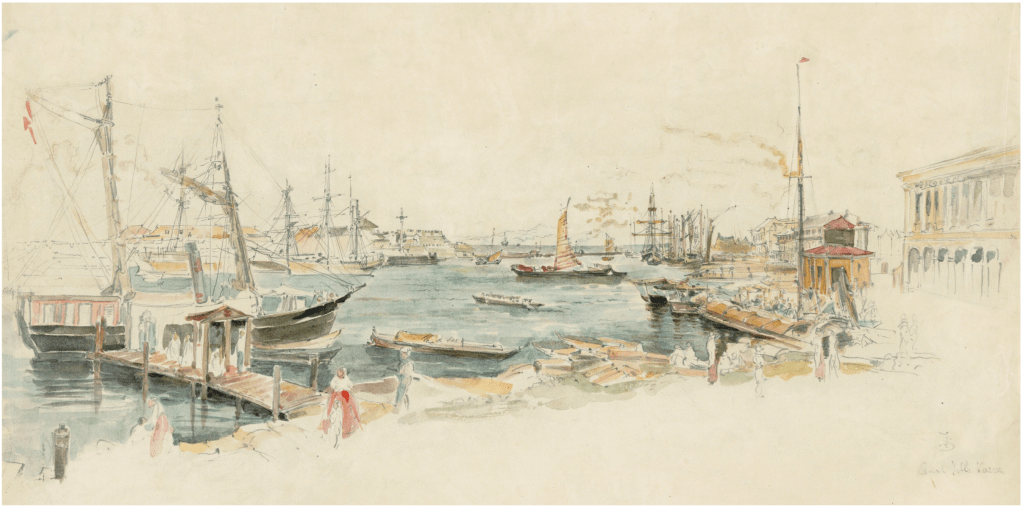
When Josef Selleny visited Manila in 1858 as part of the Austrian Novara expedition, the city was a busy Spanish colonial port defined by walls, churches, cigar factories, river traffic, and the movement of hemp, tobacco, and other commodities. Shipping on the Pasig River at Manila belongs to this moment of maritime activity. Signed with Selleny’s monogram at the lower right, with an indistinct title that appears to read “Canal della Kar…,” the work shows the Pasig as a working waterway, filled with large vessels, smaller river craft, waterfront structures, and figures gathered along the bank.
The drawing were part of the visual record of the Austrian frigate Novara, which circumnavigated the world from 1857 to 1859. The Novara was the first Austrian warship to make a port call in the Philippines. Its visit to Manila took place from 15 to 25 June 1858. The expedition was a scientific mission under the patronage of Archduke Ferdinand Maximilian, brother of Emperor Franz Joseph and later emperor of Mexico. Austrian scholars joined the voyage, including Karl Scherzer, who wrote the official account of the expedition.
Scherzer’s account appeared in German as Reise der Österreichischen Fregatte Novara um die Erde, in den Jahren 1857, 1858, 1859, unter den Befehlen des Commodore B. von Wüllersdorf-Urbair, published in Vienna in 1861–62. According to an article by Wilhelm M. Donko, a former Austrian ambassador to the Philippines, who published art article in The Philippine Star on 19 May 2013, the book became the second most successful popular scientific work in the German language in the nineteenth century, after Alexander von Humboldt’s five-volume Cosmos. Around 30,000 copies were sold. An English edition followed in London from 1861 to 1863 under the title Narrative of the Circumnavigation of the Globe by the Austrian Frigate “Novara” (B. von Wullersdorf-Urbair), Undertaken by Order of the Imperial Government, Under the Immediate Auspices of His I. and R. Highness the Archduke Ferdinand Maximilian, Commander in-Chief of the Austrian Navy. The English edition appeared in three volumes and contained more than 1,200 pages.
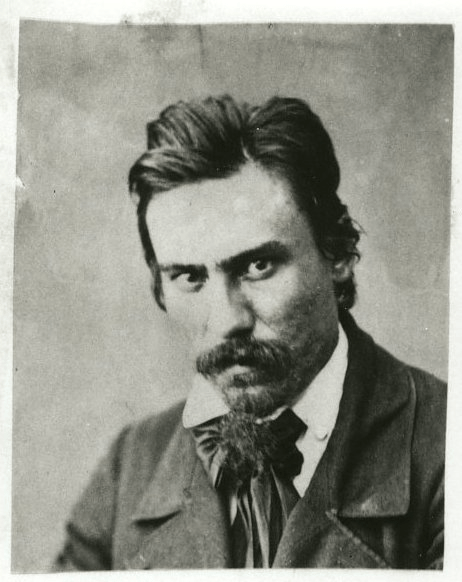
Selleny served as the official artist of the expedition. Photography was already known by the 1850s, and Donko notes reports that photographs from the voyage were taken and later lost during wars. He states that these reports could not be verified and gives his view that such photographs likely did not exist. The expedition therefore relied on an artist for its visual documentation. Selleny produced around two thousand watercolors and drawings during the voyage. His sketches supplied models for many of the illustrations in Scherzer’s publications.
Selleny was born in Vienna in 1824. He studied at the Academy of Fine Arts and traveled in Europe for artistic training. He came under the patronage of Archduke Ferdinand Maximilian, who supported his work before he became widely known. Selleny also worked in landscape gardening and is associated with the design of the Wiener Stadtpark, the Vienna City Park, created in the style of English gardens. Later in life he developed a nervous disorder and moved to Southern Tyrol, where he painted mountain landscapes. He returned to Vienna because of illness and died there in May 1875 at the age of fifty-one.
After Selleny’s death, his sisters entered into a legal dispute with the Austrian Navy over ownership of his Novara works. The pictures were still in Selleny’s possession when he died, while the Navy maintained a claim over them. A compromise was reached that considered the poverty of his sisters and the claim that Archduke Ferdinand Maximilian had given the pictures to Selleny. After later transfers following the end of the First World War, a substantial part of his Novara material entered Viennese museum collections. Works from the expedition are now held in institutions including the Österreichische Galerie Belvedere, the Albertina, the Heeresgeschichtliches Museum, and the Naturhistorisches Museum in Vienna.
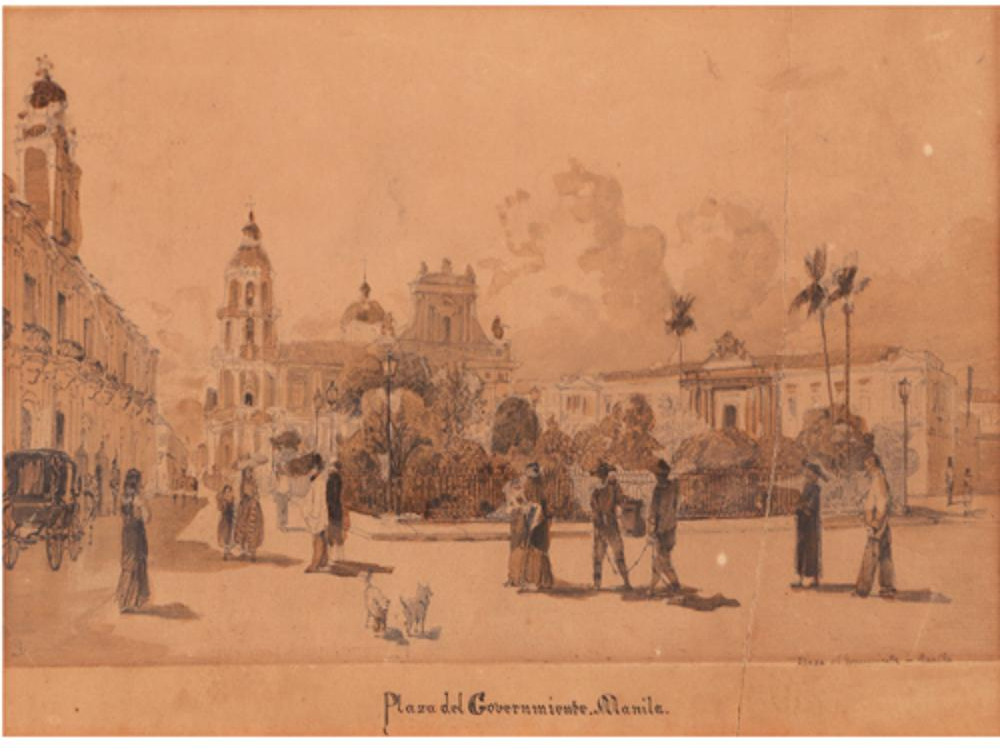
Shipping on the Pasig River at Manila should be understood within this expeditionary context. It records Manila during the Novara’s ten-day stay in June 1858. The view is related to other panoramic Manila subjects associated with Selleny’s voyage work. The 2004 Landesmuseum Schloss Tirol exhibition catalogue Der Freie Horizont: Die Weltumseglung der Novara und Maximilians Mexikanischer Traum includes comparable panoramic views of Manila, including “Santa Cruz auf der Insel Manila” and “Am Hafendamm von Manila,” listed on pages 219–20 as catalogue numbers 4.12/1 and 4.12/2.
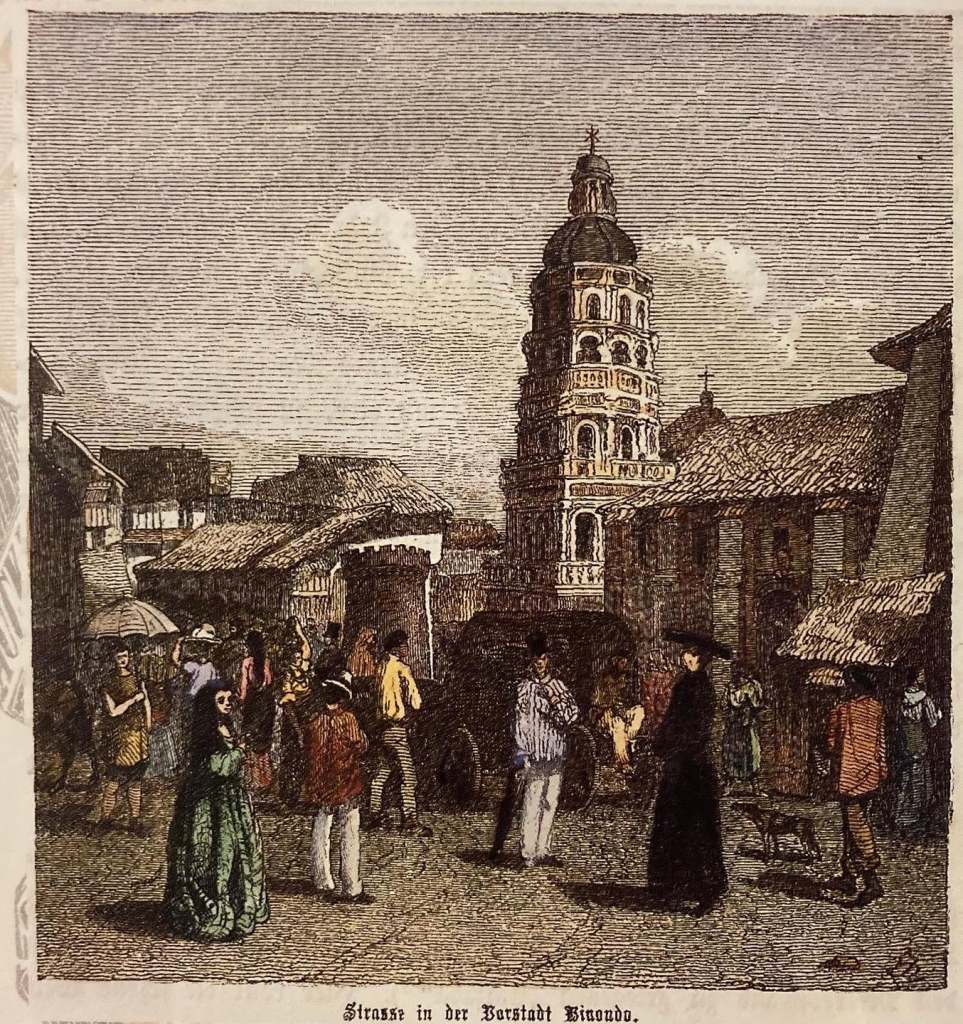
Other images after Selleny’s sketches show urban and social life in Manila. (See above) Strasse in der Vorstadt Binondo [Street in the Suburb of Binondo], published in 1861 in the official account of the expedition, presents a busy street in Binondo with its famous church visible in the background. The foreground includes pedestrians in varied dress. Two well-dressed men wear striped barong tagalog, white trousers, leather shoes, and top hats. One appears to carry a cane or umbrella. Another man at the right wears a darker work barong, rolled-up trousers, and no shoes. The image is useful for the study of nineteenth-century urban clothing, especially the barong tagalog as worn in Manila by men of different social positions.
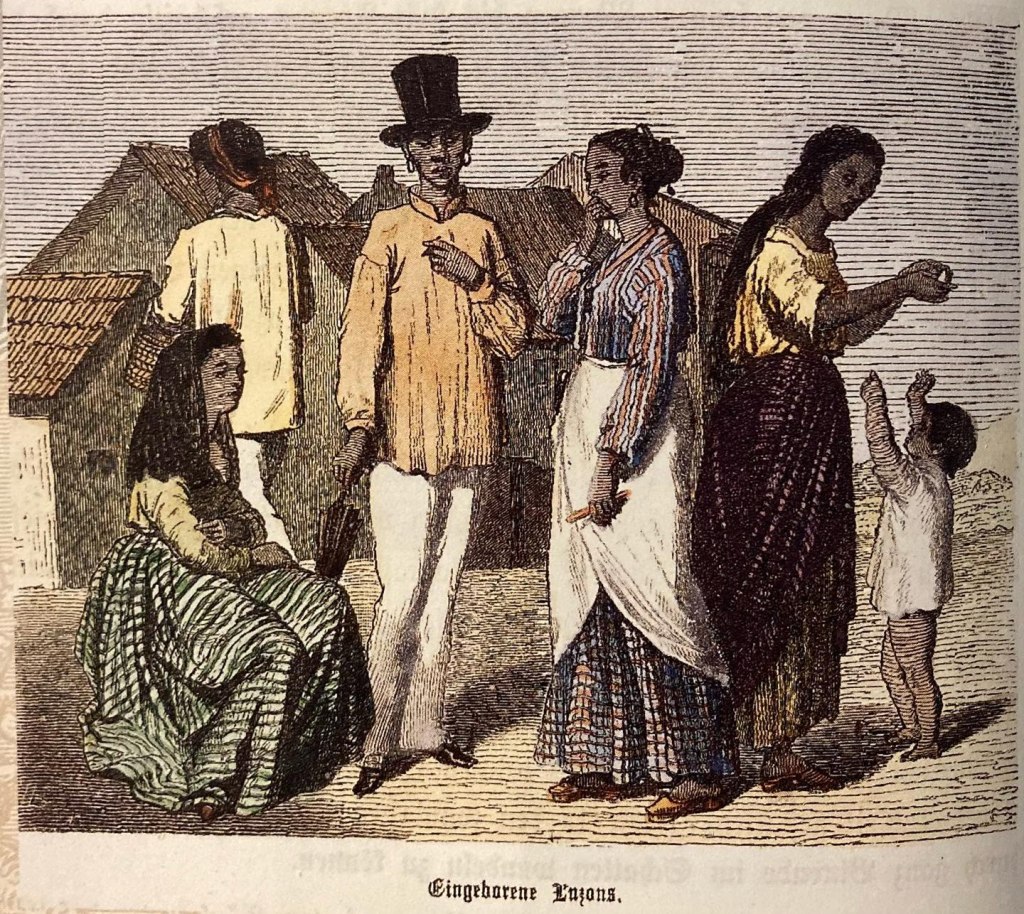
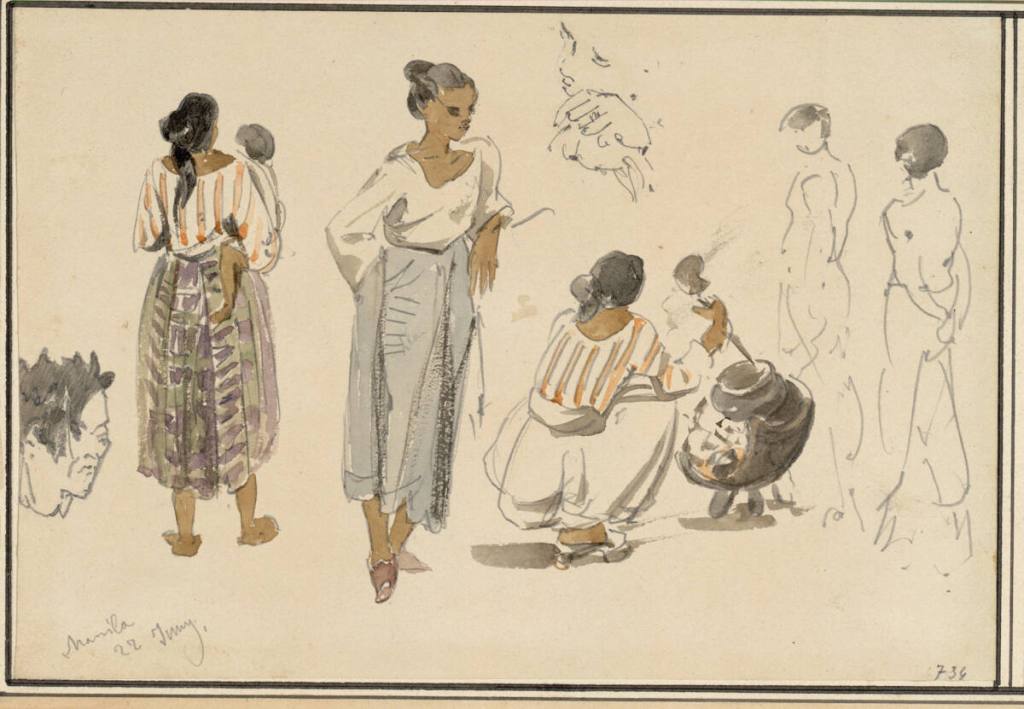
A second image, Eingeborene Luzons (Natives of Luzon), also published in 1861, presents three women, two men, and a child in front of houses. The women wear baro’t saya with tapis over their skirts and slippers on their feet. The seated woman at the left wears a mantilla over her head. The men wear barong tagalog with white trousers.The man facing the viewer wears black leather shoes, a top hat, and a barong with a standing collar and striking pearl earrings. He holds a cigarillo in his left hand and an umbrella in his right. The man seen from behind wears a putong or head wrap and carries a container. The child at the right wears a white shirt. The clothing suggests figures represented in respectable everyday dress, likely from the middle or upper strata of Manila society.
Joseph Selleny’s watercolors are significant as an Austrian visual record of the Philippines under Spanish rule in the mid-nineteenth century. It shows Manila as a port city organized around river traffic, with foreign shipping, local craft, landing areas, and urban buildings occupying the same scene. It also forms part of a larger scientific and publication project that brought images of Manila into German-language and English-language accounts of global circumnavigation.
Ambassador Donko emphasized the value of the Novara material as a first-hand Austrian source on Manila and its vicinity in 1858. He also noted that the engravings based on Selleny’s work in Scherzer’s book are now in the public domain. Donko later published An Austrian View of the Philippines 1858, issued by e-publi GmbH of the Holtzbrinck publishing group in Berlin, with Scherzer’s seventy-page narrative on the Philippines as its central source.
 Geronimo Cristobal