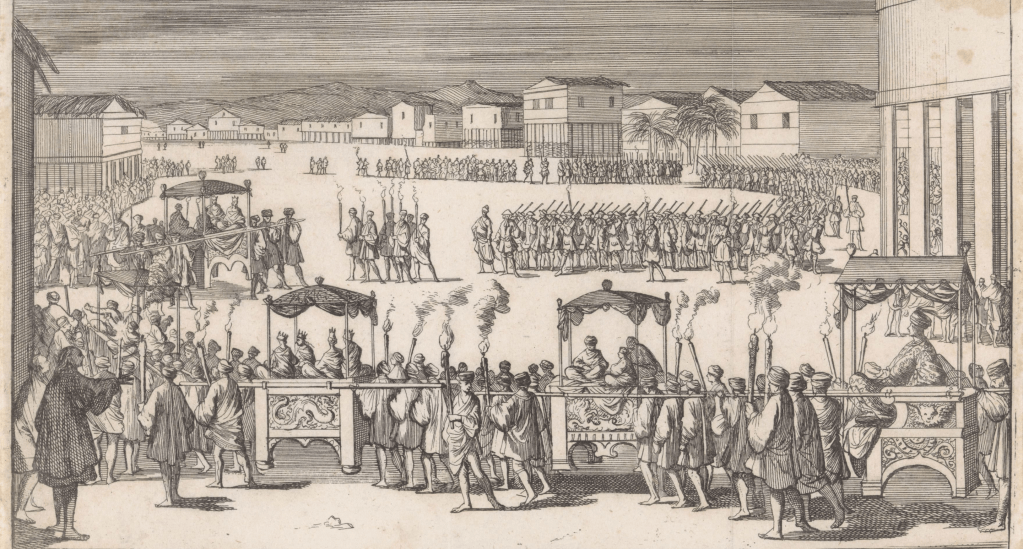
Caspar Luyken’s Grote optocht ter gelegenheid van de aankomst van kapitein Charles Swan op Mindanao (Grand Procession on the Occasion of the Arrival of Captain Charles Swan on Mindanao) is a Dutch etching dated 1698. Made as a book illustration for volume I of William Dampier’s Nieuwe reystogt rondom de werreld, published in The Hague by Abraham de Hondt, the print is now in the Rijksmuseum collection and measures 163 × 284 mm.¹
The image shows a formal procession in Mindanao. In the foreground, several elevated platforms or pageants are carried by attendants. Some figures sit beneath canopies, while others walk with torches, weapons, and ceremonial objects. In the middle distance, armed men stand in formation. The background shows an open settlement with houses raised on posts, spectators, and palm trees.²
The man at the center of the event, Captain Charles Swan, was a reluctant buccaneer. In the 1680s, Swan was forced into piracy by his own crew and wrote letters to the owners of his ship, the Cygnet, in London, asking them to intercede with James II of England for his pardon, even as he continued to raid the coastal areas of Spanish America. He was present at the attack on Payta in 1684 with John Eaton, where the town was burned after no booty was found. On 25 August 1685, Swan separated from Peter Harris and Edward Davis and sailed north along the coast of Mexico with Francis Townley, with limited success. He later seized Santa Pecaque, but lost fifty men, including Basil Ringrose, in a Spanish counterattack.³
On 31 March 1686, Swan crossed the Pacific in an attempt to ambush the Manila treasure galleon, but failed to overtake it. Provisions were short after the losses at Santa Pecaque, and by the time the Cygnet crossed the Pacific, the crew was reportedly considering eating its officers, beginning with the captain. Swan is said to have joked that William Dampier, being lean, would have made a poor meal, while Swan himself was a much fatter man. The crew reached Guam without resorting to cannibalism and continued to Mindanao.⁴
The historical context for Luyken’s image comes from Dampier’s account of Swan’s stay in Mindanao. Dampier says that Swan and his companions arrived before the river of Mindanao on 18 July 1686, anchoring near the river mouth. Soon after, Raja Laut, the sultan’s brother, and one of the sultan’s sons came out by canoe and asked who they were. They welcomed the English and asked whether they had come to establish an English trading factory.⁵
Dampier describes Mindanao as a place of possible English trade in the region. He specifically notes that Swan and his men considered the possibility of settling there, because Mindanao could connect English trade to nearby spice and gold-producing islands. Dampier also records that the Mindanayans [sic] hoped the English had come to establish trade, not merely to buy provisions.⁶
The procession in Luyken’s print corresponds to Dampier’s descriptions of courtly reception and public ceremony in Mindanao. Dampier describes gifts sent to the sultan, including scarlet cloth, gold lace, a Turkish scimitar, and pistols. He also describes later ceremonial movement with torches, armed men, pageants, dancing women, the sultan’s children, the sultan, Raja Laut, and Captain Swan.⁷
The good relations did not last. Swan’s arrogance and the unruliness of his men reportedly strained relations with Raja Laut. When Swan decided to abandon the attempt on the Manila galleon, his men mutinied and replaced him with John Read. Swan remained in Mindanao, where he became an officer in Raja Laut’s army. He managed to keep £5,000, legally the property of the Cygnet’s owners, away from the mutineers. In 1690, while attempting to leave Mindanao on a Dutch ship with the money, he was pursued by Raja Laut’s warriors, who capsized his boat and speared him in the water.⁸

This image is important because it is an early European printed representation of Mindanao as a Muslim courtly and diplomatic space. Modern discussions of Dampier often single out the image of Giolo or Jeoly of Miangas, the tattooed man who was enslaved in Mindanao, brought to England, exhibited in London, and died shortly afterward. Much less attention is usually given to the other Philippine-related illustrations connected with Dampier’s voyage, including Luyken’s procession on Mindanao and the Bashee Islands punishment scene, the subject of another post. These images broaden the visual record beyond the now-familiar figure of Giolo. I wrote earlier about Stradanus’s Conquest of the Philippine Islands, which represents the archipelago through Spanish landing and military conquest. Luyken’s Mindanao print offers a different image of the Philippines: one centered first on diplomacy, ceremony, and reception, then on the breakdown of alliance. It is not organized around Manila or Spanish colonial authority, but around the sultanate of Mindanao and its encounter with English maritime visitors.⁹
Notes
- Rijksmuseum, Grote optocht ter gelegenheid van de aankomst van kapitein Charles Swan op Mindanao, RP-P-1896-A-19368-1313; William Dampier, Nieuwe reystogt rondom de werreld, 3 vols. (The Hague: Abraham de Hondt, 1698–1704), vol. 1, 258.
- Rijksmuseum, Grote optocht ter gelegenheid van de aankomst van kapitein Charles Swan op Mindanao, RP-P-1896-A-19368-1313.
- William Dampier, A New Voyage Round the World (London: James Knapton, 1697); see also accounts of Swan’s buccaneering career and the attacks at Payta and Santa Pecaque.
- Dampier, A New Voyage Round the World, chap. 11.
- Dampier, A New Voyage Round the World, 348–49.
- Dampier, A New Voyage Round the World, 349–51.
- Dampier, A New Voyage Round the World, 353–55; see also chap. 12 for Dampier’s description of the torchlit procession, pageants, armed men, dancing women, and the sultan’s retinue.
- Dampier, A New Voyage Round the World, chap. 12; see also biographical accounts of Charles Swan’s death in Mindanao in 1690.
- Jan van der Straet, called Stradanus, Conquest of the Philippine Islands, 1598, pen and brown ink with washes over black chalk on laid paper, Cooper Hewitt, Smithsonian Design Museum, 1901-39-2637r; Dorine van Sasse van Ysselt, “Johannes Stradanus: De decoraties voor intochten en uitvaarten aan het hof van de Medici te Florence,” Oud Holland 104, nos. 3–4 (1990): 149–78.
 Geronimo Cristobal