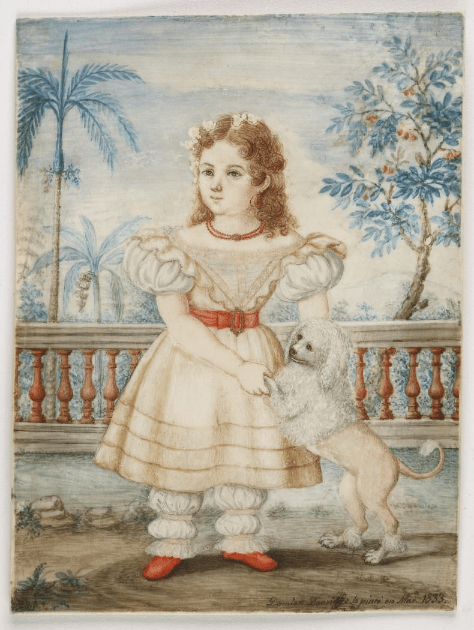
I would not describe Damián Domingo’s Niña con perrito [Girl with a puppy, a miniature poodle] as a discovery in the strict sense. The ivory miniature was already known by at least 2012, when it appeared in Madrid’s Museo del Romanticismo records on children’s portrait miniatures. To my knowledge, however, it has received little or no attention in Philippine art history.
There seems to be little doubt about the attribution. The miniature is signed and dated: “Damian Domingo lo pintó en Manª 1833” [Damián Domingo painted this in Manila in 1833], which corresponds to that on an earlier miniature, Retrato de muchacho (Rafael Enriquez Sequera), dated 1832 and now in the Museo Nacional de Artes Decorativas. The comparison with Domingo’s 1832 portrait of Rafael Enríquez Sequera is tempting. Both works are small gouache-on-ivory miniatures, signed by Domingo within a year of each other, and both portray elite children with the same delicate modeling, large eyes, and composed frontal presence. Since Rafael Enríquez Sequera belonged to a large family (three brothers and two sisters) it is possible that the unidentified girl in Niña con perrito came from the same family circle. While this remains a hypothesis, the resemblance of their features, however, may indicate kinship, but it may also reflect Domingo’s manner as a miniaturist and the conventions of elite child portraiture in Manila in the 1830s.

Niña con perrito was painted a year before Domingo’s death in 1834. I felt a rush of blood when I realized how this detail makes the miniature especially affecting: near the end of his life, Domingo was still painting with delicacy and attention, down to the charming detail of a child holding a small poodle.
The work is a rectangular miniature showing a young girl standing on a terrace before a garden landscape. She wears a light-colored short dress with puffed sleeves, a red belt, flowers in her curled hair, a double-strand coral necklace, and matching coral earrings. She holds a small poodle by its front legs. Behind her, a balustrade separates the terrace from a garden with palms and fruit trees. Aside from the bunches of bananas on the left side, the red fruits to the left near the foreground may represent macopa, or wax apple, a plausible garden fruit in Manila which indicates that the sitting happened around April-June of the year.
Born in Tondo around 1796, Damián Domingo became one of the most important painters in early nineteenth-century Manila and directed the first Academia de Dibujo y Pintura in the Philippines. He is often remembered for his tipos del país, his religious commissions, and his role in the formation of Philippine academic art.
Domingo’s confirmed body of work is small: four easel paintings, at least six ivory miniatures, and three full watercolor albums. Niña con perrito adds another important example to his surviving oeuvre. I hope to identify the sitter of this portrait in due time.
 Geronimo Cristobal