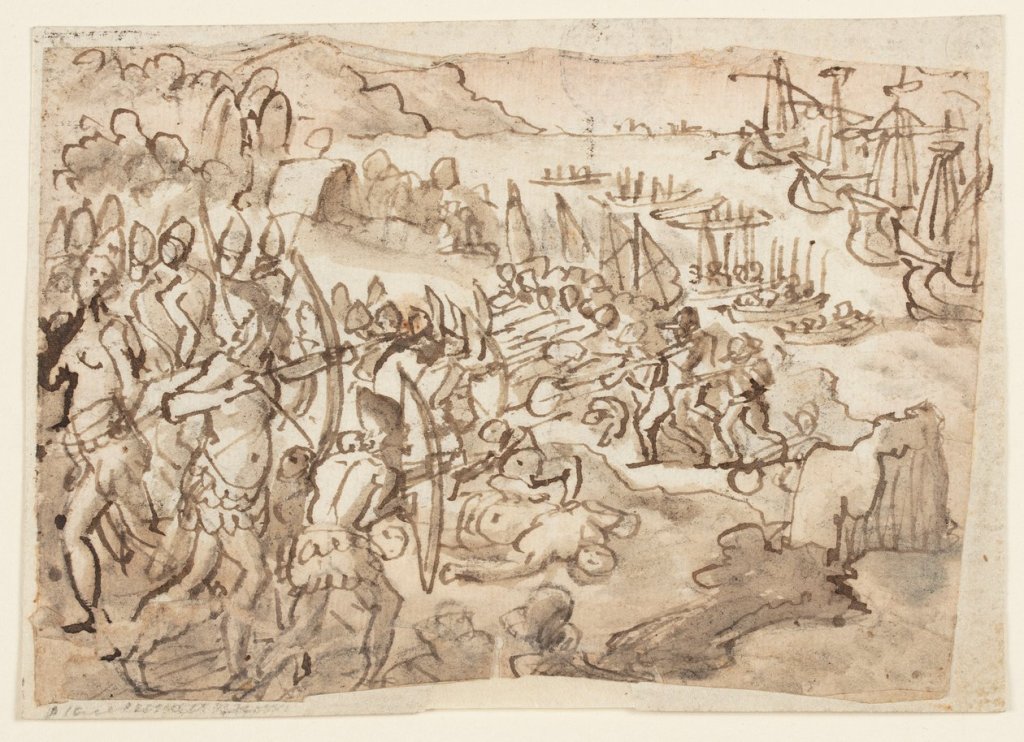
Jan van der Straet’s (Stradanus) Conquest of the Philippine Islands (ca. 1590s) is among the earliest European images of the archipelago. The surviving work is a preparatory drawing (modello) for a monochrome (grisaille) painting executed by his son Scipione Stradano for the funeral ceremonies of Philip II of Spain at the Basilica of San Lorenzo in Florence on 12 November 1598. Created as part of a temporary decorative program commemorating the Spanish monarch, the finished painting appears to have been dismantled after the ceremonies. The drawing preserved in the Cooper Hewitt, Smithsonian Design Museum is the principal surviving record of the composition.
The image depicts Spanish troops disembarking from ships and engaging indigenous defenders armed with bows and arrows. Five vessels anchor in the bay behind them, while smaller boats ferry soldiers to shore. The prominence of ships and coastal geography presents the conquest as a maritime enterprise. Produced nearly thirty years after the occupation of Manila, the drawing belongs to the commemorative culture of the Medici court rather than to the visual record of the event itself. Contemporary scholarship has connected the image to a Florentine intellectual milieu shaped by travel literature, printed histories, and discussions of overseas expansion within the Accademia degli Alterati and the Medici court. The Philippines appears here as a distant possession of the Spanish monarchy incorporated into a global narrative of exploration and conquest. The islanders, rendered according to conventions used by Stradanus in other images of non-European peoples, reflect contemporary European conceptions of overseas societies more than direct observation of the archipelago.
 Geronimo Cristobal