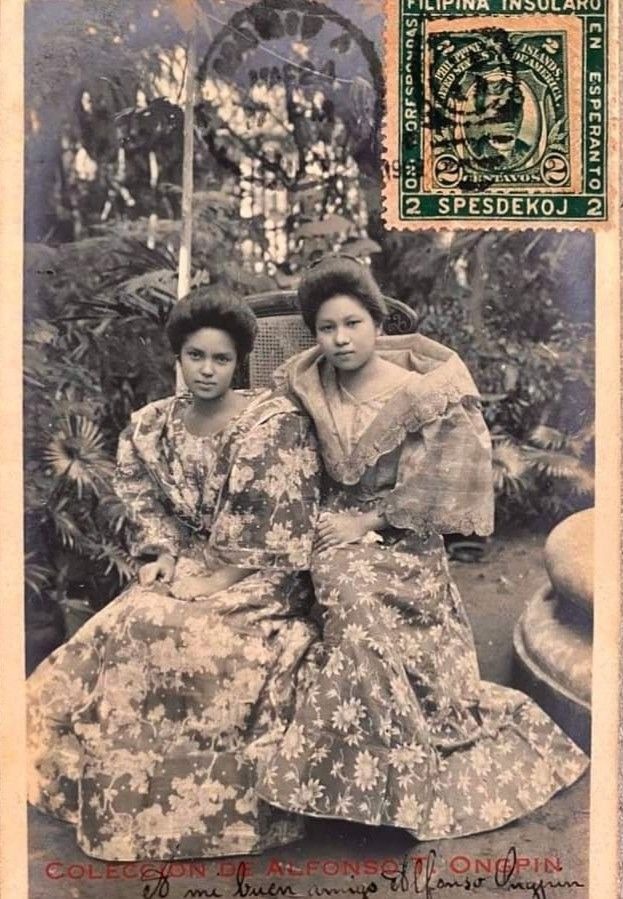
I returned to Vicente Rafael’s essay on photography after learning of his passing on February 21, 2026. Professor Rafael, as I continued to call him even after knowing him for years, was seventy. Our conversations became more regular after I began graduate studies at Cornell, where he had also studied in the early 1980s. I pulled his book from my shelf and reread his essay “The Undead: Notes on Photography in the Philippines, 1898–1920s.” I was struck again by his insight about how postcard photographs survive their senders.
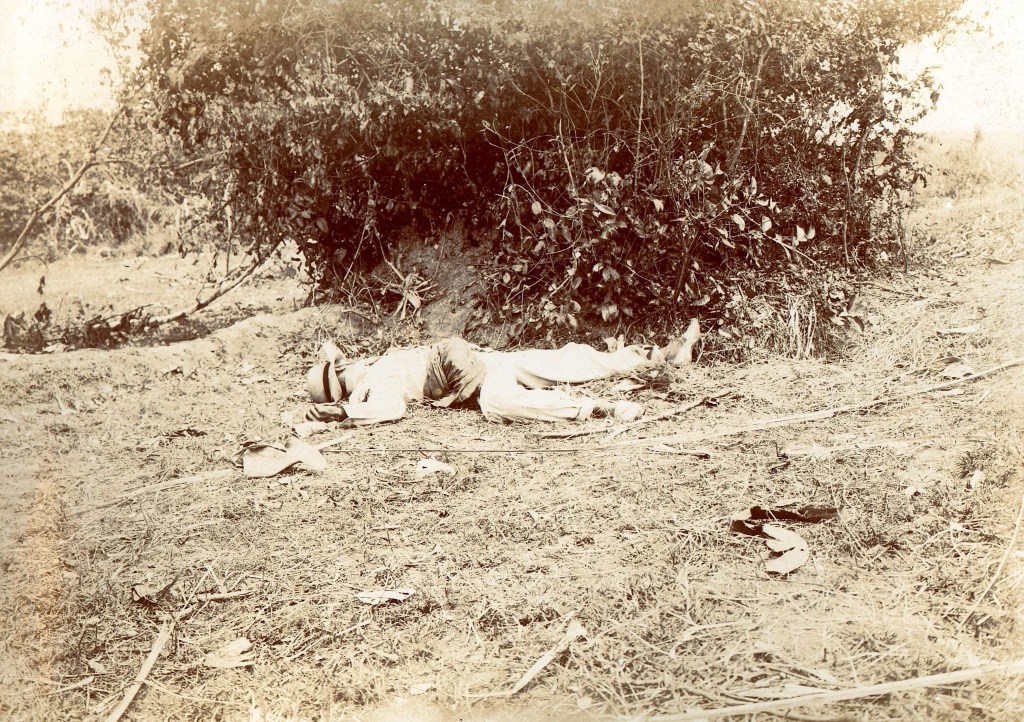
In that essay he shows how studio portraits at the turn of the twentieth century allowed Filipinos to picture themselves as living subjects rather than as colonial types or future corpses. Photography, he wrote, unsettled the boundary between life and loss.
In White Love, Vince situates the rise of photographic portraiture in the years following the Philippine–American War.
For survivors who could afford studio portraits, photography presented an unsettling paradox. The medium had long been associated with death and memorialization, with the souvenir pictures of the dead from the Philippine-American War and what people once called recuerdos de patay. Vince wrote that studio photographs emerged so that the living could represent themselves in a way that distinguished them from the dead. In their fashionable portraits and humor-filled inscriptions, Filipinos resisted being absorbed by overwhelming tides of grief.
As I was writing this, the Metropolitan Museum of Art had mounted Raphael: Sublime Poetry, a major exhibition on Raffaello Sanzio da Urbino. The exhibition reminded me that portraits preserve lives through partial evidence: faces, clothing, inscriptions, gestures, and later stories attached to them. Professor Rafael’s essay helped me see Philippine photographs in a similar way: as evidence of how sitters used images to compose themselves to mark milestones and also during episodes of war, distance, and loss.
Rafael Enriquez Sequera

By the early nineteenth century painted miniatures had already prepared the ground for photographic portraiture. One example is Damián Domingo’s Retrato de muchacho (1832), a miniature ivory portrait later identified by art historian Concha Díaz Pascual as Rafael Enriquez Sequera.
Sequera, born in 1817 in Poitiers, France, was fifteen when the portrait was painted. It was likely commissioned to commemorate his time as a cadet in the Escuela Náutica de Manila. Letters by his parents preserved in the Francisco Enriquez y Giron collection describe epidemics, earthquakes, and the declining fortunes of Spaniards in the colony.
The portrait was produced as the family prepared to leave Manila, possibly as a gift to Francisco’s wife Gertrudis by its painter Damian Domingo. A dedication visible on the table suggests that it may have been commissioned through the painting academy where Domingo taught painting. The dangers of sea travel and colonial life in general lent gravity to these painted portraits and their makers recognized this too. Domingo died from a yet to be determined illness likely aggravated by the poor sanitation in Manila two years after the portrait was painted in 1834.
The inscription along the edge reads “Damian Domingo lo pintó, 1832” [Damian Domingo painted this]. The signature does more than identify the painter. It anticipates the journey the portrait would undertake. Ivory miniatures were meant to circulate among family members separated by distance. The signature served to distinguish the work within a growing trade in such portable objects while also enhancing its value. These paintings commemorated kinship, sometimes even a fictive one between sender and recipient. Through the painter’s labor, these relationships were made tangible and preserved for commemoration.
While studying Domingo’s works I relied heavily on the history of the Ongpin family. Their archive contains photographs by Alfonso Ongpin, who is Domingo’s great grandson, that reveal how the established tradition of family portraiture evolved in the early twentieth century. By chance, the family history that gave so many colorful details was also written by a Rafael, Alfonso’s great grandson, who is currently executive director of the Makati Business Club.
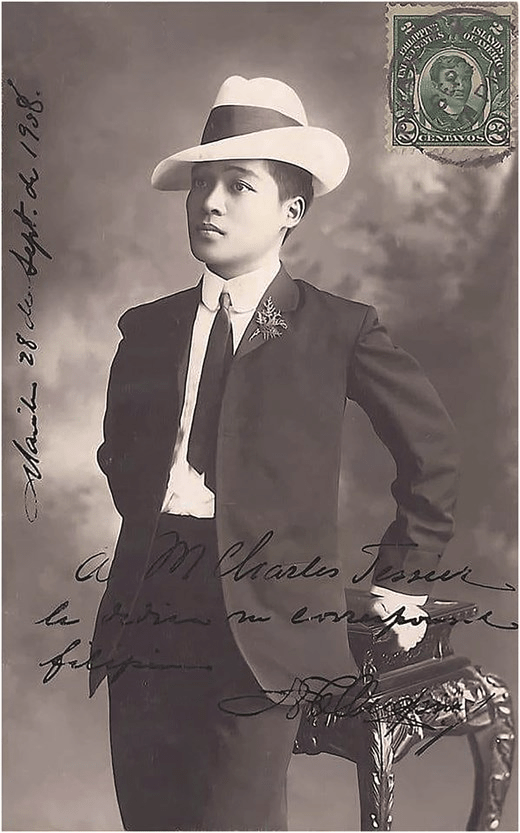
Rafael Ongpin and other antiquarians scanned many of Alfonso’s postcards from the early 1900s. One in particular from 1908 became viral among collectors because it was a fashionable self-portrait of a young man whom they thought looked like pop icon Bruno Mars. The corners were slightly worn. Turning it over, I read Ongpin’s French letter addressed to a certain Charles Tessier written in elegant cursive. It begins simply: “I was born in the year 1885.” Judging from the introduction, the two men were pen pals who had likely never met.

In the photograph Alfonso, twenty three years old, leans against an ornate side table wearing a dark suit and homburg hat popularized by Edward, Prince of Wales. The brim casts a thin shadow across his forehead. His tie is tightly knotted and his detachable collar stiff. Although Alfonso spoke French, English, and Spanish fluently, he was not known to have travelled abroad. Yet his image did. In the early 1990s, a copy of the postcard surfaced in an antique shop in Paris where it was discovered by a collector, returned to Ongpin’s descendants, and eventually scanned and sent to me. I felt an immediate affinity with the image. I too was twenty three once, who traveled to the city of lights hoping to find my way as a young writer.
Raffaello Sanzio da Urbino
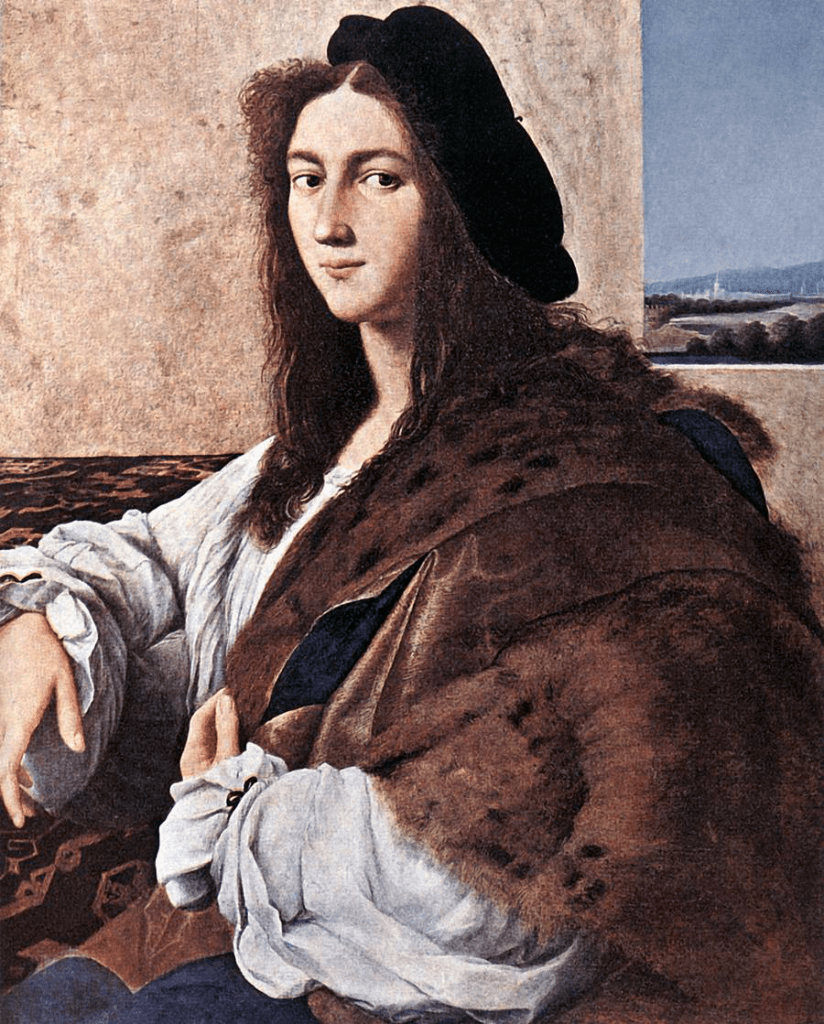
Raffaello Sanzio da Urbino(1483–1520), Portrait of a Youth (Ritratto di giovane uomo), 1514, Oil on board.
Portraits not only travel widely, they also often outlive not only their sitters and makers but the original surfaces that once carried them. A famous example is Portrait of a Youth by Italian artist and notable Renaissance figure Raffaello or Raphael, painted around 1514 and formerly housed in a museum in Krakow.
The portrait shows a confidently poised man garbed in sable fur against a flesh-toned wall. The young man’s erect poise, gesture and the decorous ornament of the setting became associated with nobility in southern Italy because of this painting.
Long believed to depict Raphael himself, the painting disappeared during the German occupation of Poland in the Second World War and remains the most valuable work of art looted by the Nazis that was never recovered. Only postcard reproductions that circulate in place of the original survive. In this strange afterlife, the portrait persists through copies detached from the panel that once held it. The painter and sitter are gone, and the painting itself is missing, yet the image continues to pass from viewer to viewer, waiting to meet the gaze of anyone who chooses to look back.
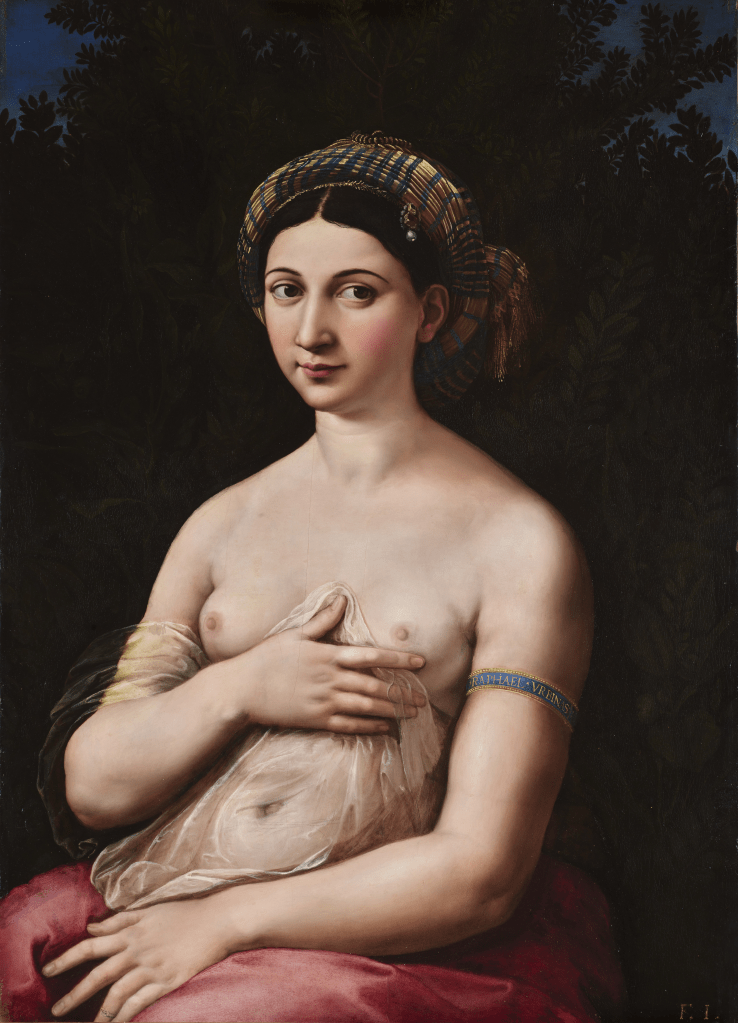
One portrait that struck me in Raphael’s Met Museum exhibition (2026) is La Fornarina. The portrait preserves so much information about Raffaello while also raising questions about what has been concealed. Technical examination of the painting revealed that a ring on the sitter’s left hand had been painted over. The sitter wears a jeweled ornament on her turban, ending in a pendant pearl, a detail often linked to the traditional identification of the woman as Margherita Luti: in Latin, margarita means pearl. The sitter has often been identified as the daughter of a Roman baker and traditionally understood as Raphael’s lover, but this identification remains debated. The painting preserves a likeness that clearly mattered deeply to Raphael, even as the sitter’s precise identity and relationship to the artist remain unresolved.
Reflecting on the lost self-portrait and the secret portrait of La Fornarina by Raphael, I began thinking about the last photograph I took with Professor Rafael. He was recovering from a fall he suffered while delivering a lecture at Ateneo and I wanted to check on him. He was in good spirits and we even spoke about building a reading room in Bulacan around the manuscript and typewriter he used to write his magnum opus Contracting Colonialism the following year.
Yet something about that meeting felt as though it would be our last. Shaking off the premonition, Instead of saying our usual goodbyes, I asked if I could take a photograph with him.#
 Geronimo Cristobal