Maybe we are not only greeting a father, but acknowledging a presence that shaped us before we could fully recognize it. For Jacques Lacan, the father is not only the biological parent but also a place in language. The father is one of the first figures through whom we learn that love is also structure.
For those who have lost their fathers, Michel de Certeau wrote that “the labor of closing the eyes of the father also heralds the law of his return.” Meaning: the father does not simply disappear. He finds his way back in the ways we learn to carry ourselves.
Rizal’s last words to his father were an apology. He understood that his becoming was never his alone. It was built on the sacrifice and labor of his father.
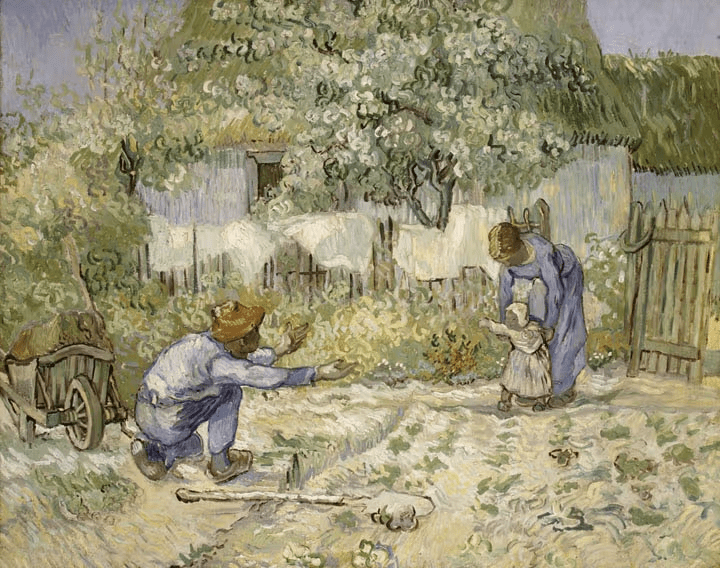
Maybe artworks can give us a better sense of what it means to be one. In Vincent van Gogh’s First Steps, after Millet (1890), the father is not an abstract idea of love or distant authority. He is there, bent forward, arms open, waiting for the child to move toward him. He has taken a short break from toiling in the field. In that pause, one meaning of fatherhood appears: an interruption of labor in order to make time for love.
Van Gogh’s and Millet’s image gives form to what most of us mean when we greet fathers and father figures: thank you for giving me the confidence to take the first steps; thank you for the life and love that continue in us, even in ways we are still learning how to understand.
 Geronimo Cristobal