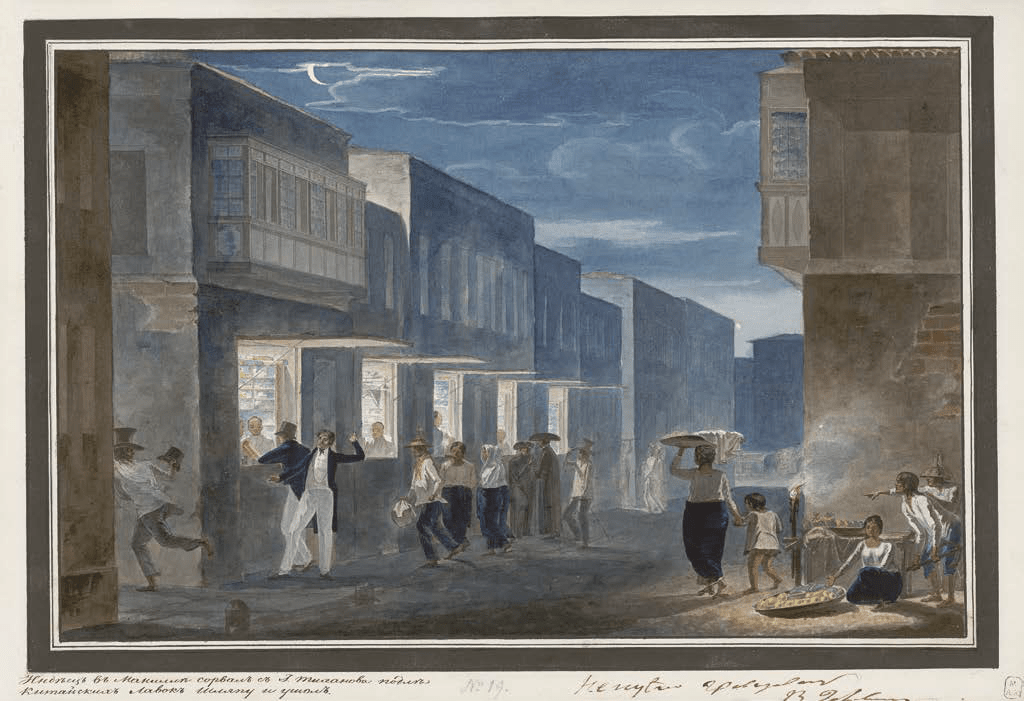
During the Manila stop of Captain V.M. Golovnin’s 1817–1819 circumnavigation aboard the sloop Kamchatka, the expedition artist Mikhail T. Tikhanov produced a series of drawings from direct observation, of which only three Manila scenes are known to survive. An Indian in Manila Took Tikhanov’s Hat and Ran Away, Malays Arey and Thomas from the Island of Luconia Living in Manila, and Manila Indians. All are included in later publications of Golovnin’s voyage.
In the watercolour An Indian in Manila Took Tikhanov’s Hat and Ran Away (1818–1819), Manila street life is rendered in a single scene along a narrow road lined with two-storey houses—living quarters above, storage and service spaces below. Capiz-shell windows diffuse interior light into the street. Figures gather near shopfronts, identified as Chinese stalls, while others move through the space. At the left, a man runs off with a hat; just behind him, the artist, marked by his European dress, raises his arm in surprise. In the right foreground, bystanders observe, one pointing, while others continue their routines. The theft is absorbed into the flow of the street. Figures wear loose white shirts and dark trousers, often barefoot.
The hat theft corresponds to an actual incident recorded by Golovnin, who noted that hats were repeatedly snatched from officers in Manila streets.
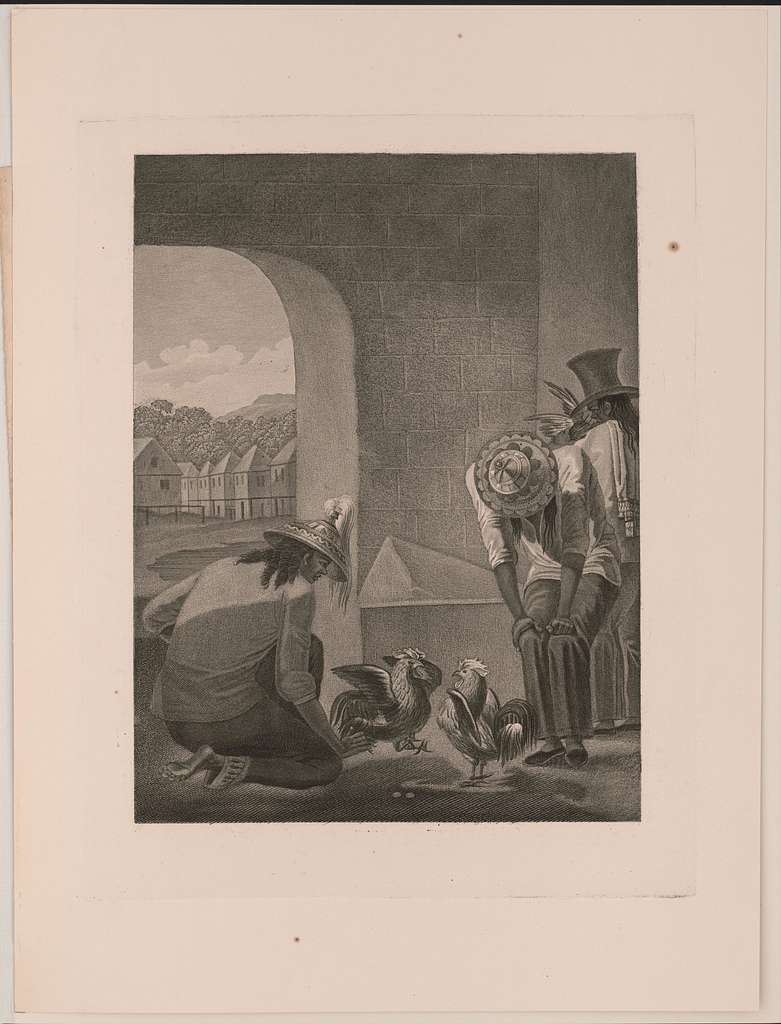
Manila Indians presents a quieter, more contained scene. Two figures crouch in the foreground, absorbed in a cockfight placed at the center. Their bodies lean inward, forming a tight triangular composition around the birds. Behind them rises a stone archway (perhaps the walls of Intramuros), framing a distant view of low houses and a receding landscape. The setting is pared down: a wall, an opening, and the ground plane. The figures wear loose shirts and broad hats; their faces are turned away or obscured.
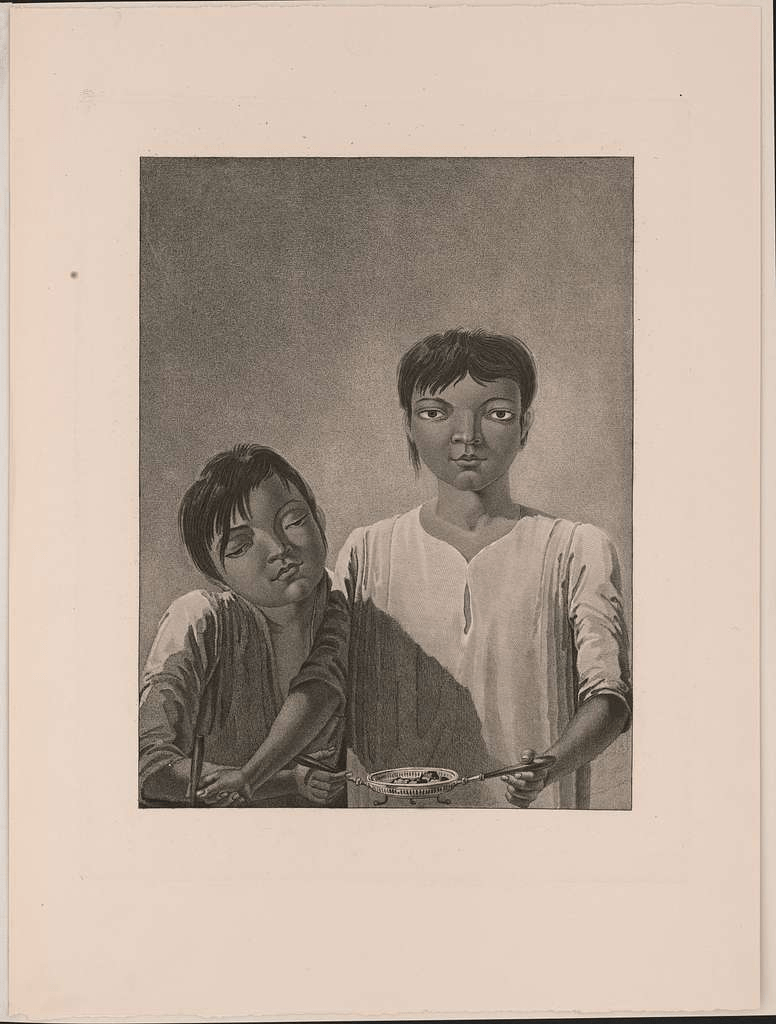
Malays Arey and Thomas from the Island of Luconia Living in Manila shifts to portrait format. Two children occupy the frame frontally, set against a blank ground. One stands upright while the other leans against him, head tilted and eyes half-closed. The standing child holds a small, handled object resembling a shallow strainer or sieve, its exact function unclear but likely a domestic utensil. Their clothing—simple, loose garments—is rendered with care, especially in the folds and drapery, reflecting Tikhanov’s academic training. The figures are proportionally stable but slightly stylized, with enlarged eyes and softened features that may recall “big eyes” artist Margaret Keane. The composition is direct and symmetrical, with no environmental detail to distract from the figures.
Mikhail Tikhonovich Tikhanov (1789?–1862) entered the Imperial Academy of Arts in Saint Petersburg in 1806 as a serf of Prince N.A. Golitsyn. He studied there for approximately nine to eleven years, training under V.K. Shebuyev and alongside figures such as Sylvester Shchedrin and Vasily Sazonov. His early work included historical paintings shaped by the patriotic climate following the War of 1812. In 1813, he produced a composition depicting Russian citizens executed by the French in Moscow; the work received high recognition, though he was denied the full award because he remained unfree. He obtained his freedom shortly before completing his studies in 1815, after which he was retained at the Academy on state support and granted the rank of artist.
In 1817, following a decision to assign trained artists rather than artisan draftsmen to expeditions, Tikhanov was selected—through the intervention of Academy president A.N. Olenin—to join Captain V.M. Golovnin’s circumnavigation on the sloop Kamchatka. His role was defined clearly: to record the peoples, customs, landscapes, and material environments encountered during the voyage. In the absence of photography, such drawings were considered essential scientific instruments, capable of conveying details that written descriptions could not.
The expedition departed Kronstadt on 26 August 1817 and returned on 5 September 1819. It visited multiple ports across the Atlantic and Pacific. The route included Britain, Brazil, Cape Horn, Kamchatka, Russian America (Kodiak, Novo-Arkhangelsk/Sitka), California (Monterey and Rumyantsev Bay), the Hawaiian Islands, and the Mariana Islands before reaching the Philippines. Tikhanov’s drawings were intended to cover the entire voyage, though illness prevented him from completing this program.
In total, forty-four drawings are known, unevenly distributed: two from Brazil, four from Peru, twenty from Alaska and the Aleutian Islands, five from California, four from Hawaii, five from Oceania, and three from the Philippines. One drawing depicts an albatross caught off Cape Horn. Several planned works—such as views of Manila and other sites—have not survived.
The expedition spent thirty-five days in the Philippines, including twenty days in Cavite for repairs. During this time, Golovnin and his officers frequently travelled between Cavite and Manila, observing local life. Tikhanov worked intensively, producing the three surviving Philippine sheets.
After leaving the Philippines, his work ceased. During the return voyage, at the Azores in June 1819, Tikhanov began to withdraw into prolonged states of pensiveness, then fell into hypochondria, and finally lost his reason entirely. He was brought back to Kronstadt in this condition.
He was placed in the Academy’s infirmary, where he briefly resumed work on drawings, but his condition deteriorated. He was transferred to a psychiatric hospital, where he remained until early 1822. Thereafter, he was entrusted to the care of fellow artist I.V. Luchaninov and later his family. The state granted him an annual pension of 600 rubles. He never returned to artistic production. Tikhanov died on 6 October 1862, having lived the remainder of his life in illness.
His watercolours were preserved in the Academy of Arts. Plans to engrave and publish them alongside Golovnin’s account were only partially realized. Of the intended thirty engravings, twenty-two were eventually produced, and publication was delayed for decades. Many drawings remained unknown or reproduced only in black and white well into the twentieth century, obscuring their original colour and detail.
Tikhanov’s drawings function as his “journal,” a term he himself used. In a letter to Olenin, he described his method: to observe with precision the faces, clothing, and environments of different peoples; to draw animals, landscapes, and buildings; and to depict everything “strange and beautiful” as it appeared, without embellishment. His Manila works follow this instruction closely. They record not types that were commonly made by Manila artists but situations, and they retain value as direct documents of the expedition’s passage through Manila in 1819.
References
Bellingshausen, F.F. Two Explorations in the Southern Ice Ocean and a Circumnavigation in 1819–1821 on the Sloops Vostok and Mirny. Moscow, 1960.
Golovnin, V.M. Voyage Around the World on the Sloop Kamchatka, 1817–1819. St. Petersburg, 1829. Parts I–II.
Golovnin, V.M. Collected Works: Voyage of the Sloop Diana…; Voyage Around the World on the Sloop Kamchatka… Moscow–Leningrad, 1949.
Golovnin, V.M. Voyage Around the World on the Naval Sloop Kamchatka, 1817–1819. Moscow, 1965.
Goncharova, N.N. “On the Portraits of A.A. Baranov.” Chronicle of the North, vol. IX. Moscow, 1979.
Divin, V.A. “Russian Voyages to the Shores of America after Bering and Chirikov.” In From Alaska to Tierra del Fuego. Moscow, 1967.
Kotzebue, O.E. A New Voyage Around the World, 1823–1826. Moscow, 1987.
Krusenstern, I.F. Voyage Around the World in 1803–1806 on the Ships Nadezhda and Neva. Vladivostok, 1976.
Lisovsky, V.G. The Academy of Arts. Leningrad: Lenizdat, 1982.
Levtonova, Yu.O. A Short History of the Philippines. Moscow, 1974.
Matyushkin, F.F. “Journal of the Circumnavigation on the Sloop Kamchatka.” In To the Shores of the New World, ed. L.A. Shur. Moscow, 1971.
Pigafetta, A. Magellan’s Voyage. Moscow, 2009.
List of Russian Artists for the Jubilee Directory of the Imperial Academy of Arts, ed. S.N. Kondakov. St. Petersburg, 1914.
Fedorov-Davydov, A.A. Russian Landscape of the 18th to Early 19th Century. Moscow, 1953.
Khlebnikov, K.T. Biography of A.A. Baranov. St. Petersburg, 1836.
Tselishcheva, L. “Forgotten Authors of Famous Paintings.” Khudozhnik, no. 5 (1989): 38–42.
Shur, L.A. To the Shores of the New World. Moscow, 1971.
Shur, L.A. “The Traveller-Artist Mikhail Tikhanov.” Latin America, no. 5 (1974): 163–180.
Porco, P. “Russian Legacy.” The Seattle Times, 1990.
Science Under Sail: Russia’s Great Voyages to America, 1728–1862, ed. B.S. Smith. Anchorage, 2000.
Shur, L.A., and R.A. Pierce. “Artists in Russian America: Mikhail Tikhanov (1818).” Arts, Seattle, 1990.
Wiswell, E. “Around the World on the Kamchatka, 1817–1819.” Pacific Historical Review, 1981.
Yeltsina (Rutenko), Yu.S. M.T. Tikhanov (1789–1862), the First Russian Painter to Visit the Philippines. St. Petersburg State University, 2005 (manuscript).
Rutenko, Yu.S. “M.T. Tikhanov (1789–1862) — The First Russian Painter to Visit the Philippines.” In Pilipinasmuna!. St. Petersburg, 2011.
Zubov, N.N. Russian Navigators—Explorers of Seas and Oceans. Moscow, 1954.
Petrov, P.N. Collection of Materials on the History of the Imperial Academy of Arts for the First Hundred Years of Its Existence (1811–1843). St. Petersburg, 1864.
Archive of the Academy of Arts (AAH), fond, inventory 20, file 28, 1818.
 Geronimo Cristobal