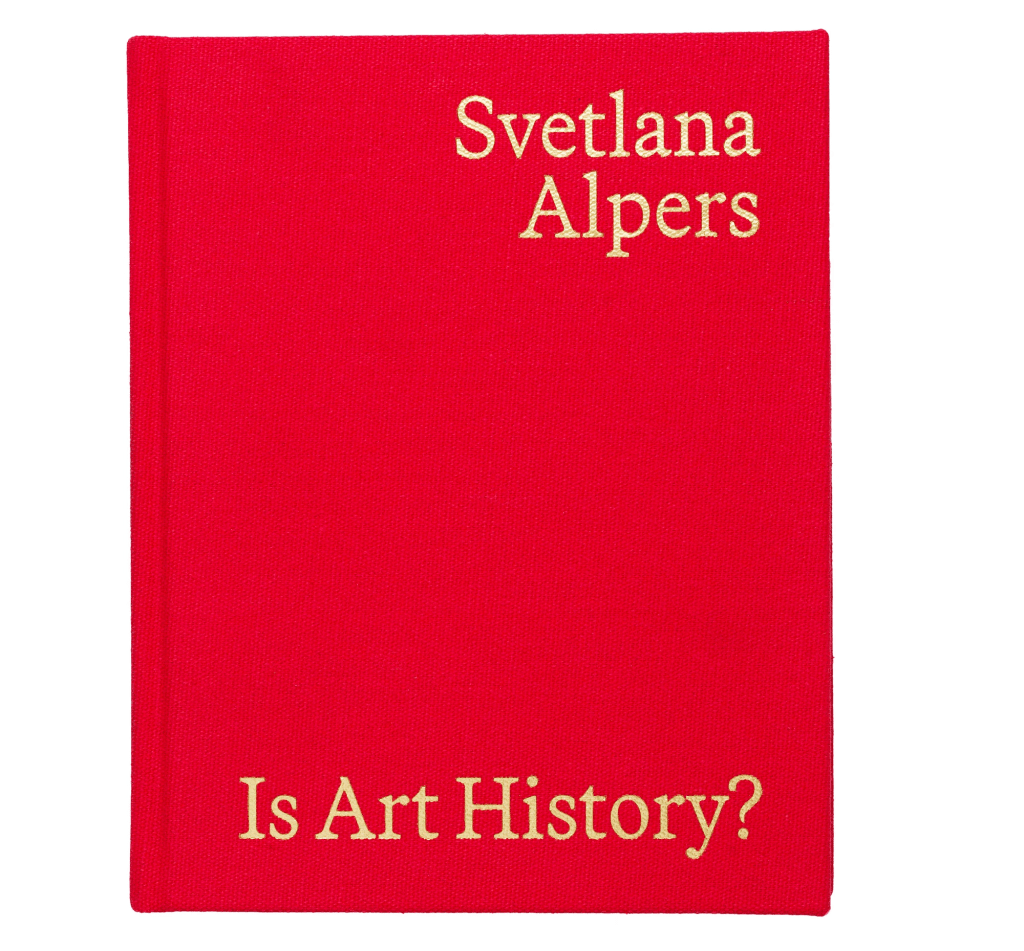
Selected Writings by Svetlana Alpers
Foreword by Barney Kulok
Introduction by Richard Meyer
Interview by Ulf Erdmann Ziegler
Hunters Point Press, 2024
Just found out there’s a new book gathering the writings of Svetlana Alpers: Svetlana Alpers: Is Art History?
A fitting title for someone who fundamentally changed how many of us think about pictures, surfaces, description, Dutch art, and the discipline itself. Includes selected writings, a foreword by Barney Kulok, an introduction by Richard Meyer, and an interview by Ulf Erdmann Ziegler.
Required reading for anyone interested in art history beyond style and attribution.
The following is a recap of the epynomous essay not the book.
Svetlana Alpers’s “Is Art History?” (1977) is both a critique of traditional art history and a manifesto for a broader, more self-aware discipline. Rather than treating art as an autonomous sequence of masterpieces organized by style and genius, Alpers argues that works of art should be understood as “pieces of history” embedded in specific social, political, economic, and perceptual conditions.
Her essay reflects on what she calls the “new art history” emerging in the 1960s and 1970s, associated with scholars such as Michael Baxandall and T. J. Clark. These scholars rejected purely stylistic analysis and instead examined how artworks were shaped by systems of patronage, commerce, labour, ritual, class, and habits of seeing. Baxandall’s study of fifteenth-century Italian painting, for example, links pictorial form to merchant mathematics and everyday visual training, while Clark connects Courbet’s realism to the social upheavals of post-1848 France. Alpers stresses that the shift is significant because “it is the work of art itself, not a history or sequence of works, which is seen as a piece of history.”
One of Alpers’s central claims is that this new social history of art demystifies artistic genius. Artistic invention no longer appears as mysterious inspiration but as the negotiation of concrete historical conditions: patronage, architecture, liturgy, audience, economics, and viewing position. She notes that “what was previously puzzled over as a mystery has now come to be understood as the task of fitting a work to a particular task.” This is one of the essay’s most important interventions because it reframes art as labour and social production rather than transcendental creativity.
Another major argument concerns perception itself. Drawing on Baxandall, Alpers argues that vision is historically conditioned. People in fifteenth-century Florence saw differently because their daily lives trained them differently. Merchants accustomed to gauging barrels, reading gestures in sermons, or evaluating colour distinctions brought those visual habits into their experience of painting. Baxandall’s phrase that painters catered to “the highest common factor of skill in his public” becomes central to Alpers’s understanding of socially produced vision. Art is therefore not only made historically; it is also seen historically.
The essay also attacks the hierarchy between “high” art and supposedly lesser or vernacular forms. Alpers notes the growing scholarly attention to carpets, barns, prints, decorative arts, craft traditions, and non-Western objects. She observes that “shoes and cathedrals, but more to our point barns and cathedrals, carpets and frescoes are all treated as products of society.” This flattening of hierarchy destabilizes older art histories centred on monumental European painting and architecture. The distinction between art and craft also weakens, particularly through attention to textiles, pottery, weaving, and Islamic objects. For Alpers, this expansion changes not only what counts as art but also who counts as an artist.
A crucial section of the essay critiques Erwin Panofsky and Renaissance-centered humanism. Alpers admires Panofsky’s brilliance but argues that his methods became too normative within the discipline. Panofsky’s iconography assumed a Renaissance conception of the human subject: a centred viewer confronting the world through perspective and symbolic meaning. Alpers contends that this framework does not adequately explain northern European art, where flatness, repetition, surfaces, mirrors, and optical effects matter more than perspectival depth or human-centred space. She writes memorably: “As an image of the world, northern art is often more like a mirror than like a window.” This distinction later became foundational for her own work on Dutch art, especially The Art of Describing.
Alpers questions whether attribution and originality should always be the discipline’s primary concerns. She asks how art historians should study collaborative workshops, anonymous traditions, or artistic cultures based on imitation rather than originality, such as Chinese painting. Similarly, she critiques the bias toward the “original” object over reproducible media such as prints, photographs, and textiles. Repetition, she argues, is not necessarily a defect. In some visual systems, repetition is the very condition of communication.
This becomes especially important in her reflections on northern art and print culture. She suggests that certain traditions of painting might function more like printed images than unique masterpieces. This challenges the Renaissance model that privileges singularity, authorship, and painting as the highest form of art. Her discussion anticipates later scholarship on mechanical reproduction, circulation, and visuality.
One of the essay’s strongest meta-critical points is that art historians themselves produce knowledge rather than merely discover it. Alpers criticizes the discipline for pretending to objectivity while hiding its assumptions. She notes that graduate training often emphasizes technical skills—dating, attribution, iconography—without teaching students the intellectual history of the discipline itself. The result is a field that performs neutrality while unconsciously reproducing inherited values.
This self-reflexive dimension becomes especially clear when she discusses contemporary critics such as Leo Steinberg, Michael Fried, and T. J. Clark. She admires them because they openly acknowledge their interpretive positions rather than pretending to pure objectivity. Her formulation that “this too is knowledge we make” is among the essay’s most important conclusions.
Alpers ultimately argues that art history cannot remain insulated from broader intellectual transformations occurring in philosophy, criticism, anthropology, Marxism, structuralism, and contemporary art. She invokes Michel Foucault, Fernand Braudel, and Robert Smithson as thinkers who similarly challenge singular authorship, stable meaning, and linear history. Art history, in her view, must acknowledge its own historical conditions and theoretical commitments.
The essay remains foundational because it helped shift art history away from connoisseurship and stylistic formalism toward social history, visual culture studies, historiography, and critical theory. Many contemporary fields—material culture studies, global art history, feminist art history, postcolonial art history, media archaeology, and studies of craft and reproducibility—owe something to the questions Alpers posed here. It is not simply an essay about method; it is an essay about what kind of discipline art history wants to become.
 Geronimo Cristobal