Thank you to my colleagues at the Ateneo, especially Charlie Samuya Veric, for making this possible.
This lecture on January 19 2026 will be inside Ateneo Katipunan Campus at the NGF Conference Room, located on the ground floor of Horacio De La Costa Hall.
During my dissertation research, I came to see how many of the Philippines’ most celebrated modernist painters turned repeatedly to Islamic themes and Muslim subjects—often in ways that demand a rewriting of Philippine art history from the standpoint of the Moro and from Sulu and Mindanao, long central yet marginalised within the project of nationalist culture.
Register for ease of entry into Ateneo Campus.
***
Start your 2026 with an LCSP lecture!
Please register at this link: https://go.ateneo.edu/LCS-GerCristobal
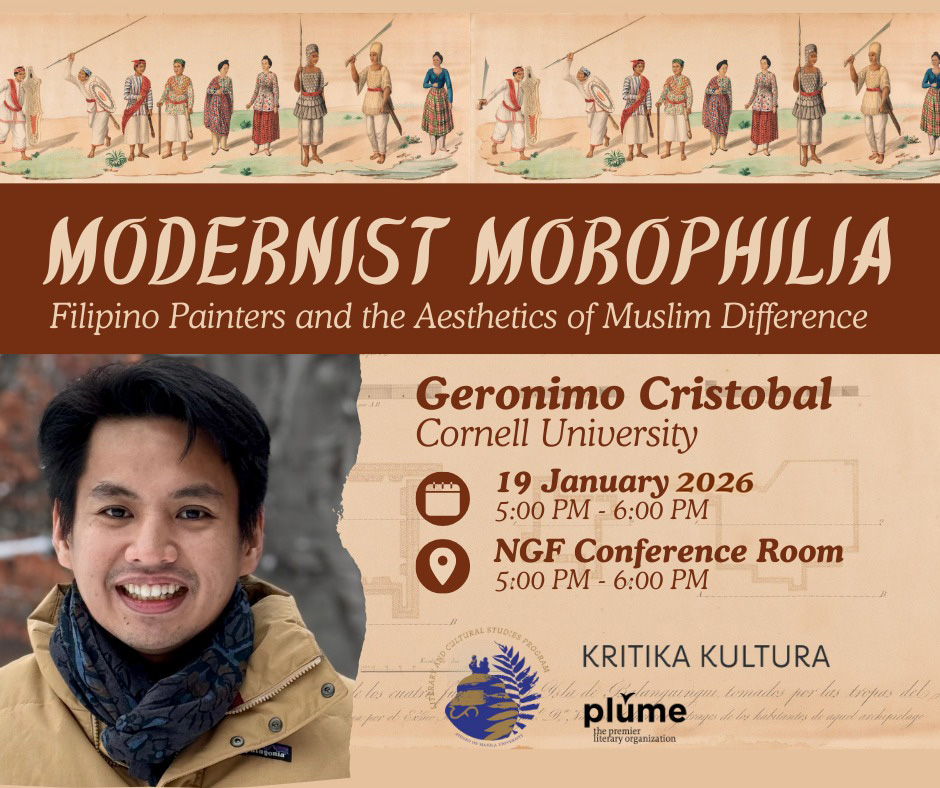
On January 19, the Literary and Cultural Studies Program, in collaboration with Kritika Kultura and PLUME, invites you to Geronimo Cristobal’s lecture, “Modernist Morophilia: Filipino Painters and the Aesthetics of Muslim Difference,” happening from 5:00–6:00 PM at the NGF Conference Room Horacio de la Costa Hall, Ateneo de Manila University.
The lecture reframes Orientalism as a dynamic discourse shaped by the positions and artistic practices of Filipino painters within broader systems of imperialism. It explores how 19th- and 20th-century Filipino artists depicted Muslim communities and how these representations contributed to an evolving aesthetic—one that opens new ways of understanding modernity and imagining a more plural and inclusive Philippine future.
ABSTRACT
This lecture examines how Filipino painters in the 19th and 20th centuries imagined, constructed, and contested the figure of the Moro within the evolving landscape of Philippine modernism. Instead of viewing Orientalism as solely a European project, the talk reframes it as a mobile discourse shaped by colonized artists negotiating their place within imperial hierarchies. Through the works of José Lozano, Félix Martínez, Galo Ocampo, Botong Francisco, and Irineo Miranda, the presentation traces how images of Muslim Filipinos shifted between ethnographic distance and cultural affinity. These painters rendered the Moro as adversary, performer, and kin, forming an aesthetic vocabulary inflected by nationalism, regional distinctions, and the desire for a more plural Philippine future. Read alongside theallegorical writings of José Rizal and Francisco Balagtas, these paintings reveal how representations of Muslim peoples became a key site for rethinking modernity and reshaping the nation’s cultural horizon.
BIONOTE
Geronimo Cristobal is a PhD candidate in the History of Art and Archaeology at Cornell University.
This lecture is open to the public.
The video recording of the lecture is now available through this link.
 Geronimo Cristobal