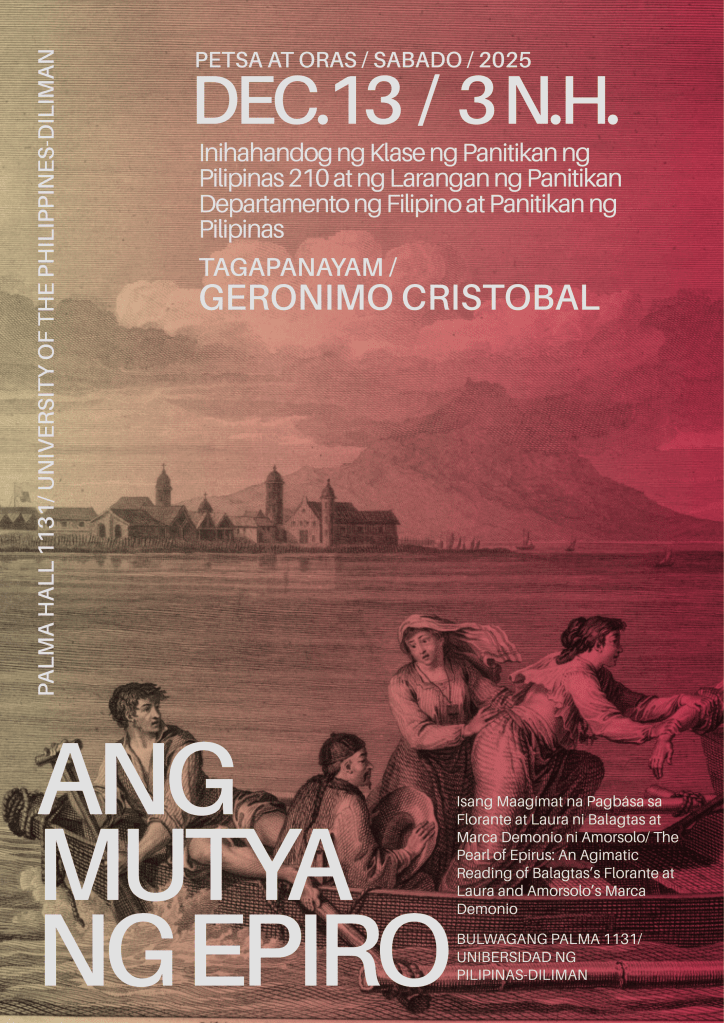
Disyembre 13, 2025, Sabado 3-4 PM
Unibersidad ng Pilipinas-Diliman
Tatalakayin ng presentasyong ito ang dalawang anyo ng alegorikong substitusyon. Una, ang pagpapalit ng Pilipinas bilang Epiro sa Florante at Laura ni Balagtas. Dito inilalarawan ang isang kalis bilang sandata ng kabutihan at sagisag ng banal na katarungan. Ikalawa, ang Kris Joloano na muling lumitaw sa imahen ni San Miguel Arkanghel sa Noli Me Tangere ni Rizal at Marca Demonio ni Amorsolo, na taglay ang parehong tensyon ng labanang celestial at politikal. Sa mga lumang Diksyunaryong Tagalog, ang kahulugan ng agímat ay maihahambing sa salitang Griyego na oikonomia, o ang banal na pamamahala ng isang bahay o estado na parehong tumutukoy sa sistemang nagbibigay katawan sa imbisibol na kapangyarihan. Sa mga akdang ito, ang kalis ay sagisag na hindi nakatali sa isang panahon at may bisa na tulad ng isang amuleto, na siyang naging kahulugan ng agimat noong ikalabinsiyam na siglo. Mula sa pagbasang ito, ibig kong patunayan kung paano naging tagapamagitan ng soberanya ang isang agimatikong imahen at kung paanong patuloy na naiintindihan ang sining bilang kasaysayan.

The Pearl of Epirus: An Agimatic Reading of Balagtas’s Florante at Laura and Amorsolo’s Marca Demonio
December 13, 2025, Sabado 3-4 PM
University of the Philippines Diliman
This presentation will discuss two forms of allegorical substitution. The first is the replacement of the Philippines with Epirus in Balagtas’s Florante at Laura, where a sword is depicted as a weapon of virtue and a symbol of divine justice. The second is the reappearance of the Kris Joloano in representations of Archangel Michael in Rizal’s Noli Me Tangere and Amorsolo’s Marca Demonio, bearing the same tension between celestial and political struggle. In early Tagalog dictionaries, the meaning of agímat can be compared to the Greek term oikonomia, or the divine management of a household or state—both referring to a system that gives form to invisible power. In these works, the sword functions as a symbol untethered to any specific time, possessing the efficacy of an amulet, the very sense of agímat in the nineteenth century. From this reading, I aim to demonstrate how an agimatic image mediates sovereignty and how works of art continue to be understood as history.
 Geronimo Cristobal