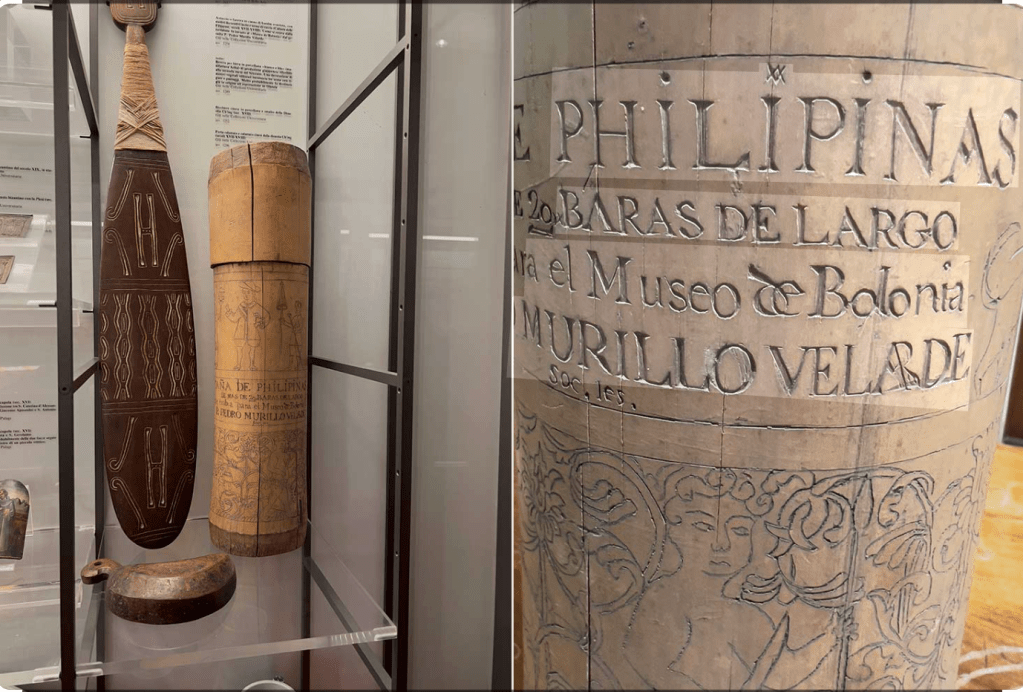
From Manila to Bologna
The recent death of Carlo Ginzburg, one of my favorite historians, made me think again about Bologna. Ginzburg, the great scholar of microhistory, taught us to look closely at small things, traces, clues, and fragments. That way of thinking brought me back to an unexpected connection between Manila and Bologna.
The famous Pedro Murillo Velarde map of the Philippines is like a great ambassador. Not only does it show our historical possessions in disputed waters, it also makes ambitious connections between Manila and the greater early modern world.
Officially known as the Carta Hydrographica y Chorographica de las Islas Filipinas, the map was made in Manila in 1734 with the Tagalog engravers Nicolás de la Cruz Bagay and Francisco Suárez.
Recent research by Caroline Paganussi, published in January 2026, argues that a related object survives in Bologna, Italy: a decorated Philippine bamboo container, likely made in Manila in the 1740s. An earlier article in Mapping Philippine Material Culture by Cristina Juan had reached a similar conclusion.
The object is now in the Museo Civico Medievale. It is a hollow bamboo tube with a removable cap, measuring about 55.5 cm high and 14 cm in diameter. Its inscription says it was made from a Philippine bamboo culm of more than twenty varas and sent to the Museum of Bologna by Pedro Murillo Velarde, S.J.
Paganussi suggests that the tube may have contained the smaller 1744 version of Murillo’s map. Its carved scenes include an indio attendant, a Spanish or European figure, a Japanese figure offering a flower, carabao hunts, aetas hunting a crocodile, and a Hoklo merchant.
Its life in Europe is just as interesting. Murillo left Manila in 1749 as a Jesuit representative to Madrid and Rome, where he sought support for the Philippine missions. Because he missed the Manila galleon, he traveled by way of the Cape of Good Hope. The bamboo container may have been part of his appeal to Pope Benedict XIV, a major supporter of the Academy of Sciences in Bologna and a collector of books, natural specimens, maps, instruments, and curiosities.
Read more here:
Paganussi, Caroline. “From Manila to Bologna and Beyond: The Maritime Trajectory of an Eighteenth-Century Philippine Bamboo Container.” Eighteenth-Century Life 50, no. 1 (January 2026): 105–135. https://doi.org/10.1215/00982601-12206955.
Juan, Cristina. “Introducing Murillo Velarde’s Philippine Bamboo in Bologna.” Mapping Philippine Material Culture. Philippine Studies at SOAS. Accessed June 19, 2026.
 Geronimo Cristobal