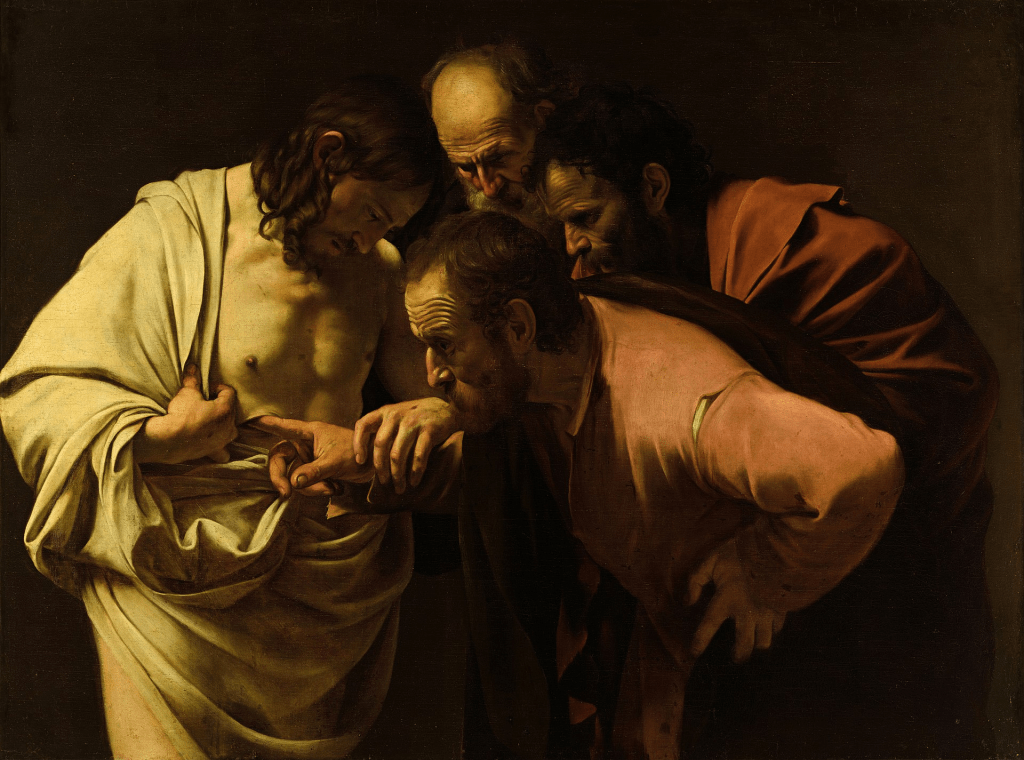
The Feast of the Resurrection has just passed, marking a return to work and to Manila traffic. I find myself going back to old emails. In them, I notice Vince Rafael’s last email and the profile picture he once used: a detail from The Incredulity of Saint Thomas by Caravaggio. It feels, in retrospect, like an Easter egg he left for younger scholars to recognize only after his passing last February 21. For Filipinos, there is also the belief that the souls of the dead linger on earth for forty days, recalling the time Christ remained before the Ascension. His fortieth day was on the 2nd of April. Until that date we never really believe that the dead have left us.
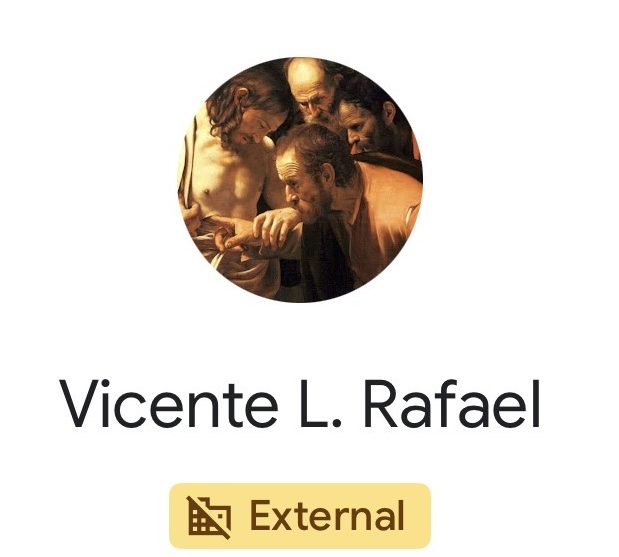
I do not know why he chose that profile picture. Perhaps it had something to do with the kind of historian he was. Someone attentive to how knowledge is formed, and to the question of why we know what we know (I remember him saying as much during our interview). The painting itself, an oil on canvas made c. 1601–1602, was originally commissioned by another Vince, Vincenzo Giustiniani. It later entered the Royal Collection of Prussia, survived the Second World War unscathed, and is now housed in the Sanssouci Picture Gallery in Potsdam.
The painting shows the episode that gave rise to the term “Doubting Thomas.” The subject had been represented in Christian art since at least the fifth century and used to make a range of theological arguments about faith and proof. According to the Gospel of John, Thomas, having missed Christ’s first appearance after the Resurrection, insisted: “Unless I see the nail marks in his hands and put my finger where the nails were, and put my hand into his side, I will not believe.” A week later, Christ appeared again and invited him to do so, before stating: “Because you have seen me, you have believed; blessed are those who have not seen and yet have believed.”
Caravaggio’s treatment is highly focused. Four half-length figures are pressed into a shallow space against a dark background. Christ stands at the centre, his torso exposed. Thomas bends forward and inserts his finger into the wound in Christ’s side. Christ holds and guides Thomas’s wrist, making the action explicit. Two other apostles lean in from either side, their faces close, their attention fixed on the same point.
There are no secondary elements in the composition. No architectural setting or landscape is provided. The figures emerge from darkness, and the light, falling from the left, illuminates Christ’s body, the wound, and the faces of the apostles.
Thomas does not rely on sight alone but tests the wound directly. The apostles’ expressions reinforce this emphasis. They observe carefully and there is no indication that they too are accepting the veracity of the wound or the scene before them immediately. The scene presents belief as something that, in this moment, depends on sensory confirmation.
Caravaggio’s painter-disciples from across Europe, including many from the Netherlands, travelled to Rome to study Caravaggio’s work. Rembrandt van Rijn, although he never visited Italy, encountered this style through the Utrecht Caravaggisti. Rembrandt’s commitment to a radical form of realism, sustained throughout his career, and his distinctive use of light both develop within this broader Caravaggesque tradition.
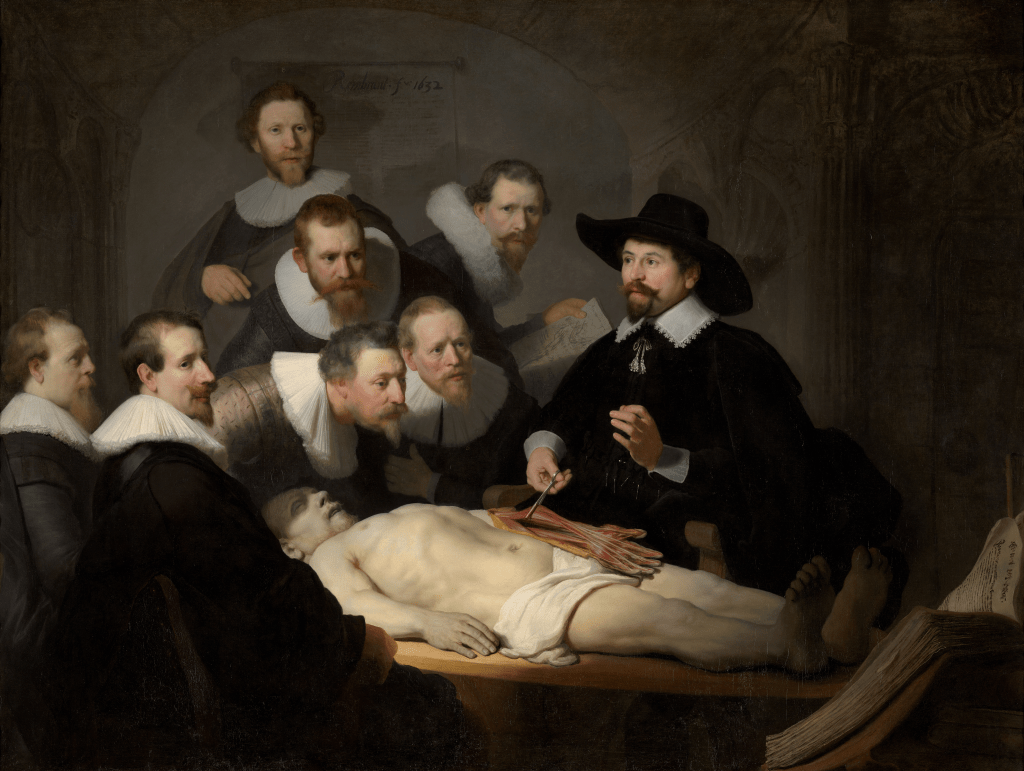
In Rembrandt’s The Anatomy Lesson of Dr. Nicolaes Tulp (1632), an oil painting commissioned by the Amsterdam Guild of Surgeons, Nicolaes Tulp is shown teaching the dissection of a cadaver’s arm to a group of surgeons. The painting functions as both a group portrait and a record of Early Modern medical teaching and practice.
The work recognizably shares a similar visual structure with Carravaggio’s painting. In both, a group of men gather closely around an opened body. In Caravaggio, Christ’s side is exposed and Thomas inserts his finger into the wound while Christ guides his hand. In Rembrandt, Tulp lifts and explains the musculature of the cadaver’s arm while the surgeons observe.
Both compositions are tightly arranged and set against a dark background. Light isolates the central action: the wound in Caravaggio, the dissected arm in Rembrandt. In both works, attention is directed to a precise point where hand meets body.
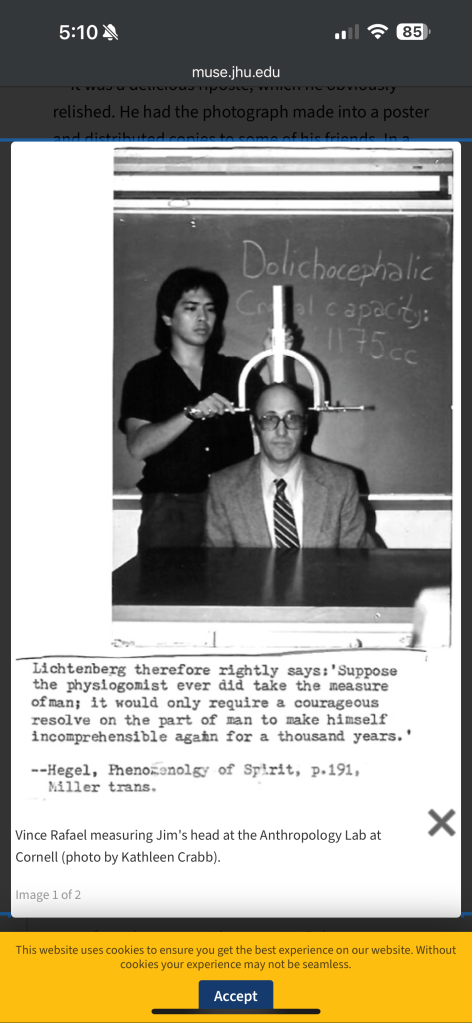
The difference lies in the purpose of that contact. In Caravaggio, the scene comes from the Gospel of John and centers on doubt and belief. Thomas tests the truth of the Resurrection through touch, and the others act as witnesses. In Rembrandt, the dissection is instructional. Tulp demonstrates knowledge to an audience already positioned to learn. This brings to mind a photograph of Vince measuring the head of his teacher, James Siegel, in a Cornell anthropology class demonstrating how craniology was once conducted.
The status of the body also differs. In Caravaggio, Christ is alive, and the wound serves as proof. In Rembrandt, the body is a cadaver used for study.
***
No one really prepares you for the departure of someone you considered a mentor. Christ was first known to his disciples as a teacher, and in Caravaggio’s scene he teaches one last time, using his own body as proof of the good news. Beyond the fulfilment of his coming, Christian faith rests on the resurrection of the body.
Perhaps this is why the image continues to resonate, especially among scholars. It shows that doubt does not disappear and remains, even in the presence of proof. What is left to the disciples is the work of looking closely, of testing, of trying to understand. The search for proof—something I have come to realize as both a burden and a discipline—endures after the teacher is gone.
 Geronimo Cristobal