Originally published in Excelsior, Ano XXIX (Numero 928), Febrero 29, 1932
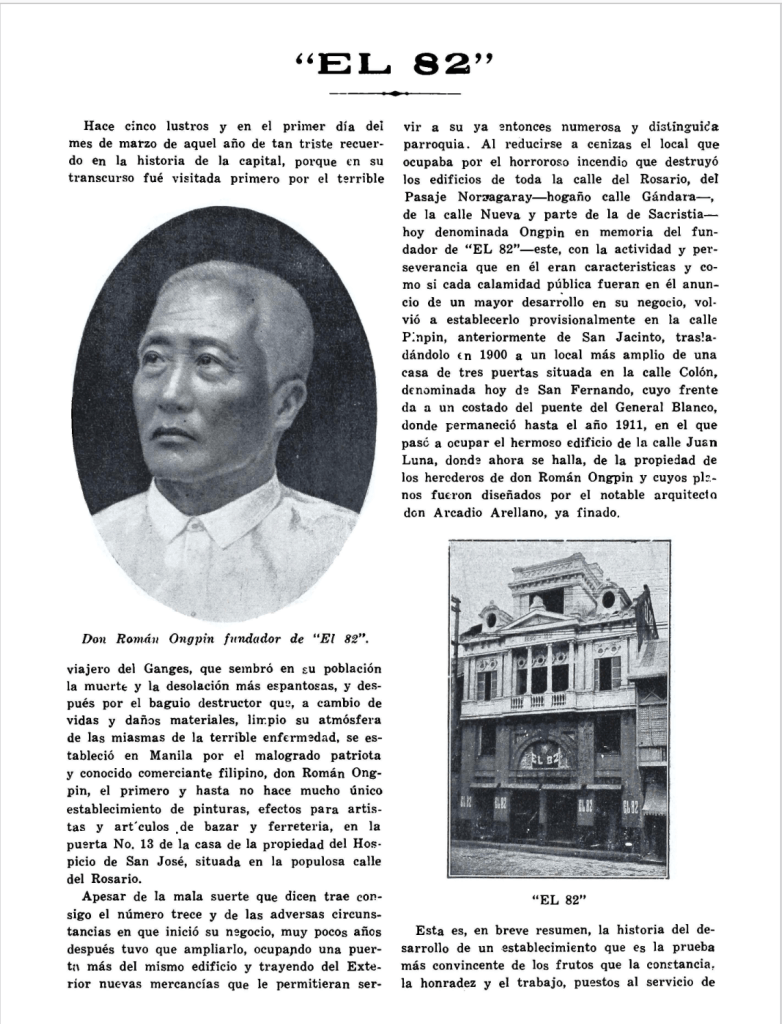
Five decades ago, on the first day of March of that year so sorrowfully remembered in the history of the capital—because during its course it was first visited by the terrible traveler from the Ganges, which spread death and the most dreadful devastation among the population, and afterward by the destructive typhoon which, in exchange for lives and material losses, cleansed the atmosphere of that same terrible disease—there was established in Manila, by the late patriot and well-known Filipino merchant Don Román Ongpin, the first—and until not long ago the only—shop for paints, artists’ supplies, and bazaar and hardware goods, at Door No. 13 of a building owned by the Hospicio de San José, located on the bustling Calle del Rosario.
Despite the ill fortune said to accompany the number thirteen and the adverse conditions under which he began his business, only a few years later he was compelled to expand it, occupying an additional doorway in the same building and importing new goods from abroad that allowed him to serve his already numerous and distinguished clientele. When the premises he occupied were reduced to ashes by the dreadful fire that destroyed the buildings along Calle del Rosario, Pasaje Norzagaray—now Calle Gándara—Calle Nueva, and part of Calle de Sacristía—today called Ongpin in memory of the founder of “EL 82”—he, with the energy and perseverance characteristic of him, and as if each public calamity were a sign of greater growth for his business, reestablished it provisionally on Calle P. Pimpin, formerly San Jacinto, moving it in 1900 to a larger premises of a three-door house on Calle Colón, now called San Fernando, whose façade faces one side of the General Blanco Bridge. There it remained until 1911, when it moved to occupy the handsome building on Calle Juan Luna where it is now located, property of the heirs of Don Román Ongpin, and whose plans were designed by the notable architect Don Arcadio Arellano, now deceased.
This is, in brief summary, the history of the development of an establishment that stands as the most convincing proof of what constancy, honesty, and labor—placed in the service of intelligence—can yield; and furthermore, the clearest demonstration of the capacity of Filipinos for business. It is a history tied to the names of all the artists who have brought honor to their country and of those who today give it renown in the world of Art, from Rizal, the national hero, through Guerrero, Luna, Hidalgo, Zaragoza, Roxas, Rocha, and Santos, to De la Rosa, Amorsolo, Rivera among Filipinos, and Alberoni and Divela—scenographic painters who decorated the churches of San Agustín and Binondo and were teachers of Antillón, who in turn taught Alvero, Torres, and Abelardo—Herrer, Enriquez, and Fuster among foreigners. All of these, and all those of past and present generations who cultivated the noble Art of Apelles, were and are clients of “El 82”, in whose shop we have often seen many of their works exhibited.
To say, then, “El 82” is to say art, and this alone is its finest distinction and credential. At its head today is Don Constancio Ongpin, who, assisted by his sisters, continues the business begun by his father, whom death prevented from seeing the full fruition of his efforts and labors.
 Geronimo Cristobal