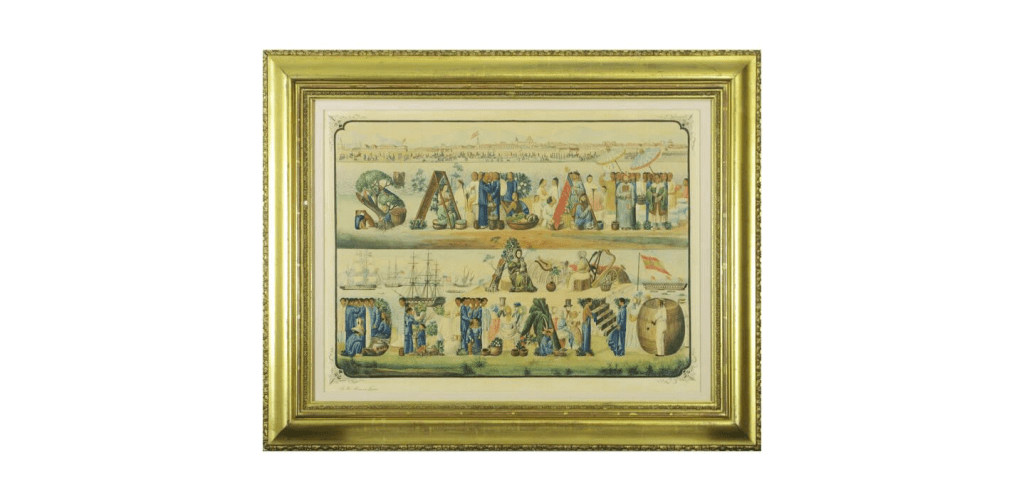
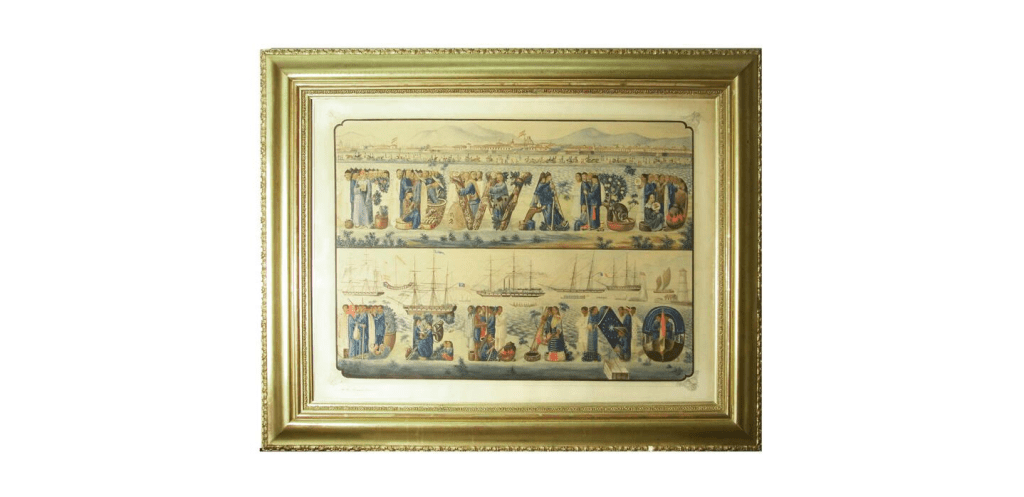
Two related letras y figuras watercolours by Filipino painter José Honorato Lozano (1815/1821–1885) survive today in the collection of the Franklin D. Roosevelt Presidential Library and Museum. Executed in the mid-nineteenth century, the paintings commemorate members of the American Delano family—Edward Delano (1818–1881) and Sarah Alvey Delano (1822–1880)—whose family was involved in the Pacific mercantile networks linking Manila, Canton, and the United States. Both works measure approximately 24 × 30 inches (61 × 76.2 cm) in their gilt frames and are executed in watercolour on wove paper. Each bears Lozano’s signature in the lower left: Por José Honorato Lozano.
The two compositions are representative of the letras y figuras format that Lozano developed in Manila during the mid-nineteenth century. In this genre, the letters of a patron’s name are constructed from small figural groups drawn from everyday life in the colonial port. The device synthesizes the typological imagery of tipos del país watercolours—popular representations of the inhabitants of the Philippines in distinctive costume and occupation—with the ornamental format of landscape painting and calligraphy. Lozano’s compositions typically unfold across two horizontal registers in which the letters themselves become stages for scenes of urban activity, framed by panoramic views of Manila and its harbour.
The Edward Delano painting (MO 2008.33.1) spells the name EDWARD DELANO across two tiers. In the upper register, the letters of “EDWARD” are composed of Chinese figures engaged in the commercial and artisanal trades associated with Manila’s Chinese community. Their bodies, tools, and baskets collectively outline the letterforms while continuing their activities, a pictorial conceit that merges narrative scene with typographic structure. Behind them rises a distant view of colonial Manila, identifiable as the walled city of Intramuros by the ramparts and the Spanish flags flying above its fortifications. The lower register forms the name “DELANO,” its letters constructed from Filipino figures in mid-nineteenth-century attire. These figures stand, converse, or carry goods along a shoreline landscape. The harbour behind them is animated by maritime traffic: sailing ships flying the flags of several nations—including the United States and France—appear alongside rowboats and a lighthouse, emphasizing Manila’s status as an international port.
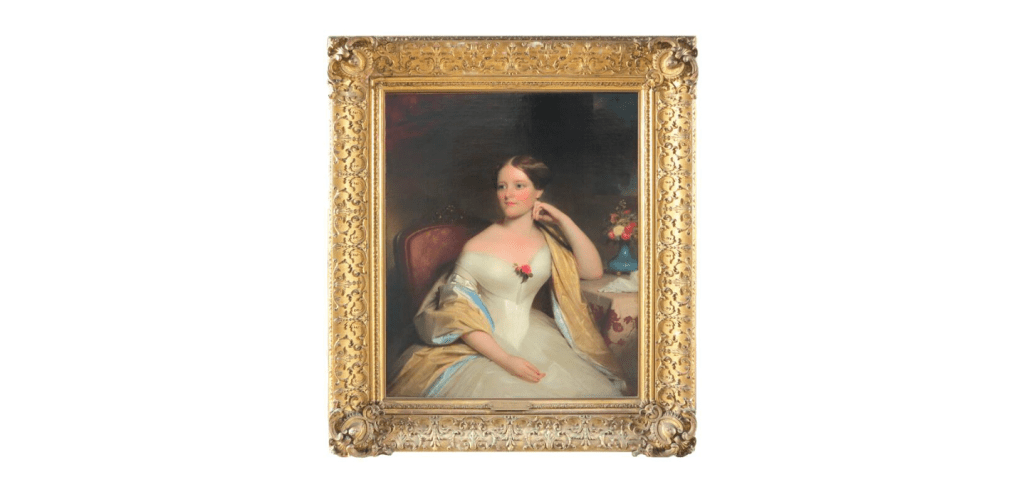
The companion work dedicated to Sarah A. Delano (MO 2008.33.2) follows the same compositional structure. The upper register spells SARAH, again formed by Chinese figures associated with commerce and craftsmanship in Spanish Manila. The background reproduces the distant skyline of Intramuros, its Spanish flags asserting the colonial authority under which the city functioned as a hub of regional trade. The lower register forms the inscription A. DELANO. In the letter “A,” Western women sit along a pier surrounded by musical instruments, creating a vignette of leisure within the larger harbour setting. The remaining letters are composed of Filipino and Western figures dressed in mid-nineteenth-century clothing, arranged in small groups that echo the ethnographic typologies of tipos del país painting. As in the Edward Delano composition, the horizon is lined with sailing vessels from different nations, reinforcing the maritime context that underpinned Manila’s cosmopolitan society.
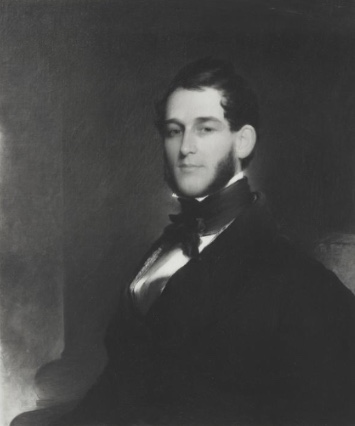
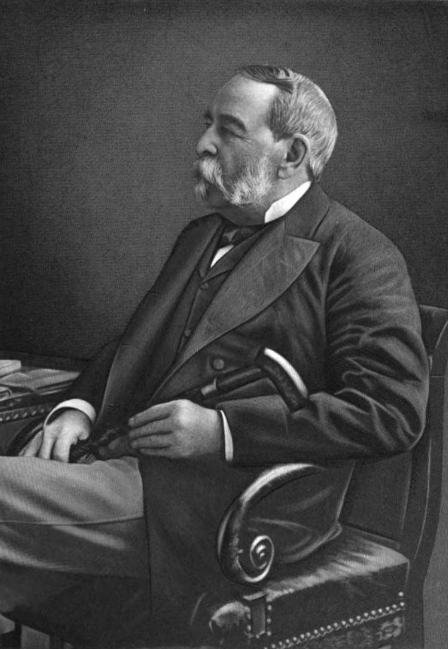
The two paintings reflects the Delano family’s commercial presence in East and Southeast Asia. Edward (known to affectionately to FDR as Uncle Ned) and Sarah Delano were the siblings of Waren Delano II (FDR’s grandfather), who commissioned the pair of paintings. Warren Delano II amassed a substantial fortune in the opium trade in Canton (Guangzhou), participating in the offshore system through which American and British firms smuggled opium into Qing China despite imperial prohibitions. By the early 1840s he had spent nearly a decade in the China trade and risen to become the firm’s senior partner, witnessing the upheavals surrounding the First Opium War and the dismantling of the Canton system. The wealth generated through this trade later formed the financial foundation of the Delano family, whose lineage would produce Franklin D. Roosevelt, the thirty-second president of the United States.
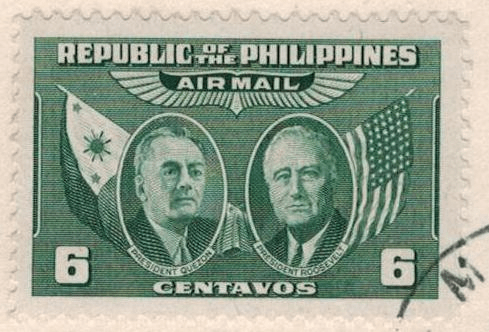
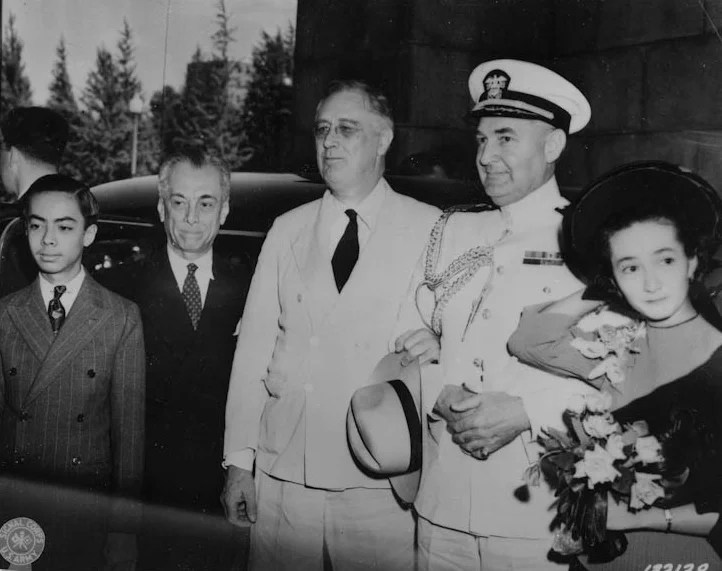
Nearly a century after Lozano painted the Delano family names in Manila, the Philippines reappeared in the political career of their descendant Franklin D. Roosevelt. On 23 March 1935 Roosevelt approved the 1935 Constitution of the Philippines, implementing the Philippine Independence Act and inaugurating the Commonwealth government under Manuel L. Quezon.
Lozano’s watercolours once again proved themselves an extraordinary document of an under-researched era when Manila stood within a global network of maritime commerce that connected Spanish colonial society with American mercantile families active in China and the Pacific.
Within Lozano’s body of work, the Edward and Sarah Delano paintings demonstrate his synthesis of ethnographic observation, landscape, and ornamental inscription. Chinese artisans, Filipino townspeople, Western visitors, Intramuros, and Manila’s harbour appear within the contours of the letterforms, which organize scenes of colonial life into a personalized composition. In this format, the typological figures of tipos del país are recomposed into a more inventive pictorial device that appealed to foreign merchants in Manila.
Compact yet densely descriptive, the Delano watercolours record the social and commercial world of nineteenth-century Manila, linking the city’s transpacific networks to the Delano family whose descendant, Franklin D. Roosevelt, would later oversee the Philippines’ transition toward independence.
Further Reading
On Letras y Figuras and Jose Honorato Lozano
Blanco, John D. Frontier Constitutions: Christianity and Colonial Empire in the Nineteenth-Century Philippines. Berkeley: University of California Press, 2009.
Capistrano-Baker, Florina H., and Sandra Castro. Intertwined: Transpacific, Transcultural Philippines. Makati: Ayala Foundation, 2022.
Capistrano-Baker, Florina H. 2020. “Inside the Outsider’s Gaze.” Panorama: Journal of the Association of Historians of American Art 6, no. 1 (Spring). https://doi.org/10.24926/24716839.10066.
Legarda, Benito J. After the Galleons: Foreign Trade, Economic Change and Entrepreneurship in the Nineteenth-Century Philippines. Madison: University of Wisconsin Center for Southeast Asian Studies, 1999.
Wickberg, Edgar. The Chinese in Philippine Life, 1850–1898. New Haven: Yale University Press, 1965.
On Sarah and Edward Delano at the FDR Library
National Archives. Sarah A. Delano Letras y Figuras Painting, by José Honorato Lozano. Franklin D. Roosevelt Presidential Library and Museum Collection, MO 2008.33.2. https://fdr.artifacts.archives.gov/objects/26251/sarah-a-delano-letras-y-figuras-painting.
National Archives. Edward Delano Letras y Figuras Painting, by José Honorato Lozano. Franklin D. Roosevelt Presidential Library and Museum Collection, MO 2008.33.1. https://fdr.artifacts.archives.gov/objects/29194/edward-delano-letras-y-figuras-painting.
Other Philippine items in the Franklin Delano Roosevelt Presidential Museum and Library
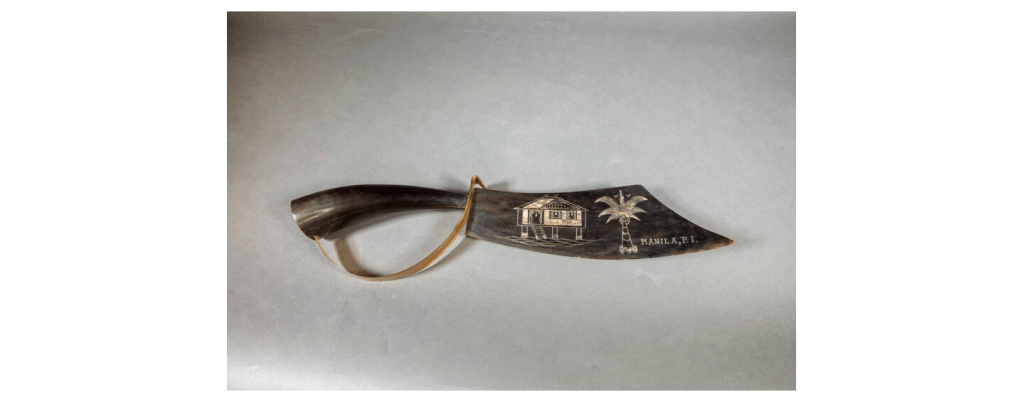
 Geronimo Cristobal