A orillas del Pasig circulated in late nineteenth-century Manila as music sung in drawing rooms and printed as sheet music. Its most familiar version, A orillas del Pasig: Danza Filipina para Canto y Piano, features lyrics credited to José Rizal and music composed by his Ateneo Municipal classmate Blas Echegoyen.
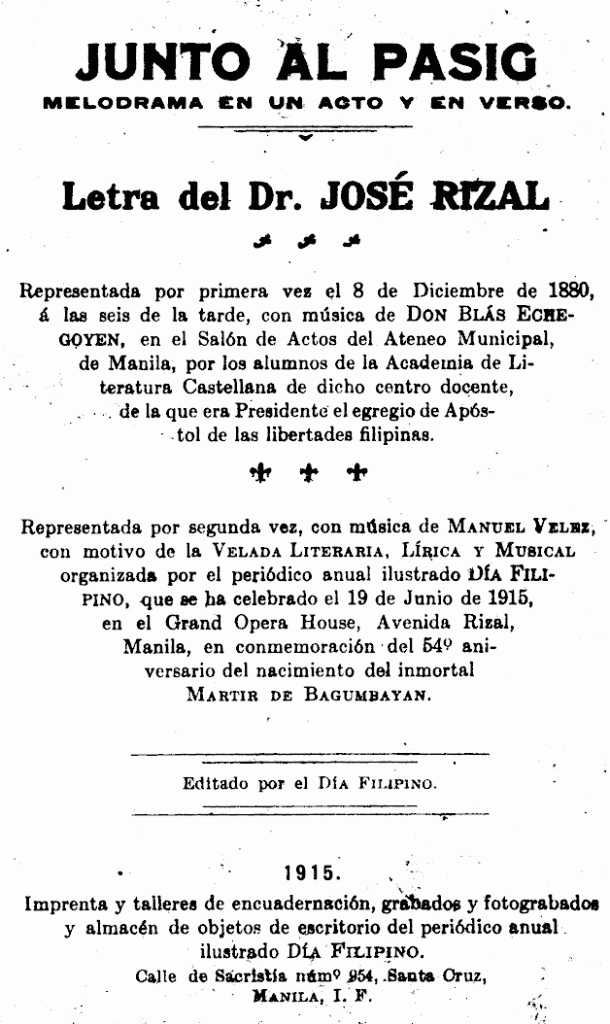
Hardly anyone remembers that the song’s origin, however, lies in Rizal’s earlier stage work Junto al Pasig, from which the opening children’s chorus—“A orillas del Pasig”—was taken. On its title page, Junto al Pasig is described as a “melodrama en un acto y en verso.” It was first performed on 8 December 1880 at the Ateneo Municipal, and later performed again on 8 December 1915 with new arrangement and music by Manuel Vélez. The nineteenth-century edition preserved on Project Gutenberg reproduces the complete Spanish text along with its stage directions, sequential scene divisions, and musical cues.
The play is set along the banks of the Pasig River, in the town that shares its name. Its opening scenic instruction—“La decoración representa el río Pásig, en cuya orilla hay toldos, banderas y adornos”—establishes a festive riverside tableau of canopies, flags, and decorations. The cast includes Leónido, Elías, Satanás, Ángeles, and a chorus of niños, reflecting a moral allegory expressed through dialogue, verse, and choral song.
The melodrama begins with the children’s chorus singing of the river’s murmur, the bamboo swaying along its banks, and preparations for a feast in honor of the Virgin of Antipolo. Later scenes introduce the central conflict: Satanás confronts Leónido, offering temptations of power, which Leónido rejects in favor of faith. The work concludes with a procession bearing the image of the Virgin of Antipolo, accompanied by hymns and choral singing which was meant to be both a visual and musical resolution to the drama.


Original sheet music, A orillas del Pasig: Danza Filipina para Canto y Piano, with lyrics by Dr. José Rizal and music by Maestro Blas Echegoyen; Tagged by Leon Auctions as slight TS (toning spots); graded F (Fair condition). 
Original sheet music, A orillas del Pasig: Danza Filipina para Canto y Piano, with lyrics by Dr. José Rizal and music by Maestro Blas Echegoyen; Tagged by Leon Auctions as slight TS (toning spots); graded F (Fair condition).
The cover of the published score A orillas del Pasig: Danza Filipina para Canto y Piano, issued by the Almacén de Música de la Vda. de Echegoyen follows the conventions of late Spanish-period print design, with sawali borders, bamboo framing, and an engraved vignette of the Pasig River showing nipa houses and a banca. Oval portraits of Rizal and Echegoyen emphasize their co-authorship, while the teal-green ink and tight typography echo the visual style of music sold in Escolta shops.
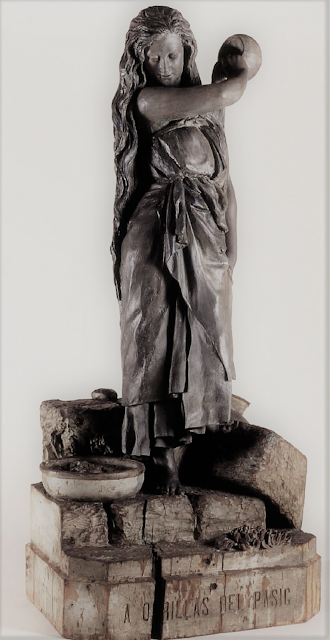

At the same time that A orillas del Pasig circulated in print and music during José Rizal’s lifetime, Rosendo Martínez y Lorenzo (Manila, 1856–c.1920) produced his own sculptural interpretation of the theme for the 1887 Exposición General de las Islas Filipinas in Madrid. A member of the Santa Cruz, Manila artistic family that included Félix and Leandro Martínez, Rosendo exhibited two carved works at the exposition, of which A orillas del Pasig is thought to be the only surviving example (see infra, La Sampaguita, for the details of the other work). Now held in the Museo Nacional de Antropología (on long-term deposit from the Museo del Prado), the sculpture depicts a young woman cooling herself at the riverbank, her long hair falling freely as she lifts a small bowl of water. The composition centers on this single gesture: the tilt of her head, the slight bend of her torso, and the raised arm all draw the viewer toward the quiet act of bathing. Martínez’s most meticulous carving appears in the treatment of the wet clothing. The fabric adheres closely to the body, with tight folds where it stretches and deeper cuts at the hem to suggest water-heavy cloth.
Concha Díaz Pascual (2020) highlights the ethnographic grounding of the sculpture by citing Félix Laureano’s Usos y Costumbres de Filipinas, also displayed at the 1887 exposition. Laureano wrote that Filipinos bathed “varias veces al día” [several times a day] using the tavo or tabú, a coconut-shell dipper for pouring water from head to foot. His photographs show women bathing along the Pasig with dippers identical to the one implied in Martínez’s scene. These images and descriptions form the documentary basis for the sculpture.
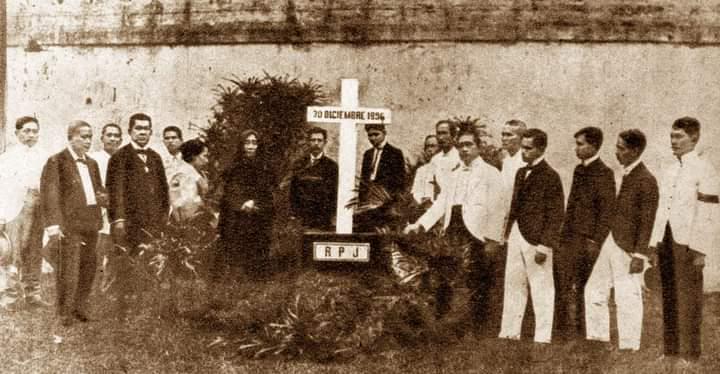
We do not yet have an individual photograph of Rosendo Martínez, but he appears in a rare group portrait taken at José Rizal’s grave, where his fellow Ateneo classmates gathered to pay their respects. That Martínez is among them is a testament to their closeness, and it strengthens the case that his sculptural treatment of A orillas del Pasig was not merely thematic but a deliberate homage to a friend whose literary work had shaped their shared intellectual world.

Rosendo Martínez y Lorenzo (1856–1920), La Sampaguita, titled and signed on base (right side), Filipino, c.1880s; carved and polychromed Tipos del País statuette in baticuling wood with oil paint; sculpture: 22 1/2 × 11 × 8 in (57 × 28 × 20 cm); base: 5 × 9 × 8 in (13 × 23 × 20 cm). 
Rosendo Martínez y Lorenzo (1856–1920), La Sampaguita, titled and signed on base (right side), Filipino, c.1880s; carved and polychromed Tipos del País statuette in baticuling wood with oil paint; sculpture: 22 1/2 × 11 × 8 in (57 × 28 × 20 cm); base: 5 × 9 × 8 in (13 × 23 × 20 cm).
The second work Rosendo showed in Madrid, La Sampaguita, was long believed to be lost, as noted by Díaz Pascual (2020) in her study of the Manila School. Its recent emergence in a private auction, however, corrects that assumption. Carved in baticuling wood and finished in delicate polychromy, the statuette depicts a sampaguita vendor—her hair held back by a tortoiseshell peineta, dressed in the familiar layers of the camisa, alampay, tapis, and striped saya, offering blossoms in a woven bilao. According to Augusto Gonzales III, the sculpture matches the one photographed in Don Pedro Alejandro Paterno’s “Sala de Diez Puertas,” where he arranged an extensive array of Tipos del País figurines for visitors and later for international expositions. Its reappearance completes the provenance of an object central to the visual culture of late nineteenth-century Manila and reaffirms Rosendo’s role within the carving traditions linking Santa Cruz, Manila and Paete, Laguna.
These musical and sculptural versions of A orillas del Pasig show how the theme operated as a flexible, repeatable motif. In print, it cast the Pasig River as a scene of gentle, idealized domestic life; in sculpture, it transformed a familiar riverside activity into a naturalistic study of the body and everyday movement.
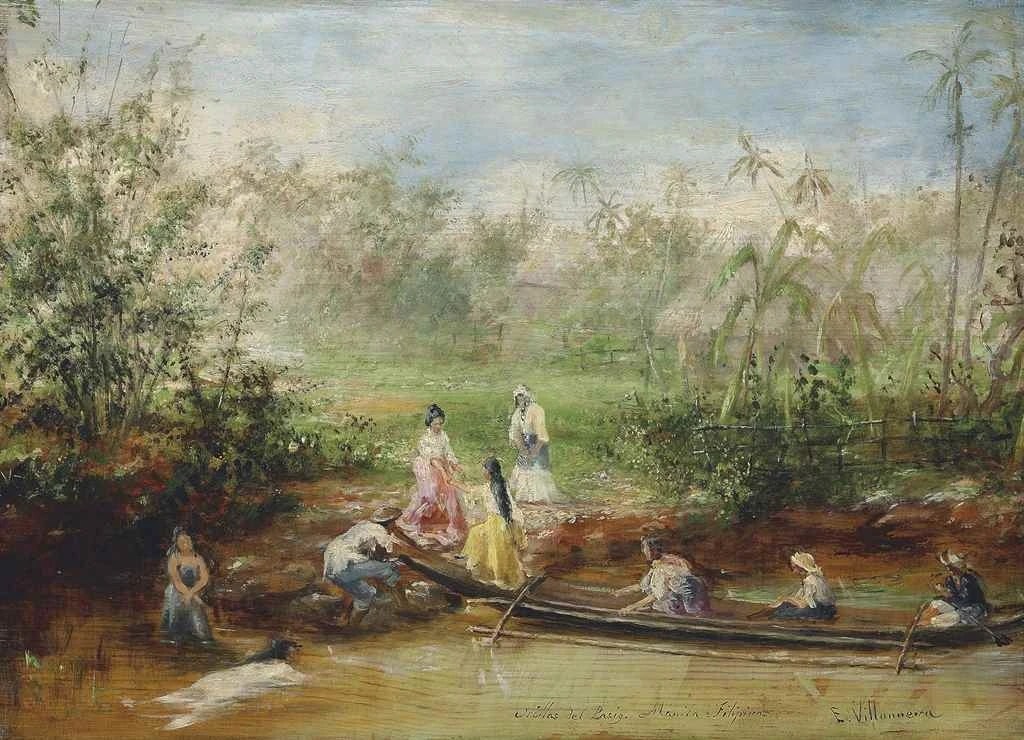
This small landscape by Esteban Villanueva depicts the banks of the Pasig River in Manila, capturing one of the principal waterways of the colonial capital that linked the commercial districts of Intramuros, Binondo, and the surrounding riverine settlements. The work belongs to the late nineteenth-century tradition of Philippine landscape painting associated with artists trained at the Academia de Dibujo y Pintura in Manila.
The theme continued to evolve into the twentieth century, when Fernando Amorsolo offered his own interpretation through the figure of the mutya, or river nymph, in Mutya ng Pasig (1936), extending the Pasig’s imaginative reach from lyric and melodrama to modern painting.

The recent recovery of works such as Rosendo Martínez’s La Sampaguita, together with the survival of the Rizal–Echegoyen sheet music, proves how strongly the Pasig River shaped Philippine cultural production. These works shared a visual and textual language through which artists, musicians, and writers interpreted—and repeatedly reimagined—the Manila’s riverine social world.
A 2021 performance of “A Orillas del Pásig” by Rachelle Gerodias-Park (soprano) with Jude Areopágita on piano reworks the historical performance by Leopoldo Brías y Roxas, with a modern arrangement for voice and piano by Paul Earvin Bibal.
References
Díaz Pascual, Concha. 2020. “Escultores Filipinos 1850–1898 (M–Z).” Cuaderno de Sofonisba, September 10, 2020.
González III, Augusto Marcelino Reyes. 2022. “The Ilustrado Trove: From the Collection of Don Pedro Paterno.” In Paintings, Sculptures, First Editions, Historical Documents and Ephemera, 14. Manila: Leon Gallery.
Rizal, José. Junto al Pasig: Melodrama en un acto y en verso. 1880. Reproduced in Project Gutenberg, https://www.gutenberg.org/cache/epub/14795/pg14795-images.html.
 Geronimo Cristobal