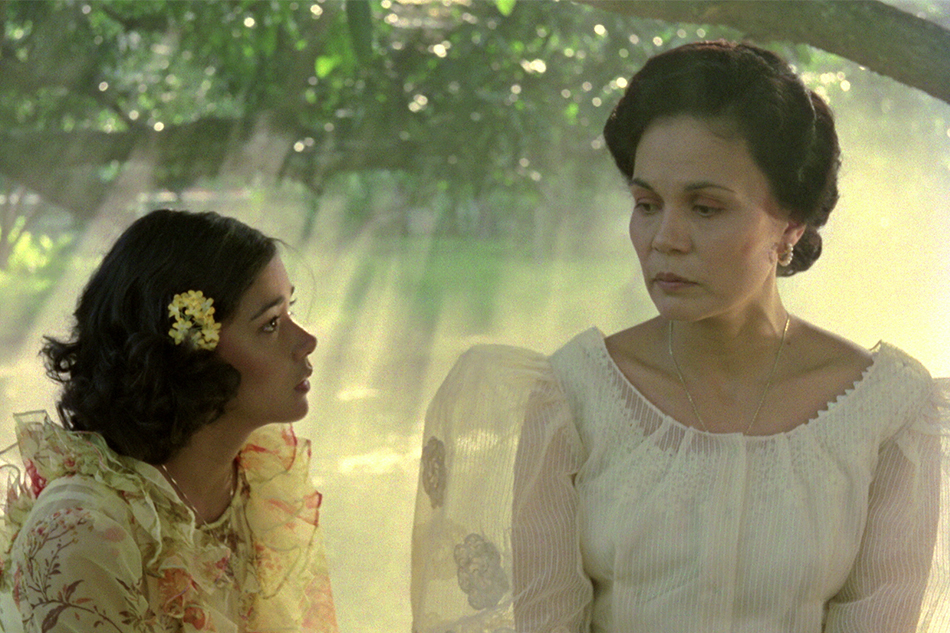
Mga Bilanggong Birhen (1977) is set on a Visayan hacienda during the early years of American colonial administration. The film follows the Sagrada family—Felipa, Juan, Doña Sagrada, and the daughters Celina and Milagros—within a household that retains social structures established during the late Spanish period. Throughout the film, the architecture of the ancestral home, its surrounding fields, and the patterns of domestic activity are presented using a system of lighting that closely echoes the visual strategies employed by painters associated with the Amorsolo school in the first half of the twentieth century.
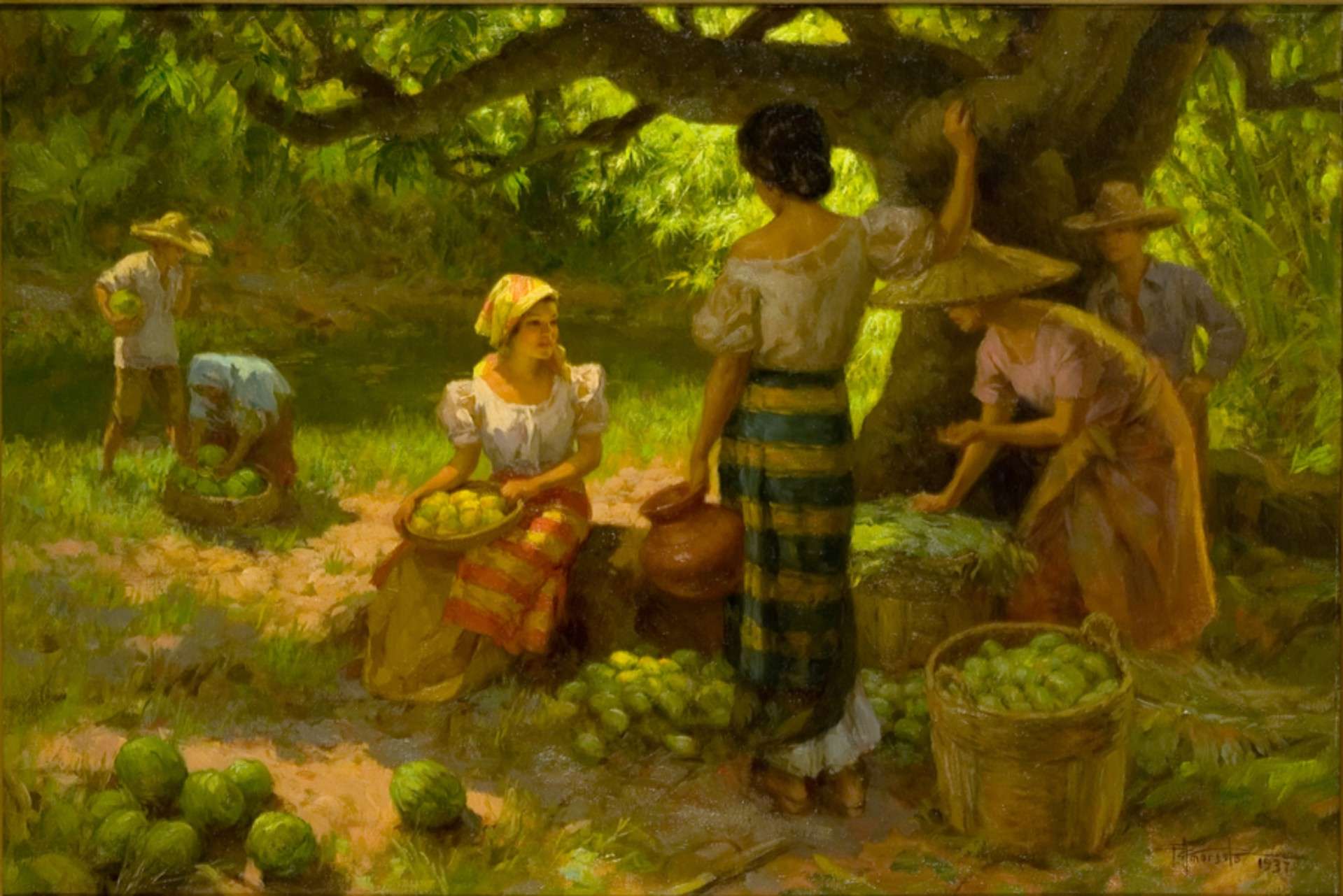


The outdoor scenes frequently make use of backlit foliage and diffused sunlight, recalling Fernando Amorsolo’s Under the Mango Tree paintings of the 1920s and 1930s. In these works, women in terno are often seated or standing beneath trees, their clothing illuminated from behind so that piña or organza fabrics appear translucent. The film reproduces this technique through cinematographer Romy Vitug’s use of capiz-filtered daylight and controlled exposures that allow shafts of sunlight to register clearly against darker foreground figures. This creates compositions where the contour of the shoulder, sleeve, or face emerges gradually from surrounding brightness—an effect also seen in Amorsolo’s rural genre scenes.
Interior sequences within the Sagrada hacienda display a different but related lineage. Many scenes resemble the domestic watercolors of Irineo L. Miranda (c. 1930s–40s), who worked within the Amorsolo school and was known for depicting women in terno, household gatherings, and interior conversation. Miranda’s works often employ soft tenebrism: low lighting, diffused shadows, and gradual tonal transitions. In the film, similar techniques appear in rooms lit by narrow windows, lamps, or filtered daylight. Figures are positioned in relation to architectural elements—doorways, carved narra furniture, staircases—that break the light into smaller fields, allowing the camera to register subtle variations in brightness across a single frame.

The ancestral home contains materials that respond predictably to light: capiz window panels, polished wood surfaces, and embroidered textiles. These enable the film to produce the chiaroscuro characteristic of Amorsolo-school interiors. The placement of characters within these spaces serves to highlight social hierarchies embedded in the household. Doña Sagrada is often shown in the receiving rooms or main hall, areas where natural illumination is strongest. Milagros, once confined to the basement as part of the family’s attempt to avoid public scandal surrounding her pregnancy, appears in extremely reduced light, the stone walls and barred openings limiting visible detail. These contrasts are produced without dramatic effects; they arise from the physical properties of the spaces filmed and the controlled use of available light.
The hacienda landscape, shown in several establishing shots, reflects conventions familiar from pastoral paintings produced in Manila during the first half of the twentieth century: level fields, distant tree lines, and cloud formations that diffuse bright overhead sunlight. These scenes also correspond to the historical conditions of early 1900s Visayas, a period marked by the presence of various resistance groups, including the Pulahanes. The Pulahanes, active primarily in Samar and Leyte, numbered between 10,000 and 15,000 adherents at their height. They wore red garments, carried bolos, and drew upon a mix of folk-Catholic and indigenous beliefs. While they do not appear in the film, their activity forms part of the region’s historical backdrop and helps situate the hacienda world depicted onscreen within the broader context of rural Visayan society.

Production designer Laida Lim-Perez filled the set with objects typical of well-to-do provincial homes—religious statuary, heavy wooden furniture, embroidered linens, and period-appropriate clothing. Their textures and reflective surfaces allowed cinematographer Vitug to use lighting techniques reminiscent of Amorsolo’s oils and Miranda’s watercolors. Ryan Cayabyab’s piano-and-string score, characteristic of 1970s period films, supports these scenes without shifting the visual focus on light and surface.
As tensions within the Sagrada family grow, the film keeps its visual logic. Light becomes more fragmented as characters move through doorways or darker interiors, not because of any change in style. By the final act, the hacienda rooms appear dimmer simply because the story has confined its characters to narrower, less illuminated spaces.
The restored Mga Bilanggong Birhen makes these choices clearer. It reveals how closely the film engages the Amorsolo school, translating its well-known pictorial strategies—sunlit pastoral exteriors and controlled indoor tenebrism—into 1970s Philippine cinema. The film documents how visual methods first developed in painting persisted in shaping the representation of domestic life, rural landscapes, and social order on screen.
 Geronimo Cristobal