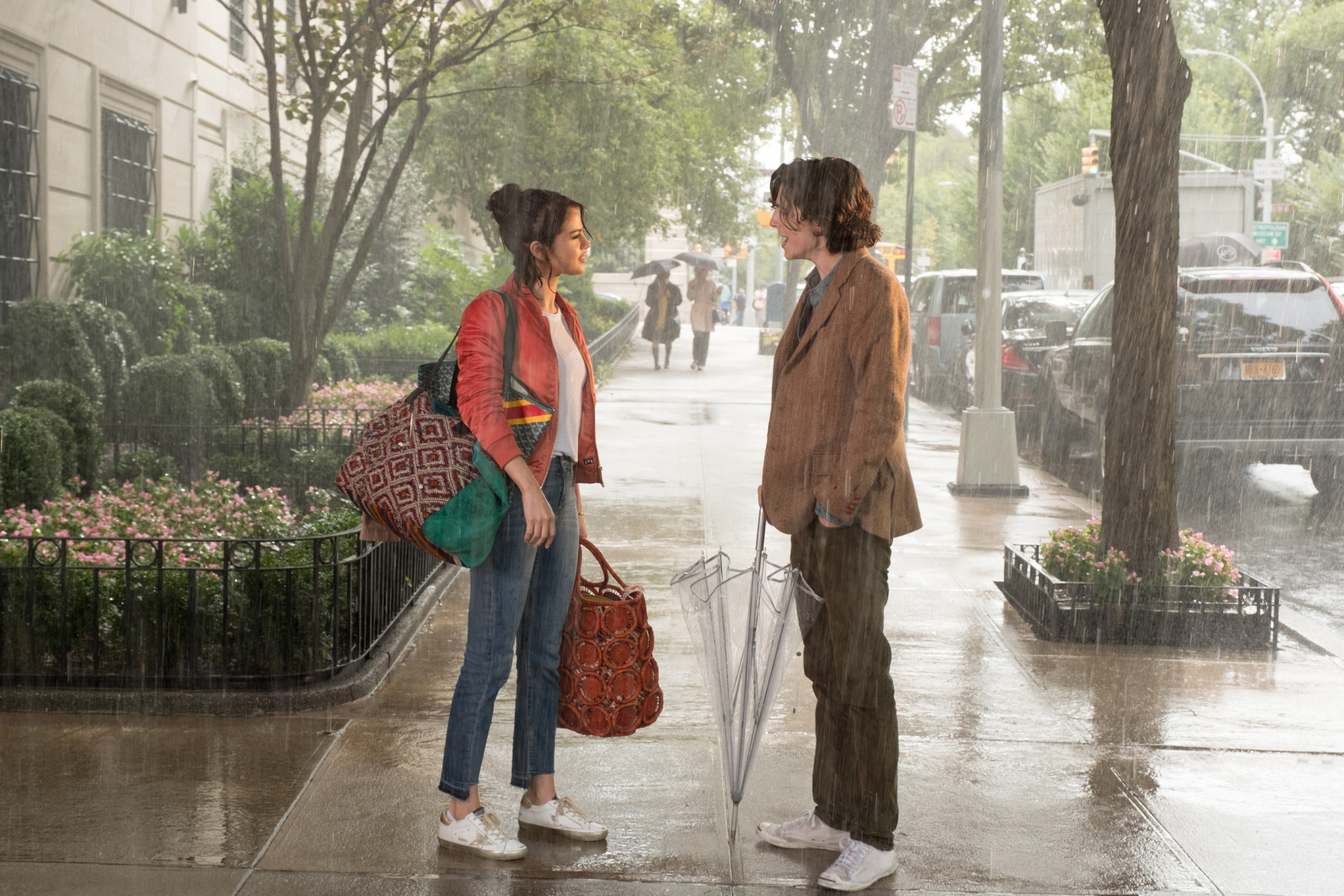
Woody Allen’s A Rainy Day in New York follows a young couple whose romantic weekend in Manhattan dissolves into a chain of misunderstandings and revelations. Gatsby Welles (Timothée Chalamet), a privileged but disaffected student from an old New York family, invites his girlfriend Ashleigh (Elle Fanning), an earnest journalism major from Arizona, to spend a carefully planned weekend in the city. Ashleigh has secured an interview with acclaimed director Roland Pollard (Liev Schreiber), and Gatsby intends to fund their stay with his gambling winnings while introducing her to his version of Manhattan—museums, piano bars, Central Park.
The plan quickly unravels. Ashleigh is drawn deeper into the film world after discovering that Pollard is in crisis over his latest movie. She accompanies him to a private screening, then joins his anxious screenwriter (Jude Law) in searching for the missing director, and eventually finds herself swept up by charismatic actor Francisco Vega (Diego Luna). Each detour pulls her further from Gatsby. Meanwhile, Gatsby wanders the rain-soaked city, encounters an old classmate shooting a student film, and reconnects with Shannon (Selena Gomez), the poised and perceptive younger sister of a former girlfriend. Their exchanges, playful and incisive, expose the superficiality of his relationship with Ashleigh.
Gatsby’s drift through Manhattan includes a lucrative poker game and an impulsive decision to hire an escort to accompany him to his mother’s society gala after he sees Ashleigh photographed with Vega and assumes the worst. At the party, his mother sees through the ruse and privately reveals her own past as a former escort before marrying into wealth. The confession destabilises Gatsby’s inherited moral posture and forces him to confront the fragility of the social world he has taken for granted.
The film moves briskly, built on crossed paths and romantic near-misses. New York is both setting and mood: museums, hotel suites, and Central Park shimmer under steady rain, while Erroll Garner’s “Misty” reinforces the tone of wistful nostalgia. Allen revisits familiar territory—the neurotic New York intellectual, the glamour and absurdity of artistic circles, the illusions that sustain romance—but reframes it through younger characters who both echo and distance themselves from his earlier protagonists. Chalamet’s Gatsby channels a contemporary version of the Allen persona, self-aware and ironic; Fanning plays Ashleigh’s buoyant naïveté with comic clarity; Gomez gradually emerges as the emotional counterweight, grounded and direct.
By the end, Gatsby recognises that his romance with Ashleigh rests on projection rather than compatibility. He ends the relationship and abandons the university path chosen for him, opting instead for something less predetermined. The film closes where Allen’s romantic imagination is most at home: in Central Park, beneath the Delacorte Clock, where Gatsby finds Shannon waiting in the rain, and they kiss.
 Geronimo Cristobal
Leave a comment