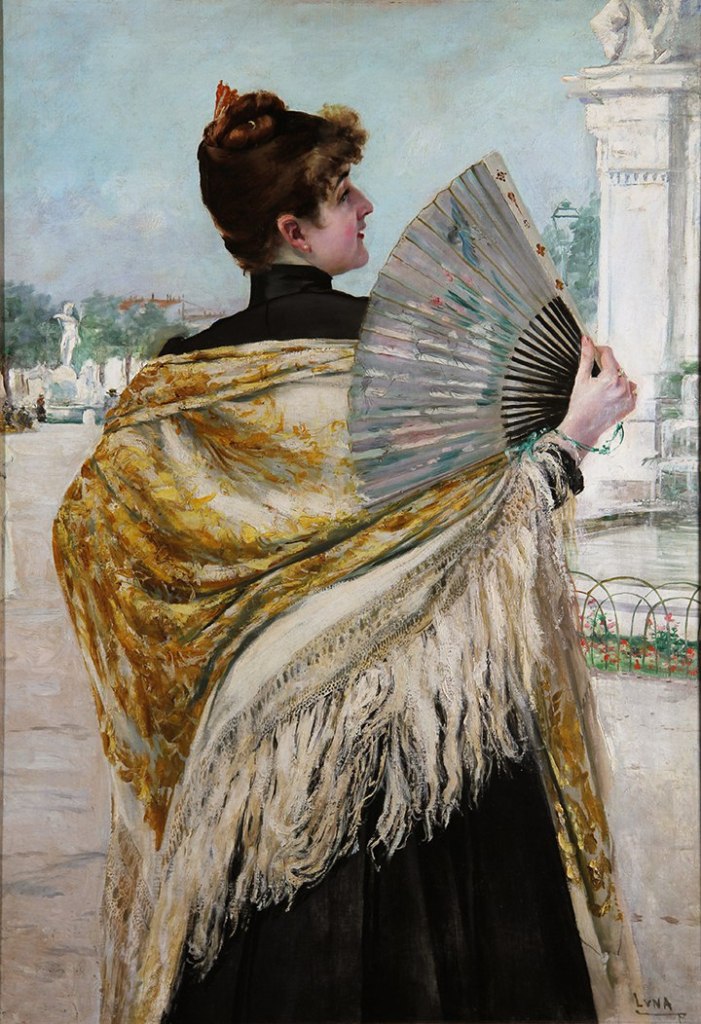
The mantón de Manila became one of the most recognizable textiles in nineteenth-century Spain, and Juan Luna’s Mujer con mantón de Manila (c. 1880s) offers a precise record of its material qualities and its use in urban fashion. The painting shows a woman standing outdoors, wrapped in a large silk embroidered shawl. Its cream ground, dense yellow-gold floral embroidery, and long knotted fringe match the characteristics of the textiles that entered Spain through Manila from the eighteenth century onward. Although these shawls took their name from the Philippine capital, they were produced in Canton, where Chinese artisans specialized in silk weaving and embroidery using techniques refined over centuries. Workshops in Guangzhou created large, square silk cloths embroidered with flowers, birds, butterflies, and occasionally figures or buildings. To prepare the textile, designs were drawn on paper, perforated, and transferred to the silk before artisans embroidered the motifs using satin stitches, shading techniques, and needle-painting methods. The long fringe, sometimes completed in China and sometimes in Spain, gave the shawl its distinctive movement and became a key element of its visual appeal.
The route that brought these textiles into Spain was the Manila Galleon trade, which connected the Spanish Philippines and Acapulco from 1565 to 1815. This was the longest continuous maritime route of the early modern world, transporting goods from across Asia—silk, porcelain, spices, lacquerware, and embroidered textiles—to the Americas. From Acapulco, many of these objects continued to Europe through the ports of Seville and Cádiz. Although the shawls were made in China, Manila served as their transit point, and the name “Manila shawl” became the standard term for these embroidered silk pieces in the Hispanic world.
By the eighteenth century, the shawl had entered Spanish fashion. Working-class and lower-middle-class women adopted the shawl for its warmth, durability, and striking appearance, draping it over dark garments or combining it with fans. With time, wealthier women incorporated it into formal dress, and the shawl became a common feature in portraiture, theater, and urban public life. The characteristic cream or black silk ground with multicolored embroidery, along with the weight and complexity of the fringe, made the shawl effective in performance and social display. Painters such as Raimundo de Madrazo, Ignacio Zuloaga, and Juan Luna documented its widespread use, providing evidence of its status as both a fashion accessory and a global commodity.
The shawl reached Catalonia through these same commercial networks, and by the mid-nineteenth century it had become a familiar item in Vilanova i la Geltrú. An advertisement in the Diario de Villanueva in early 1852 records the sale of embroidered silk shawls “nine spans long” with decorative fringe, imported from China. In Vilanova’s Carnival, the shawl gradually became a defining element of the celebration. Its size, luminous silk surface, and flowing fringe made it ideal for festive movement, and it quickly became part of the local visual vocabulary associated with Carnival costumes. Women layered the shawl over dresses and paired it with fans, echoing the combination seen in Luna’s painting and in other depictions of nineteenth-century Spanish fashion.
Over the course of the nineteenth century, shifts in global trade altered the circulation of the shawl. After the dissolution of the Royal Philippine Company in 1834 and the end of the Manila Galleon system, shipments increasingly arrived via steamships using the Suez Canal, which created a faster route between Europe and Asia. By the late nineteenth century, large-scale importation of embroidered Chinese shawls diminished as European textile industries expanded and as fashion transitioned toward lighter and more modern styles. Even so, the Manila shawl retained its symbolic significance in Spain, especially in flamenco culture and regional dress traditions. In the Philippines, it remained a recognizable object but never became as deeply embedded in local fashion as in the Iberian Peninsula.
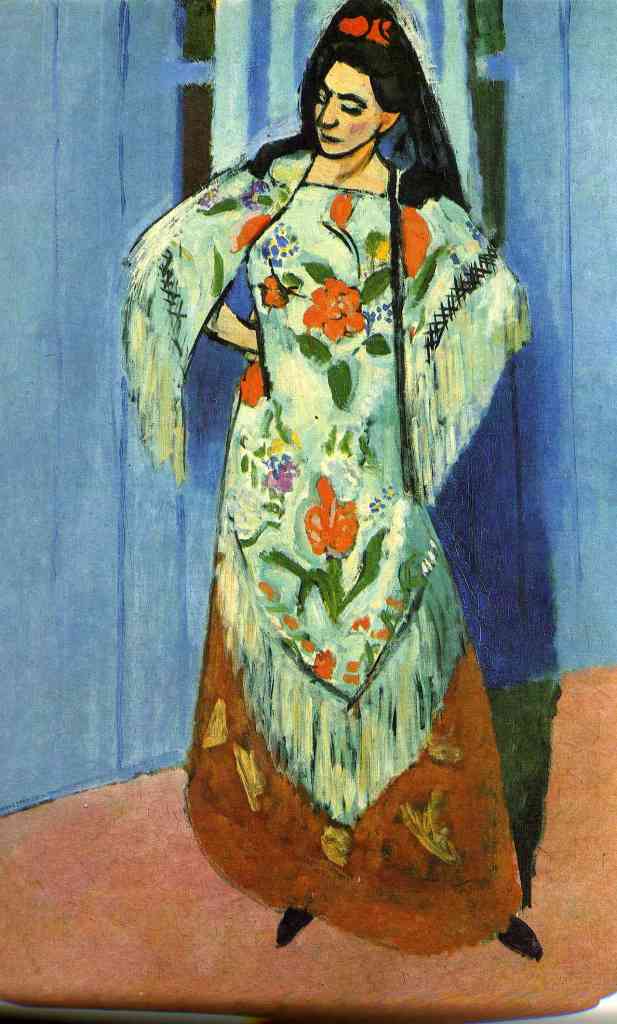
Henri Matisse’s Manila Shawl (1911) provides another clear example of how the embroidered Cantonese shawl appeared in European art. The painting shows a woman standing in an interior space, wrapped in a pale blue silk shawl decorated with large red, orange, green, and violet floral motifs, with long white fringe along its edges. Matisse paints the textile with broad, visible brushstrokes and strong outlines, emphasizing its flat decorative surface rather than fine detail. The background, composed of vertical blue panels, contrasts sharply with the warm tones of the shawl and skirt, making the embroidered textile the main focus of the composition. The work accurately records the distinctive features of the mantón de Manila—its square shape, embroidered floral field, and heavy fringe—showing how this Canton-made textile, circulated through Manila, continued to appear in European visual culture in the early twentieth century.
The mantón de Manila is therefore a product of centuries of global exchange. Made in Canton, routed through Manila, carried across the Pacific to Mexico, and introduced into Spain, the shawl reflects broader patterns of commerce, craft specialization, and cultural adaptation. Juan Luna’s Mujer con mantón de Manila documents these connections through the precise rendering of the shawl’s silk, embroidery, and fringe, embodying the history of a textile that moved across continents and became a lasting symbol of transoceanic encounter.
 Geronimo Cristobal
Leave a comment