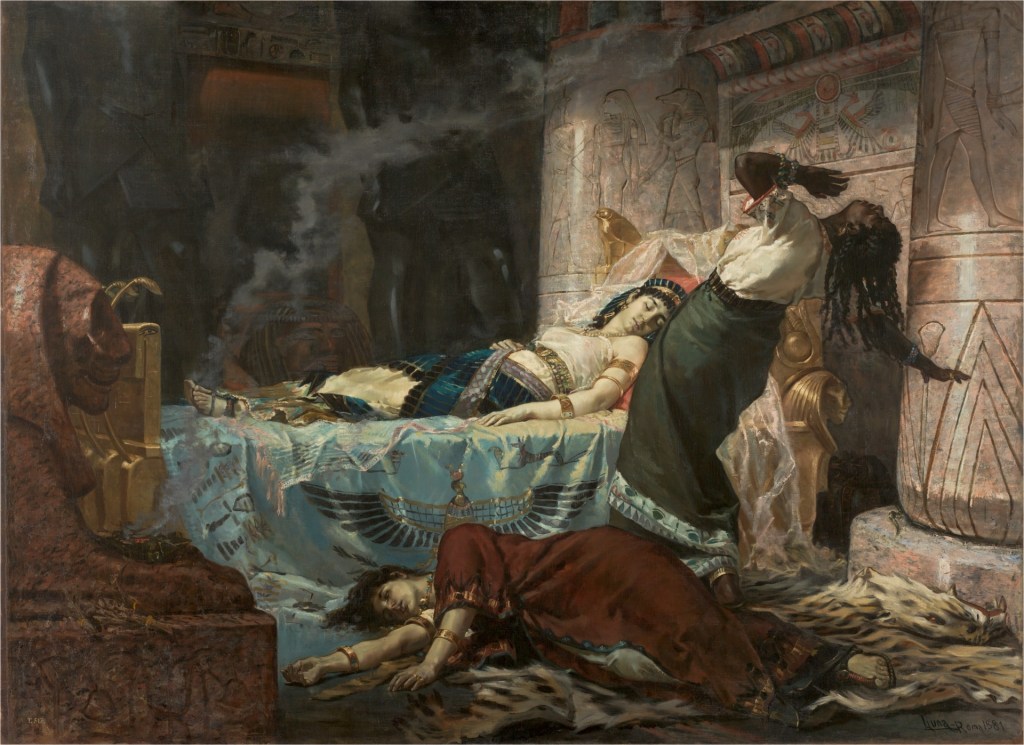
Juan Luna’s The Death of Cleopatra (1881) strikes me first for its contrast with motion and stillness. Cleopatra is already dead. Her body lies stretched across a richly adorned bed at the centre of the composition, draped in diaphanous fabric and jewellery, her torso partially exposed, her head tilted back in a pose that suggests both repose and abandonment. The flesh is carefully modelled but drained of vitality, set against the deep tonalities of the surrounding interior. At her feet lies Iras, already lifeless, while Charmion collapses beside the bed, caught at the edge of death. The asp, the supposed agent of Cleopatra’s suicide is tucked near a column, almost incidental. The room is dense with signs: hieroglyphs, canopic jars, a sphinx, the shadowy presence of Anubis. A smoking incense lamp hangs above the body, introducing a thin atmospheric veil that softens nothing so much as it settles over the scene . The composition stretches horizontally, its weight anchored in the central corpse, the subsidiary bodies reinforcing a downward pull.
When I look at the studio photograph of Luna’s setup, the painting begins to make sense in another way. The model is posed rigidly on a couch, her arm extended, her head angled back in a way that closely anticipates Cleopatra’s final posture. Around her, draped figures gather in controlled arrangements, one seated in the foreground holding a sheet, others leaning inward without expressive urgency. The lighting is concentrated, theatrical, isolating the body against a dark ground. The corpse is composed in advance and organizes the rest of the elements through pose, light, and the suspension of movement.
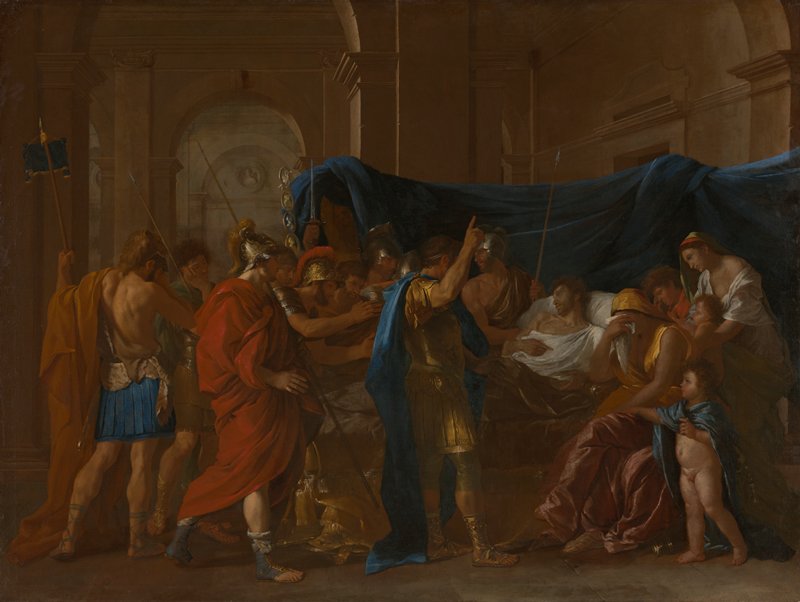
Nicolas Poussin, The Death of Germanicus (La Mort de Germanicus), 1627. Oil on canvas, 148 × 198 cm (58.25 × 78 in). Minneapolis Institute of Art, The William Hood Dunwoody Fund (inv. 58.28).
This places Luna at a distance from the Baroque model set by The Death of Germanicus by Nicolas Poussin. In Poussin’s painting, Germanicus is hanging on to life by a thin thread and the figures around him carry the scene. Their gestures—raised arms, inclined heads, clasped hands—articulate grief, loyalty, and restraint. The composition compresses them into a shallow foreground, where each body participates in a shared emotional field. From looking at many of Poussin’s paintings, I learned to read the event through the reactions of others. The painting teaches me how to respond.
Luna removes that structure entirely. There is no exchange of gestures, no distribution of feeling, no instruction. The figures around Cleopatra do not respond to her death; they are absorbed into it.

I find Luna closer to Jean-Baptiste Regnault’s Death of Cleopatra, where the action has already ended. Regnault presents Cleopatra and her attendants as inert bodies, their pale flesh rendered in a “bleak incarnate” that gives them a stony, immobilized quality. The asp is pushed aside, and no figure registers grief. The composition reads as a fixed tableau that emphasizes rather than explains. Observe how Cleopatra’s arm, hanging down, recalls The Death of Marat, aligning the image with a broader visual language of resignation .
Luna takes this reduction and complicates it. He keeps the stillness, the refusal of climax, the absence of response, but he does not empty the space. Instead, he fills it with textiles, objects, and architectural detail that frame the bodies without reanimating them. Where Regnault isolates the corpse, Luna encloses it. The scene becomes heavier, more saturated, but no more active.
What is left is a painting that mediates between these earlier models. It retains the compositional gravity of Poussin’s central figure but rejects his rhetoric; it adopts Regnault’s stillness but rejects his austerity. Death is neither dramatized nor moralized. It is presented as a completed state, sustained by the arrangement of bodies and the density of the space that contains them.
 Geronimo Cristobal