Originally published in The American Chamber of Commerce Journal, Vol. XVI, No.4 (April 1936)
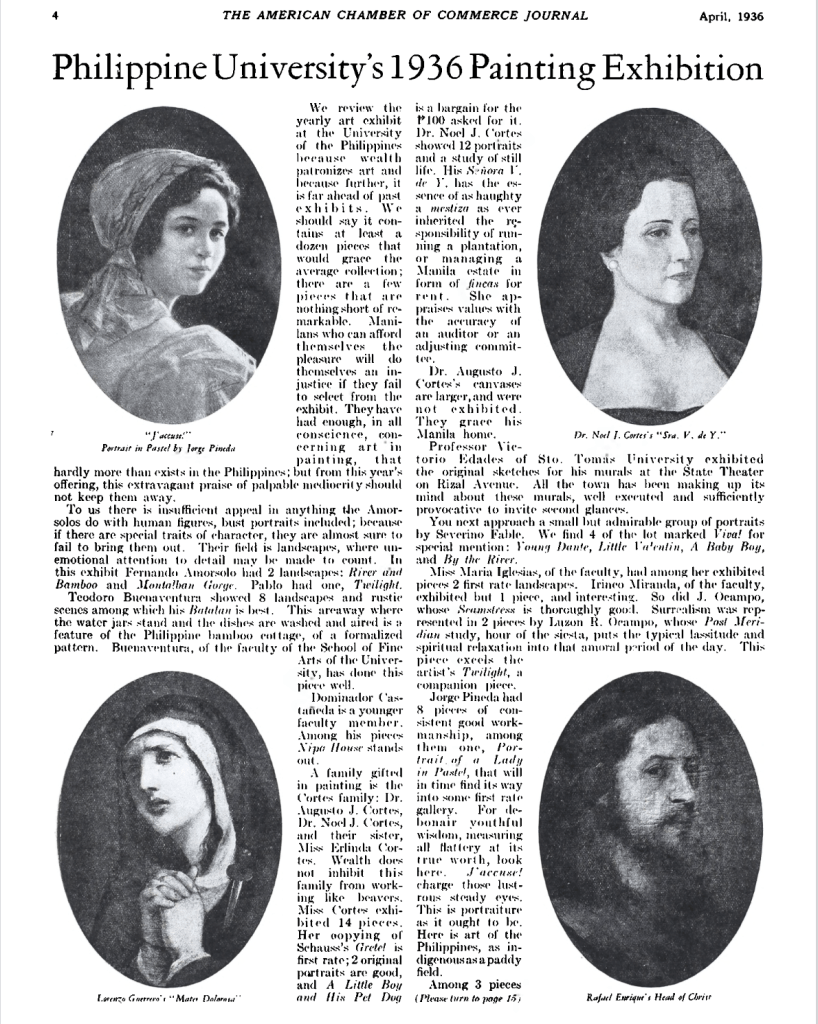
We review the yearly art exhibit at the University of the Philippines because wealth patronizes art and because, further, it is far ahead of past exhibits. We should say it contains at least a dozen pieces that would grace the average collection; there are a few pieces that are nothing short of remarkable. Manikins who can afford themselves the pleasure will do themselves an injustice if they fail to select from the exhibit. They have had enough, in all “J’accuse” conscience, concerning art in painting, that hardly more than exists in the Philippines; but from this year’s offering, this extravagant praise of palpable mediocrity should not keep them away.
Portrait in Pastel by Jorge Pineda
To us there is insufficient appeal in anything the Amorsolos do with human figures, bust portraits included; because if there are special traits of character, they are almost sure to fail to bring them out. Their field is landscapes, where unemotional attention to detail may be made to count. In this exhibit Fernando Amorsolo had 2 landscapes: River and Bamboo and Montalban Gorge. Pablo had one, Twilight.
Teodoro Buenaventura showed 8 landscapes and rustic scenes among which his Balaian is best. This areaway where the water jars stand and the dishes are washed and aired is a feature of the Philippine bamboo cottage, of a formalized pattern. Buenaventura, of the faculty of the School of Fine Arts of the University, has done this piece well.
Dominador Castaneda is a younger faculty member. Among his pieces Nipa House stands out.
A family gifted in painting is the Cortes family: Dr. Augusto J. Cortes, Dr. Noel J. Cortes, and their sister, Miss Erlinda Cortes. Wealth does not inhibit this family from working like beavers. Miss Cortes exhibited 14 pieces. Her copying of Schauss’s Crete! is first rate; 2 original portraits are good, and A Little Boy and His Pet Dog is a bargain for the P100 asked for it.
Dr. Noel J. Cortes showed 12 portraits and a study of still life. His Señora V. de Y. has the essence of as haughty a mestizo as ever inherited the responsibility of running a plantation, or managing a Manila estate in form of fincas for rent. She appraises values with the accuracy of an auditor or an adjusting committee.
Dr. Augusto J. Cortes’s canvases are larger, and were not exhibited. They grace his Manila home.
Professor Victorio Edades of Sto. Tomas University exhibited the original sketches for his murals at the State Theater on Rizal Avenue. All the town has been making up its mind about these murals, well executed and sufficiently provocative to invite second glances.
You next approach a small but admirable group of portraits by Severino Fabie. We find 4 of the lot marked Viva! for special mention: Young Dante, Little Valentin, A Baby Boy, and By the River.
Miss Maria Iglesias, of the faculty, had among her exhibited pieces 2 first-rate landscapes. Irineo Miranda, of the faculty, exhibited but 1 piece, and interesting. So did J. Ocampo, whose Seamstress is thoroughly good.
Surrealism was represented in 2 pieces by Luzon R. Ocampo, whose Post Meridian study, hour of the siesta, puts the typical lassitude and spiritual relaxation into that amoral period of the day. This piece excels the artist’s Twilight, a companion piece.
Jorge Pineda had 8 pieces of consistent good workmanship, among them one, Portrait of a Lady in Pastel, that will in time find its way into some first-rate gallery. For debonair youthful wisdom, measuring all flattery at its true worth, look here. J’accuse! charge those lustrous steady eyes. This is portraiture as it ought to be. Here is art of the Philippines, as indigenous as a paddy field.
Among 3 pieces Director Fabian de la Rosa of the fine-arts school exhibited; his landscape Stone Wall is acceptably well done.
Eduardo Salgado, a graduate of the school, does not price the best of his 5 pieces, a girl stringing sampaguita rosaries.
Rodolfo Yee, Chinese, another graduate of the school, had a landscape, Isla de Balut, and a portrait study of a Chinese girl; neither merits a second glance, but both show that the artist may do something later, in the free informal manner his native culture does not permit, that may be worth while.
The work of deceased artists was exhibited: Fortunato Basco, Lorenzo Guerrero, Miguel Zaragoza, Rafael Enriquez, the school’s first director. Enriquez’s Head of Christ, essentially secular—Christ the philosopher, Christ companioned by simple fishermen, Christ not yet written of by Paul—is superbly done. One critic (we reproduce the picture) believes the eyes very cold. Why shouldn’t they be? Why shouldn’t Christ’s eyes have been contemptuously cold when Pharisees honeyed round him? Would not a dozen situations in the world today, his Christian world, make his eyes cold and contemptuous again?
To us the eyes are not cold, but uncomfortably penetrating. The heart was never broken; final seizure was not a surprise; the mind knew all along the frailty of human nature, and this knowledge made the heart invincibly strong.
Miss Purita Kalaw, Ann Arbor graduate, exhibited a few naive studies, but more interesting than these, a bit of batik painting on silk. A wood carving varied her little exhibit.
Given the fact that freedom of expression in painting is so recent in the Philippines, the University does really well in being able to show so much, with so many pieces available for purchase. As a lot, the 5 Guerrero pieces top the exhibition: colors rich and soft enough to match the difficult subjects: The Tempest, Mater Dolorosa, A Fire, The Estuary, Moonlit Night. In A Fire all the details of a bamboo village in the sudden throes of such tragedy appear—on a small canvas.
— JEIC
 Geronimo Cristobal