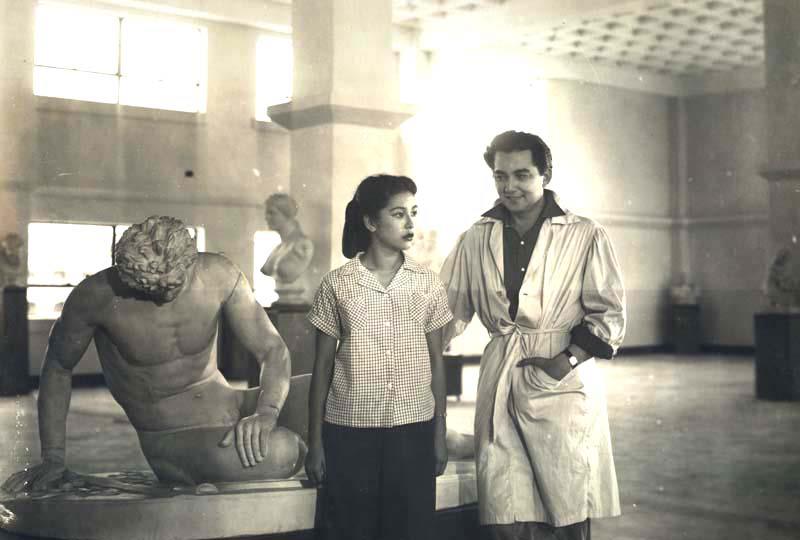
The image above is a film still from Babaing Hampas-Lupa (1952), an LVN Pictures melodrama written and directed by Nemesio E. Caravana and photographed by Raymond Lacap. The image shows Nida Blanca and Rogelio de la Rosa standing beside a plaster cast of the Dying Gaul inside the galleries of the University of the Philippines College of Fine Arts, then located on the third floor of the UP Main Library (Gonzalez Hall) in Quezon City. The sculpture is one of the most famous survivals of Hellenistic art, known from a Roman marble copy now in the Capitoline Museums. It depicts a defeated Gallic warrior collapsing from a mortal wound, identifiable by the torc around his neck and the tense, sinking posture of the body. Plaster casts of this work circulated widely in academic collections and were standard study models in art schools across Europe and the United States, including the Philippines.
The still was part of the collection of the distinguished cinematographer and film historian Cesar Hernando (1946–2019), who served as production designer to Mike de Leon, Lav Diaz and Raymond Red. In the early years of the Diliman campus, the School of Fine Arts occupied gallery-like rooms in the Main Library filled with plaster casts of Greco-Roman sculpture used for drawing instruction. Postwar studios such as LVN Pictures frequently filmed in real institutions, both for practical reasons and for the aura of refinement such spaces conveyed on screen.
Its rare to see such authenticity in popular melodramas nowadays so its real a treat to marvel at the faces and bodies of young film stars momentarily sharing the frame with the canonical forms that shaped the training of generations of Filipino artists.
In October 2026 I will present a paper at the Warburg Institute conference “Civilizing the World: Classicism, Neo-Classical Sculpture, and Plaster Casts in the Service of Imperial Powers and Post-Colonial Elites (1780–1945)”, organized by with the Institute of Classical Studies and the University of Reading Department of Classics. My presentation, The Small Museum of Empire: Plaster Casts and Artistic Formation in Colonial Manila, reconstructs the history of the plaster cast collection assembled for Manila’s Escuela or Academia de Dibujo y Pintura and later the University of the Philippines School of Fine Arts. Drawing on archival orders, photographs, and institutional records, the paper traces how casts of canonical sculptures such as the Laocoön, the Apollo Belvedere, Antinous and Medici types, and the Venus were imported from Spain and installed in Manila beginning with an 1849 plan for a “small museum.” Modeled on the pedagogical system of the Real Academia de Bellas Artes de San Fernando, these objects disciplined artistic vision through copying, proportion, and anatomical study. I argue that this cast collection materialized a colonial program of aesthetic governance whose forms were later appropriated by Filipino artists and institutions, leaving behind a rare record of how classical models were standardized, taught, and reinterpreted in Manila.
 Geronimo Cristobal