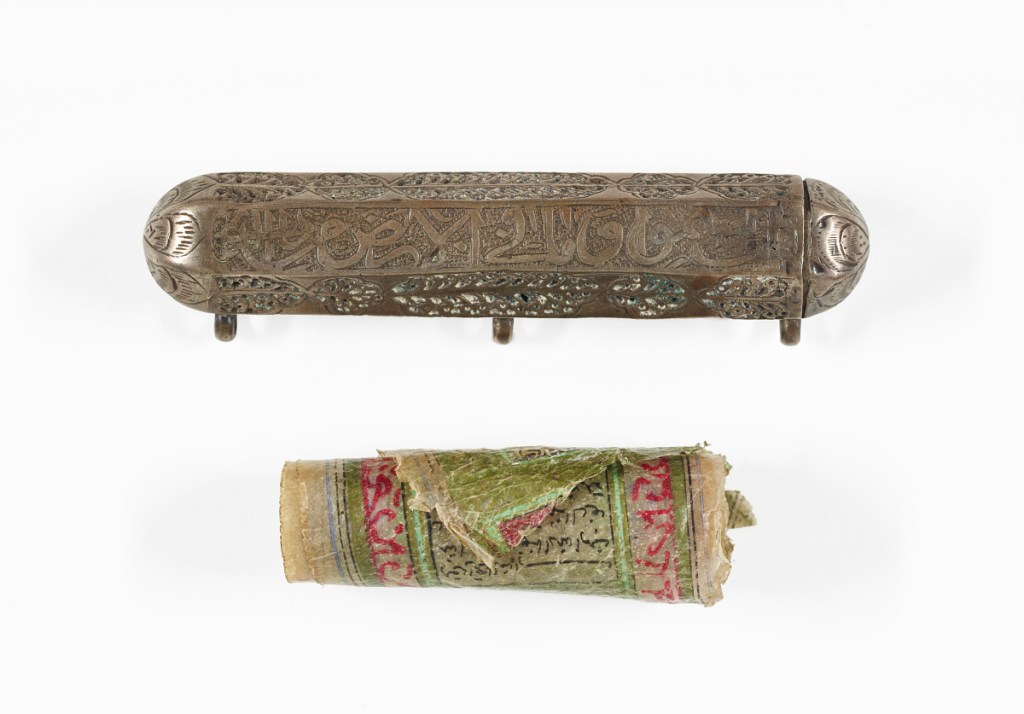
An amulet for Qur’anic prayer scrolls: silver plated over brass. Rounded ends, six sided with raised decorations and Arabic writing. Cap on end. Three loops for a chain or suspension.
Qur’anic prayer scroll from amulet: rolled semi-transparent parchment, fine black writing of prayers and talismanic numerals with color borders and border inscriptions.
This nineteenth-century Iranian amulet consists of a metal case and a tightly rolled Qurʾānic prayer scroll preserved inside it (National Museum of Asian Art, Accession S2018.6a–c). The container, made of silver plated over a copper alloy, measures approximately 1.9 × 7.6 × 1.5 cm and has a six-sided body with rounded ends. One end opens through a removable cap that allows the parchment scroll to be inserted. Three small loops attached to the exterior indicate that the object was meant to be suspended from a chain or cord and worn on the body.
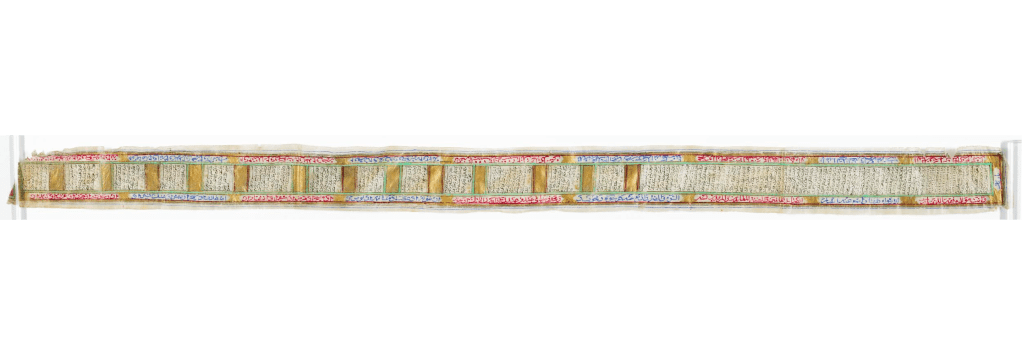
An amulet for Qur’anic prayer scrolls: silver plated over brass. Rounded ends, six sided with raised decorations and Arabic writing. Cap on end. Three loops for a chain or suspension.
Qur’anic prayer scroll from amulet: rolled semi-transparent parchment, fine black writing of prayers and talismanic numerals with color borders and border inscriptions.
Raised ornament and Arabic inscriptions decorate the surface of the case. These inscriptions likely contain Qurʾānic verses or protective formulas commonly used in talismanic objects. The metalwork belongs to the Qajar period (1779–1925), when such portable amulets circulated widely in Iran and across the Islamic world.
Inside the case is a rolled prayer scroll written on semi-transparent parchment. The text is executed in fine black ink and framed with coloured borders enriched with gold. Alongside Qurʾānic passages and supplicatory prayers appear talismanic numerals and decorative border inscriptions. These numerals correspond to systems of letter–number equivalence used in Islamic occult sciences, where Qurʾānic words and divine names could be translated into numerical configurations believed to carry protective power.
Once rolled and sealed within the metal container, the scroll was rarely opened again. Its function was not primarily to be read but to remain close to the body, where the presence of sacred text was believed to provide protection and blessing (baraka). Such amulets were commonly worn during travel, illness, or other moments of vulnerability.
The object combines calligraphy, manuscript production, and metalwork. A scribe prepared the parchment scroll with Qurʾānic verses and talismanic diagrams, while a metalsmith fabricated the decorated container that housed and protected it. Together they form a portable devotional object in which sacred writing, material craftsmanship, and bodily adornment converge.
 Geronimo Cristobal