Jacques Derrida’s La vérité en peinture (The Truth in Painting), published by Flammarion in 1978, gathers a set of essays that rethink the relation between philosophy and the visual arts. The title, borrowed from a remark by Paul Cézanne, signals the provocation at the heart of the book: if painting is said to bear or reveal truth, where does that truth reside? In the image itself, in its material support, in the discourse that surrounds it, or in the philosophical systems that claim to interpret it?
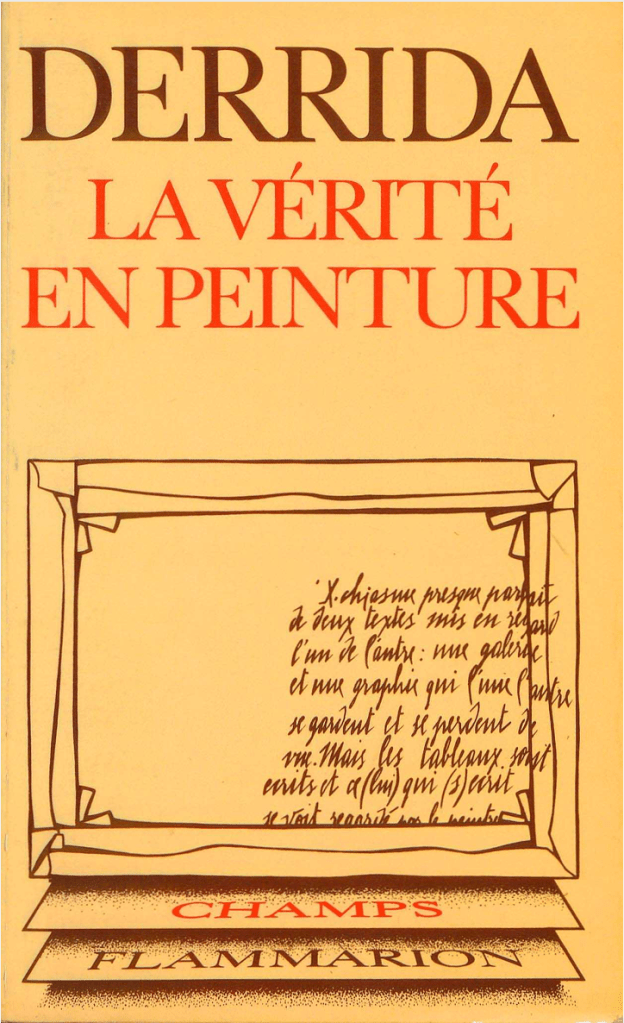
The volume is composed of four principal parts: “Parergon,” “+R,” “Cartouches,” and “Restitutions — of truth in shoe size.” The middle essays engage contemporary artists (Valerio Adami and Gérard Titus-Carmel), while the final section addresses Martin Heidegger’s reading of Van Gogh’s painting of shoes, especially in light of Meyer Schapiro’s critique. Yet it is the opening essay, “Parergon,” that has exerted the most lasting influence on aesthetics and art history.
Derrida begins by situating aesthetics within the systematic ambitions of philosophy, notably in Hegel. Art, in Hegel’s account, belongs to an encyclopedic order of knowledge; it is granted a place within a structured totality. Derrida then turns to Kant’s Critique of Judgment, where the concept of the parergon—literally “beside the work”—appears. Kant uses the term to designate elements such as frames, drapery on statues, or architectural columns: features that are not part of the work’s essential form but nonetheless contribute to aesthetic pleasure.
What appears marginal becomes decisive. A frame is not the painting, yet it conditions how the painting is seen. Drapery is not the statue’s body, yet it shapes its presentation. Derrida insists that the parergon cannot be cleanly separated from the work (ergon). It occupies a threshold position, neither simply outside nor fully inside. Philosophy traditionally attempts to isolate the essential from the ornamental, the intrinsic from the supplementary. The parergon troubles this distinction. What is treated as accessory proves structurally necessary; the “outside” operates within.
This argument extends to Kant’s broader critical project. Kant distinguishes aesthetic judgment from cognition and morality, identifying in beauty a “purposiveness without purpose.” Derrida lingers over Kant’s examples, including the tulip, whose form appears ordered and purposive without serving a determinate end. Beauty emerges from this encounter with formal organization detached from utility. Yet the very language of purposiveness suggests a tension: form intimates meaning, but meaning does not resolve into concept. The aesthetic judgment depends on a structure that both invokes and suspends purpose.
In the final section of “Parergon,” Derrida examines Kant’s account of the sublime. He draws attention to the etymological and conceptual play between column and colossus. The column, associated with architectural framing, belongs to the realm of measured addition; it can be understood as a parergon, supplementing and articulating the work. The colossus, by contrast, points toward excess and the immeasurable. Kant describes the sublime in terms of enormity, monstrosity, and magnitude that strains representation. Derrida emphasizes that the colossal is not merely a large object but the presentation of something that exceeds proportion and conceptual grasp. The distinction between beautiful and sublime thus reiterates the problem of measure and limit that the parergon had already exposed.
The closing essay, “Restitutions,” turns to Heidegger’s interpretation of Van Gogh’s painting of shoes in The Origin of the Work of Art. Heidegger famously claimed that the painting discloses the world of the peasant woman who wore the shoes; Meyer Schapiro later objected that the shoes were likely Van Gogh’s own and criticized Heidegger for projecting a rural narrative onto the canvas. Derrida does not adjudicate the dispute. Instead, he examines the interpretive gesture itself—the desire to assign origin, ownership, and truth to the painted object. The debate becomes a case study in framing: how philosophical discourse situates the artwork within a narrative that claims to reveal its essence.
Throughout The Truth in Painting, Derrida refrains from offering a positive aesthetic theory. Rather, he exposes the instability of the distinctions that structure philosophical reflection on art: inside and outside, essential and ornamental, work and frame, beauty and sublimity, object and interpretation. The book demonstrates that what is dismissed as marginal—frames, supplements, contextual discourse—cannot be excluded without remainder. They participate in the work’s operation and in the production of its “truth.”
The question posed by the title thus remains deliberately unsettled. Truth in painting is neither secured within the canvas nor reducible to external commentary. It emerges at the threshold where work and frame, image and discourse, interior and exterior intersect. In tracing these thresholds, Derrida reshaped the terms in which aesthetic philosophy and art history continue to think about the conditions of representation.
 Geronimo Cristobal