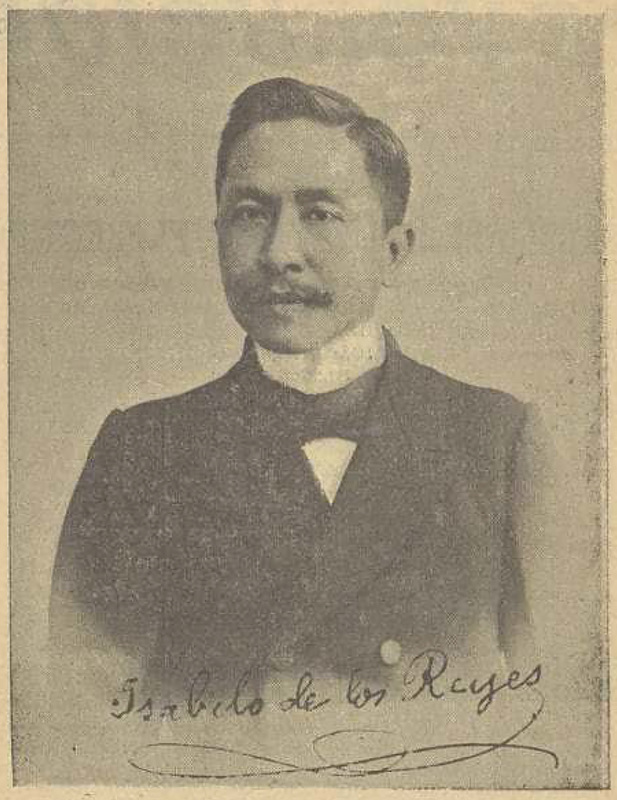
Isabelo de los Reyes was born on July 7, 1864 in Vigan, Ilocos Sur, the son of the Ilocana poet Leona Florentino. He was raised for a time under the care of his uncle, a lawyer and member of Ilocos’ literary circle. At sixteen, without his uncle’s consent, he left for Manila. He studied at the Colegio de San Juan de Letran, completing his bachelor’s degree with honors in 1883, and later finished law at the University of Santo Tomas in 1887. As a teenager he worked for a Spanish-language newspaper under José Felipe del Pan, who introduced him to folklore studies.
De los Reyes wrote in Spanish and Ilocano. In 1889 he founded El Ilocano, considered the first vernacular newspaper in the Philippines, circulated across twelve provinces in Luzon. His writings covered ethnography, history, religion, and social commentary. At age twenty he published in a Spanish folklore journal and gained recognition as a serious scholar. He corresponded with Ferdinand Blumentritt, whose translations of his work appeared in Vienna. In 1889 his El Folk-Lore Filipino received a silver medal at the Madrid Exposición Filipina.
His major works include Ilocanadas (1887), Filipinas: Articulos varios sobre ethnografia, historia y costumbres del pais (1887), Las Islas Visayas en la epoca de la conquista (1889), Prehistoria de Filipinas (1889), the two-volume Historia de Ilocos (1890), Ang Comediang Tagalog (1904), and Religion Antigua de los Filipinos (1909).
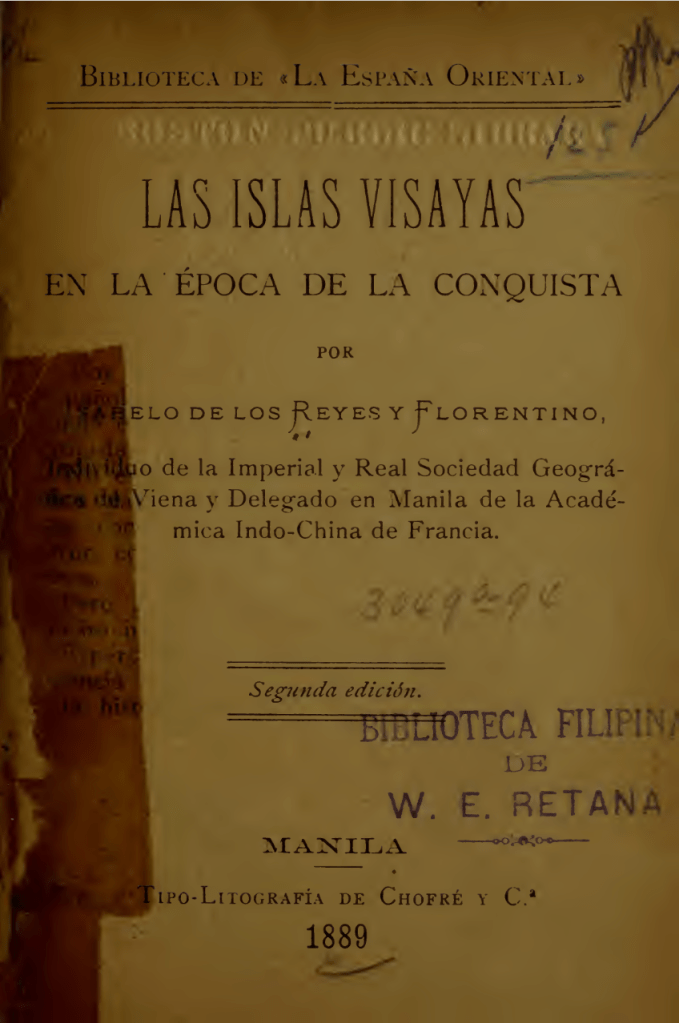
Published in 1889 in time for Spain’s participation in the Exposition Universelle in Paris, Las Islas Visayas presents a documented reconstruction of Visayan society at the time of Spanish contact. Isabelo de los Reyes bases his account on early chroniclers and limits conjecture. He avoids exaggerated claims and states clearly that it is sufficient to recognize that non-Negrito Filipinos are of Malay filiation, while it is “muy aventurado determinar de qué isla procedieron” (De los Reyes 1889, 70–71). He rejects attempts to assign precise island origins and instead grounds his argument in linguistic and comparative evidence. This methodological caution reinforces his central claim: Visayans belong to the Malay world.
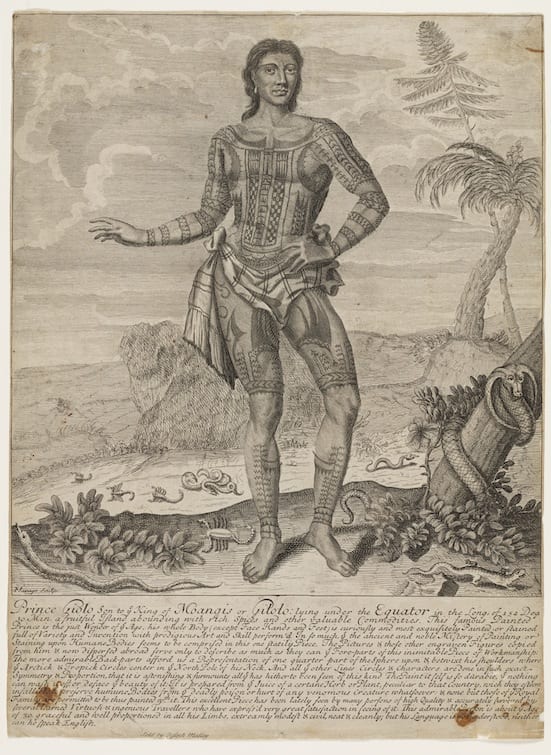
He uses comparative ethnography to support this position. In discussing tattooing, he cites Polynesian practices: “Los polinesios… se tatúan formando líneas y pintándose con colores vivos; arráncanse los pelos, se rasuran parte de la cabeza…” (De los Reyes 1889, 2). He treats these similarities as indicators of broader Austronesian connections. He then defines linguistic kinship in structural terms: “Se llaman dialectos parientes… los que entre sí tienen grandísima semejanza en la terminología y en su gramática, como el visaya y el malayo” (De los Reyes 1889, 2). He relies on grammar and vocabulary, not anecdote, to argue for Malay affiliation.
He also addresses claims that the Visayans originated specifically from Macassar. He records that “El cronista P. Colin asevera haber oído que los visayas deben haber venido de Macasar…” (De los Reyes 1889, 70), but he does not accept this as definitive proof. He argues that environmental conditions produce variation within shared lineage: “Es indudable que las circunstancias del lugar… impriman en él ciertos rasgos… aunque fuesen de una misma filiación” (De los Reyes 1889, 70). Physical differences do not negate common descent.
Throughout the book, he documents social classes, tribute systems, warfare, trade, gold extraction, and indigenous writing. He treats cosmogony and ritual as organized systems rather than superstition. By compiling these details from Spanish sources and arranging them systematically, he demonstrates that precolonial Visayan society possessed political hierarchy, economic structure, religious practice, and linguistic coherence. His argument remains consistent: Visayans formed part of a broader Malay cultural and linguistic sphere, and historical analysis must rest on documented evidence rather than speculation.In El Folk-Lore Filipino, he described religious festivals, anitos, and place names not found on official maps. He treated folklore as living knowledge, not as relics. He compared Filipino customs with European ones and argued that some “superstitions” attributed to natives may have been introduced by Spaniards. He emphasized local knowledge of flora, medicine, and climate and argued that such knowledge could contribute to modern science.
Scholars have interpreted Las Islas Visayas within the broader emergence of Filipino historical and ethnographic writing in the late nineteenth century. Resil B. Mojares argues that Isabelo de los Reyes worked consciously to assemble and systematize colonial materials in order to produce a Filipino-centered archive, using Spanish sources to reconstruct indigenous societies and assert intellectual agency (Mojares 2006, 45–50). Mojares situates Las Islas Visayas alongside Historia de Ilocos and El Folk-Lore Filipino as part of a sustained effort to write local histories that challenged colonial epistemic authority. Erlinda K. Bragado likewise emphasizes that de los Reyes engaged European ethnology critically rather than passively, drawing on comparative linguistics and anthropology while foregrounding Filipino knowledge systems (Bragado 2007, 102–110). She notes that his discussions of Malay filiation, language, and custom reveal an attempt to validate indigenous culture within contemporary scientific discourse. Both studies support the view that Las Islas Visayas was not merely antiquarian but formed part of a deliberate intellectual project to document precolonial society and contribute to the formation of a Filipino historical consciousness (Mojares 2006, 50; Bragado 2007, 110).
De los Reyes understood the link between knowledge production and colonial authority. He wrote as a lawyer annotating Spanish legislation. He defended the comedia as a Filipino art form. He engaged Western ethnology while maintaining a critical stance toward it. Proud of his Ilocano origins, he referred to himself as “hermano de los selvaticos, aetas, igorrotes y tinguianes.” His comparative folklore work sought to bridge divisions between lowland Christian Filipinos and upland or so-called “tribal” communities.
His life was also political. He owned a printing press, formed political parties, campaigned for representation and independence, and helped establish the Iglesia Filipina Independiente in 1902. The same year he organized the Unión Obrera Democrática, the first Philippine labor federation inspired by socialist principles. Imprisoned in Bilibid in 1898 on suspicion of subversion, he gathered materials on the Katipunan and later completed Memoria sobre la Revolucion. Deported to Montjuich Castle in Barcelona, he continued collecting information among Spanish anarchists and labor leaders. He later became a Manila councilor and a senator. He married three times and had twenty-seven children. He died in 1938.
His exchange with José Rizal over Rizal’s annotations of Morga revealed differences in historical interpretation. De los Reyes criticized what he saw as Rizal’s excessive patriotism and lack of impartiality. Rizal replied sharply, objecting in particular to de los Reyes’ use of the Ilocano term agturay for Morga’s “principales.” Scholars have noted that this debate reflected broader differences in approach. Rizal tended toward a more Tagalog-centered national narrative. De los Reyes emphasized ethnological plurality and regional knowledge. Both linked scholarship to national purpose, but they advanced different emphases in defining the nation.
Bibliography
Anderson, Benedict. 2004. “The Rooster’s Egg: Pioneering World Folklore in the Philippines.” In Debating World Literature, edited by Christopher Prendergast, 197–213. London: Verso.
Bragado, Erlinda K. 2007. “Revisiting Isabelo de los Reyes: Ethnography, History, and Cultural Discourse.” Philippine Studies 55 (3): 98–124.
De los Reyes, Isabelo. Las Islas Visayas en la época de la conquista. 2nd ed. Biblioteca de la España Oriental. Manila: Tipografía-Litografía de Chofré y Compañía, 1889.
Kramer, Paul. 1998. “Folklore, Science and Filibusterismo Between Empires, 1879–1901.” In The Philippine Revolution and Beyond, Vol. 2, edited by Elmer A. Ordoñez, 1026–1033. Manila: Philippine Centennial Commission and National Commission on Culture and the Arts.
Mojares, Resil. 2006. Brains of the Nation: Pedro Paterno, T.H. Pardo de Tavera, Isabelo de los Reyes and the Production of Modern Knowledge. Quezon City: Ateneo de Manila University Press.
Mojares, Resil B. 2006. “Isabelo de los Reyes’s Archive and the Formation of Philippine Studies.” The Cordillera Review 1 (1): 41–68.
Ocampo, Ambeth R. 1998. “Rizal’s Morga and Views of Philippine History.” Philippine Studies 46 (Second Quarter): 184–214.
 Geronimo Cristobal