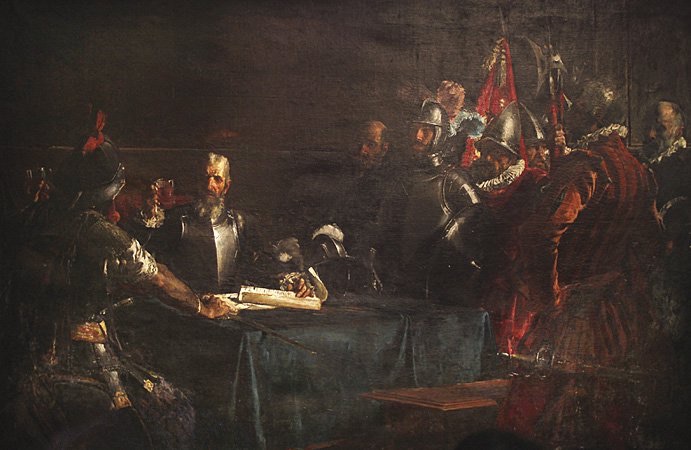
Juan Luna, The Blood Compact (El Pacto de Sangre / Ang Sanduguan), 1886, Malacañang Palace.
I reread Filomeno Aguilar’s essay on the pacto de sangre, and it reminded me how often Luna’s painting is still described as a straightforward image of uneven relations between Spaniards and indigenous leaders. Even the encyclopedia article by Santiago Pilar echoes this. That reading treats the canvas as if it were meant to function like a photographic document rather than a work intended for late-19th century viewers who understood images through academic conventions. Aguilar notes that Marcelo del Pilar read the compact as a contract of equality, and I think Del Pilar’s interpretation aligns with how Luna’s painting actually operates.
Luna had mastered the visual vocabulary associated with Géricault and Delacroix, whose works were central to the training of his professors. Géricault used back-facing bodies to draw viewers into the scene, and Delacroix often placed figures from behind to act as spectator-participants. German Romantics perfected this device: the Rückenfigur. Luna uses it clearly in España y Filipinas, where the European woman and the Filipina are seen from behind, guiding the viewer’s upward gaze along what seems to be a stairway to heaven.
Read through this visual language, Sikatuna’s partially turned back in Pacto de sangre is not the representation of an inferior party. Luna positions him as the viewer’s surrogate placing their perspective at his side of the table and directing our attention along his extended arm toward the compact. This compositional choice would have been immediately legible to nineteenth-century spectators. It was, after all, a painting commissioned by the City of Manila. Luna, perhaps with some irony, depicted a scene that did not take place in Manila but in Bohol, where Sikatuna was chieftain.
 Geronimo Cristobal