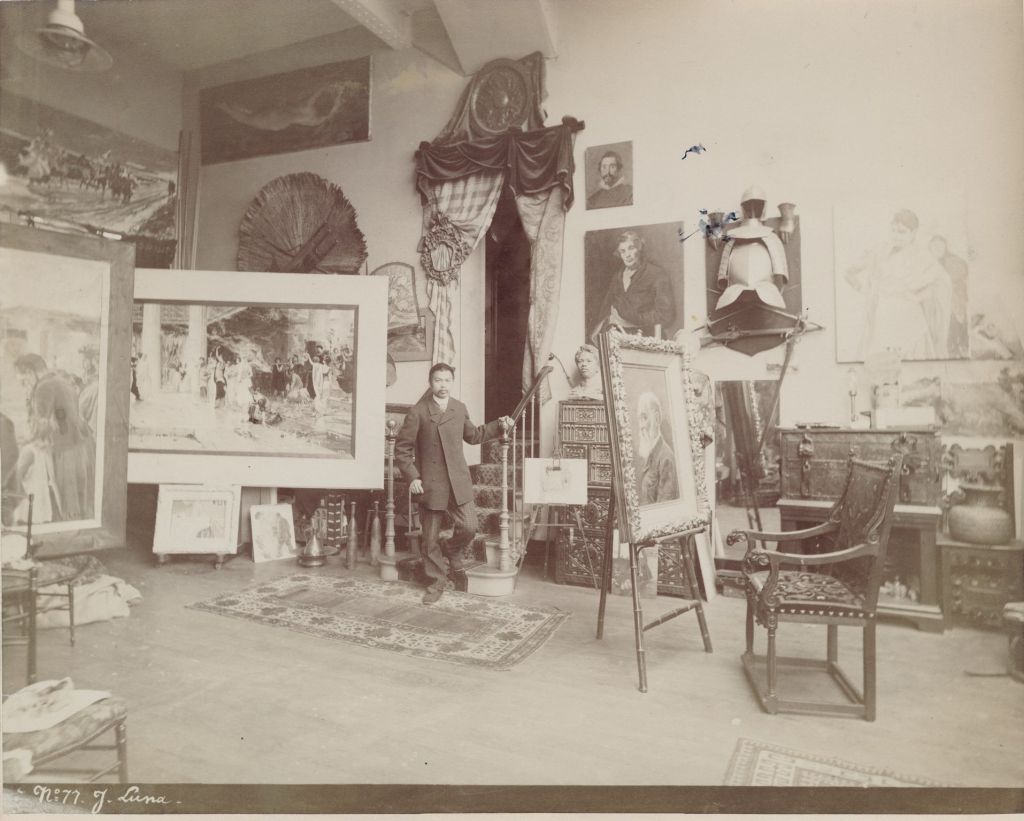
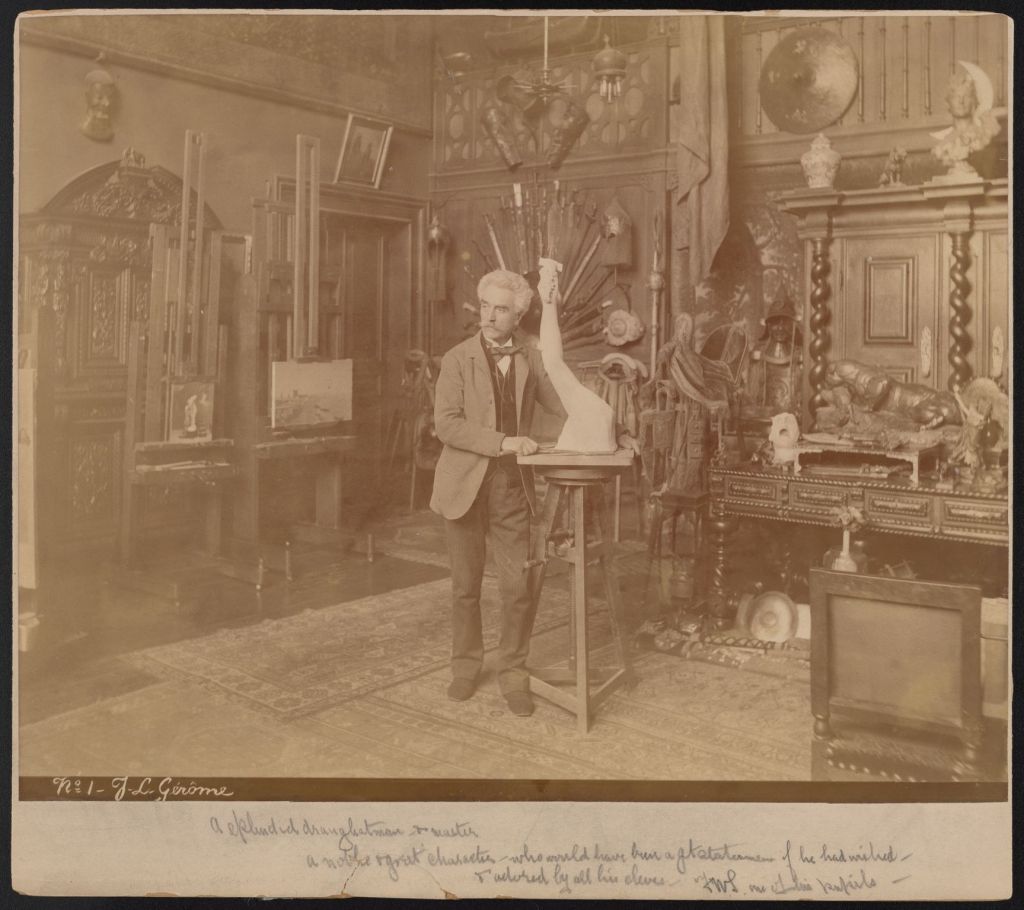
For a long time, art historians have speculated about Juan Luna’s larger network of artists in Paris, including the extent to which he moved within the academic orbit of Jean-Léon Gérôme, the towering figure of French Orientalism. Gérôme’s pedagogical influence has often been inferred through stylistic parallels and early biographical testimony, yet documentary anchors have remained thin. Recently, however, a digitized album from the Frick Art Reference Library’s Photographs of Artists in Their Studios—a collection of seventy-four albumen prints assembled by the American artist Frank W. Stokes between 1887 and 1892—offers an unexpected point of contact. Luna and Gérôme appear in the same album, photographed in their respective studios during precisely the years when Luna was working in Paris. Though the images do not prove direct mentorship, their inclusion within the same tightly curated network of artists—many of them Stokes’s instructors, colleagues, and acquaintances at the École nationale supérieure des Beaux-Arts—suggests that Luna occupied a far more integrated position within the Paris art world than Philippine historiography has previously emphasized.
The album places Juan Luna alongside several leading figures of the late nineteenth-century Paris art world. Léon Bonnat (1833–1922) was a prominent French painter and teacher who became a professor, then director of the École des Beaux-Arts, and was known especially for his official portraits. Jules Lefebvre (1836–1911) and Tony Robert-Fleury (1837–1911) both taught at the Académie Julian, where they instructed large numbers of French and foreign students, including many women; Lefebvre was noted for idealized figure painting, while Robert-Fleury was associated with history painting and institutional leadership at the school. Jean-Paul Laurens (1838–1921) gained recognition for large-scale historical and religious canvases and held important teaching positions in Paris. Benjamin-Constant (1845–1902) was a French painter identified with Orientalist subjects who achieved substantial success at the Salon and in international exhibitions. Mihály Munkácsy (1844–1900), a Hungarian painter based in Paris, became known for his large genre and biblical compositions that attracted critical and commercial attention across Europe. Emmanuel Frémiet (1824–1910) and Louis-Ernest Barrias (1841–1905) were both leading sculptors of the period, responsible for public monuments and official commissions in France. That Luna’s studio portrait appears in the same album as these artists indicates that he was recorded within the same documentary project that captured central academic, Salon, and public-art practitioners in Paris in the 1880s–1890s.

The photographs of Luna and Gérôme, themselves underscore this resonance. Luna is pictured in his studio at the Villa Dupont between 1890 and 1892, surrounded by large-scale historical canvases, Greco-Roman scenes, academic props, armour, and ethnographic objects—the visual vocabulary of an artist steeped in the narrative and archaeological language of the Salon. Gérôme, photographed in his richly appointed studio, stands beside a sculptural model, with walls crowded by Ottoman arms, classical casts, and Orientalist décor, all elements that defined both his work and the highly codified academic approach he imparted to his students. The theatrical staging of Luna’s studio interior, the archaeological props echoes Gérôme’s world more closely than earlier nationalist readings of Luna have allowed. While the photograph does not prove personal intimacy or regular instruction, the visual alignment is striking, and Frank Stokes’s organizational logic for the album (interweaving mentors, acquaintances, and admired studio-owners) strengthens the possibility that Luna and Gérôme shared more than just an artistic vocabulary.
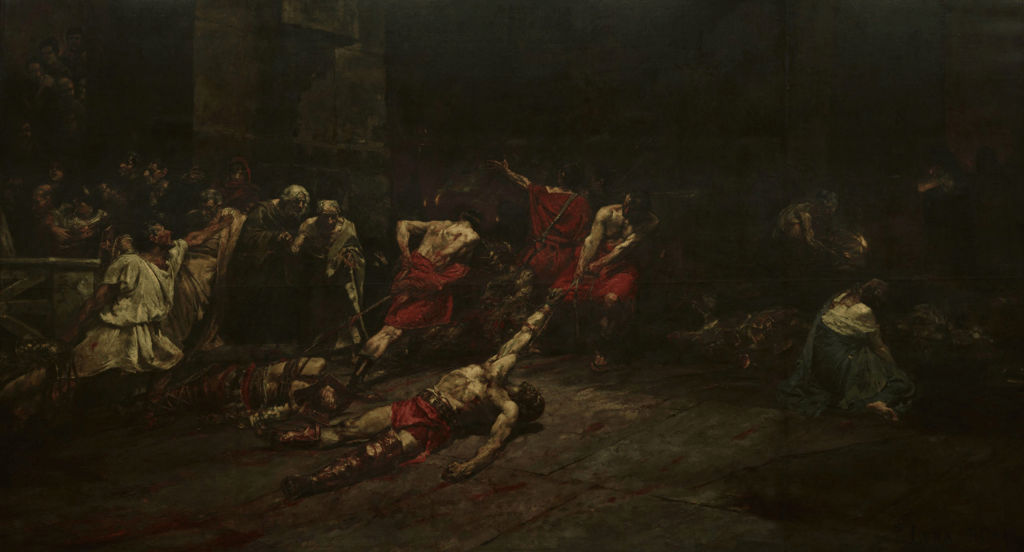
Another way to establish the connection is through a visual comparison. Jean-Léon Gérôme’s Pollice verso (1872) became one of the most influential nineteenth-century images of Roman gladiatorial spectacle. Other art historians have argued how later artists and audiences visualized the arena’s violence and choreography through this specific painting. Its combination of archaeological detail, staged aftermath, and the central motif of defeated bodies hauled across the arena floor established a compositional format that later history painters readily recognized. When Juan Luna developed Spoliarium (1884), he worked within this established academic template: the large-scale horizontal layout, focus on the removal of corpses, and reconstruction of Roman setting all resonate with the visual vocabulary Gérôme had already popularized. Gérôme’s painting thus functioned as a precedent which helps explain why Spoliarium was immediately legible to Salon audiences attuned to Gérôme’s format.

This rediscovered piece of evidence helps deprovincialize the study of Juan Luna. Instead of isolating him within narratives of Filipino proto-nationalism or reading his career primarily through colonial patronage and Salon competitions, a fuller account would trace his Parisian networks, the European patrons who commissioned or collected his works, and the cosmopolitan environment in which he lived and worked.
Luna relocated to Paris in 1885, setting up his studio and maintaining close contact with friends like Félix Resurrección Hidalgo, as documented in Aguilar Cruz (1975), Pilar (1980), and Storer, Chikiamco, and Hafiz (2017). During these years, he fulfilled his obligations to the Manila City Council by completing El pacto de sangre (The Blood Compact), depicting the 1565 Sandugo ritual between Datu Sikatuna of Bohol and Miguel López de Legazpi. The work, together with a full-length portrait of Legazpi, was sent to Manila in exchange for his scholarship support. At the same time, Luna’s European career peaked: his grand history canvases, painted in the Graeco-Roman idiom expected by the Salon, earned critical notice, yet letters to compatriots and allies reveal his growing dissatisfaction with academic pageantry. Rather than abandoning tradition or embracing Impressionism, he aligned himself with the progressive wing of the Paris Salon, which was beginning to question established hierarchies from within.

Seen through this expanded framework, Luna’s presence in the Frick album is deeply consequential for materializing his participation in a Parisian ecosystem populated by Gérôme, Bonnat, Lefebvre, Robert-Fleury, Laurens, Benjamin-Constant, and other arbiters of late nineteenth-century art. It illustrates that Luna did not simply work and study in Paris—he belonged there, photographed among the same artistic elite that shaped the global circulation of taste, Orientalism and academic art. The digitized album therefore opens fresh avenues for understanding Luna’s formation: as a Filipino master negotiating colonial and nationalist pressures while embedded in the most powerful artistic networks of his age.
Bibliography
Aguilar Cruz, E. 1975. Luna. Manila: Department of Public Information.
Pilar, Santiago Albano. 1980. Juan Luna: The Filipino as Painter. Pasig City: Eugenio Lopez Foundation, Inc.
Photographs of Artists in Their Studios Collection. Gift of Frank W. Stokes, 1940. Courtesy of The Frick Collection/Frick Art Reference Library Archives. Publication citation: Photographs of Artists in Their Studios Collection. The Frick Collection/Frick Art Reference Library Archives.
Storer, Russel, Clarissa Chikiamco, and Syed Muhammad Hafiz. 2017. Between Worlds: Raden Saleh and Juan Luna. Singapore: National Gallery Singapore.
 Geronimo Cristobal
Comments
One response to “Juan Luna’s French Orientalist Connection”
[…] of everyday life in antiquity, which provided visual and textual models for academic painters. In an earlier article, I suggested that the composition reflects Luna’s exposure to French Orientalist painting, which […]
LikeLike