
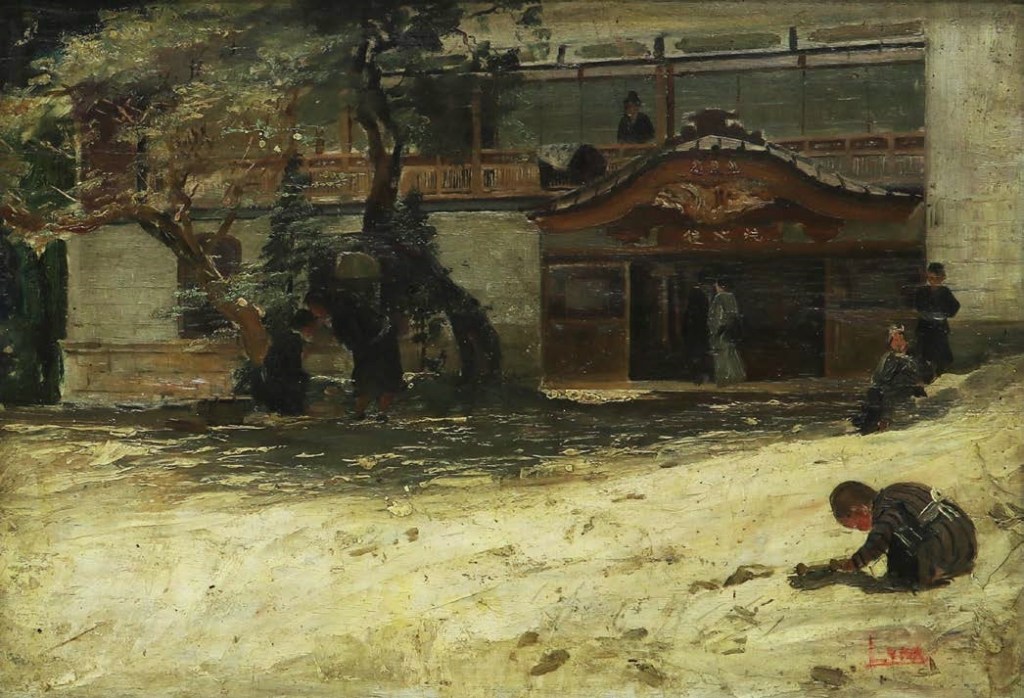
Juan Luna’s brief but productive stay in Japan in 1896 is not always discussed is scholarship even if the works he produced during those visits forms some of the most visually compelling episodes of his late career. After returning to Manila in 1894, and following a turbulent period amid the growing revolutionary climate, Luna traveled to Japan in mid-1896 with his young pupil Patricio Gaston O’Farrell and, according to several biographical sources, with his son Andrés as well. This trip occurred only weeks before the Cry of Balintawak and months before Luna’s arrest on suspicion of aiding the Katipunan revolutionaries (NCCA, In Focus: The Art of Juan Luna, 2020).
Luna produced “as many as twenty paintings in Japan,” mostly landscapes and scenes of everyday life This output is supported by a rare 44-page “Japanese sketchbook-diary” dated to 1896, once belonging to the Luna family and auctioned in Manila in 2017, which contains sketches of homes, figures, architectural details, and extensive notes on Japanese domestic objects such as tableware (Philippine Heritage Society, Movable Heritage: Luna Sketchbook, 2017). These documents confirm that Luna was observing Japan not as a tourist but as a working painter engaging closely with quotidian material culture.

The most securely documented surviving works from this period are the pair of small oil-on-wood panels. Both paintings surfaced at Claude Aguttes, Hôtel Drouot, Paris on 10 June 2015 (Lot 70) before reappearing as Lot 69 in León Gallery’s 2017 auction (Aguttes, Vente aux enchères, 2015; León Gallery, 2017 Catalogue).
One panel presents a low wooden building with an open façade and tree-shaded figures, rendered with broad strokes across an ochre foreground; the other features stone steps ascending toward a gate or small shrine—architectural motifs consistent with modest Shinto or Buddhist precincts.
These Japanese scenes are significant because they exhibit the stylistic shifts that mark Luna’s late works. Compared to the precise academic finish of Spoliarium (1884) or La Batalla de Lepanto (1887), these 1896 panels show a markedly freer, earthier brushwork. Auction notes emphasize the rough handling of paint that characterizes his post-1890 production. The close-toned palette—variously ochre, muted green, and gray—reveals how Luna used tonal subtlety rather than line to build atmospheric depth.
Art historians have compared these scenes to the softer, plein-air sensibility in Luna’s European landscape works, including Street Flower Vendors and the park studies reminiscent of Félix Hidalgo’s Bois de Boulogne (see Lopez Museum, Catalogue Notes, 2013). Yet unlike European Japonisme, which often stylized Japan through ukiyo-e flatness and ornament, Luna’s approach was observational and documentary—rooted in real spaces he visited as an Asian painter moving between uneven modern spaces.
Beyond these two panels, documentation from heritage institutions confirms that Luna produced several figure studies and landscape sketches in Japan. The aforementioned sketchbook, containing depictions of Japanese interiors and household objects, further supports a larger—though now partly missing—body of Japan-inspired works.
Luna returned to Manila later in 1896, only to be arrested and later pardoned in 1897 (NCCA 2020). After serving the Revolutionary Government abroad, he traveled again to Hong Kong in late 1899, where he suffered a fatal heart attack on 7 December 1899. His remains were later transferred to San Agustin Church in Manila in 1920 (Museo del Prado 2021).
Aguttes. Vente aux enchères: Claude Aguttes SAS, Hôtel Drouot. Paris, 10 June 2015.
Lacuata, Rose Carmelle. “Rare Rizal Sketches Come Home.” ABS-CBN News, 2017.
León Gallery. Asian Cultural Council Auction Catalogue. Manila, 18 February 2017.
Lopez Museum. Catalogue Notes: Luna and Hidalgo Collections. 2013.
Museo del Prado. “Juan Luna: Artist Biography.” Updated 2021.
National Commission for Culture and the Arts (NCCA). “In Focus: The Art of Juan Luna.” 2020.
Philippine Heritage Society. “Philippine Movable Heritage: Luna’s Japanese Sketchbook-Diary.” 2017.
 Geronimo Cristobal