
Rosa Rosal, who died today at 97, was a leading actress of the postwar studio era and one of the Philippines’ most prominent humanitarian workers. Born Florence Lansang Danon on October 16, 1928, in Manila, she was discovered by chance after the war and made her screen debut in Fort Santiago (1946) for the Nolasco Brothers Studio. She soon moved to LVN Pictures, where she became one of the studio’s central talents during the 1950s. Rosal appeared in more than 100 films over her career, including Anak Dalita (1956), directed by Lamberto V. Avellana; Badjao (1957), shot partly in Sulu and Zamboanga; Biyaya ng Lupa (1959), directed by Manuel Silos; and Sonny Boy (1955), for which she won the FAMAS Best Actress award. Known for a restrained acting style rooted in gesture and understatement, she became associated with roles that dealt with postwar poverty, rural hardship, and the emerging social-realist tendencies of Philippine cinema. She also maintained a long television career, most notably as host of Damayan, a public-service program that aired from 1969 to 1972 and again from 1975 until 2010, making her a familiar figure to viewers across several generations.

Rosal’s humanitarian work paralleled her film career. She joined the Philippine Red Cross (PRC) as a volunteer in 1950 after witnessing a child undergo an emergency blood transfusion, an experience she often cited as formative. She became a PRC governor in 1965 and spent decades promoting voluntary blood donation, helping to expand blood centers nationwide, and assisting in disaster relief and welfare operations. Her work received major recognition, including the Ramon Magsaysay Award for Public Service in 1999 and later the Order of the Golden Heart (Grand Cross) in 2006. She continued her involvement with the Red Cross well into her later years, appearing in campaigns, fundraising efforts, and public-service announcements.
Rosal died on November 15, 2025, as confirmed by the Philippine Red Cross. Her career spanned nearly eight decades, and her legacy extends across two major domains of Philippine public life: the Golden Age of the studio system and the long institutional history of the country’s humanitarian sector. Her death marks the loss of a figure whose body of work, both artistic and civic, shaped Philippine film history and public-service culture in equal measure.
Lamberto V. Avellana’s Badjao (1957) is one of the key Philippine films of the 1950s, known for its location shooting in Sulu and Zamboanga and for its clear, direct storytelling. The film pairs Tony Santos Sr. and Rosa Rosal in a romance set between two communities in Mindanao: the sea-dwelling Badjao and the land-based Tausug. Santos plays Hassan, a skilled Badjao pearl diver who marries Rosal’s character, Bala Amai, and moves into her Tausug community. There, he is valued for his diving but treated poorly because of his origins. The film follows the couple as they struggle with prejudice and with the Tausug datu’s interest in exploiting Hassan’s labor, leading Bala Amai to leave her own people and return with Hassan to the Badjao.
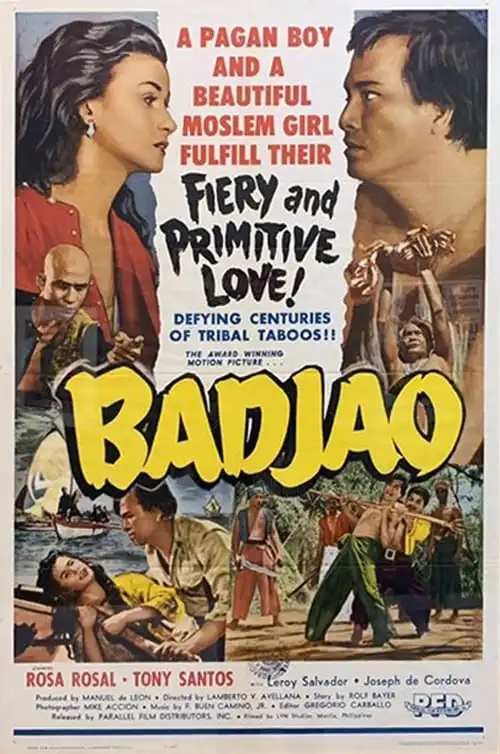
Avellana, later named National Artist, used real coastal settings, boats, and underwater scenes—unusual choices at the time for major studio films. The script by Rolf Bayer, who also wrote Anak Dalita, aimed to portray the Badjao and Tausug with more detail than was common in Manila-produced films, though still within the conventions and limitations of the period.
Produced by Manuel de Leon for LVN Pictures, Badjao was a large and risky project for the studio. Its success at the 1957 Asian Film Festival confirmed its importance: Avellana won Best Director, Bayer won Best Screenplay, Mike Accion won Best Cinematography, and Gregorio Carballo won Best Editing. Today the film is remembered for its careful depiction of maritime life, its strong performances, and its role in expanding Philippine cinema’s attention to Mindanao and its communities.
 Geronimo Cristobal