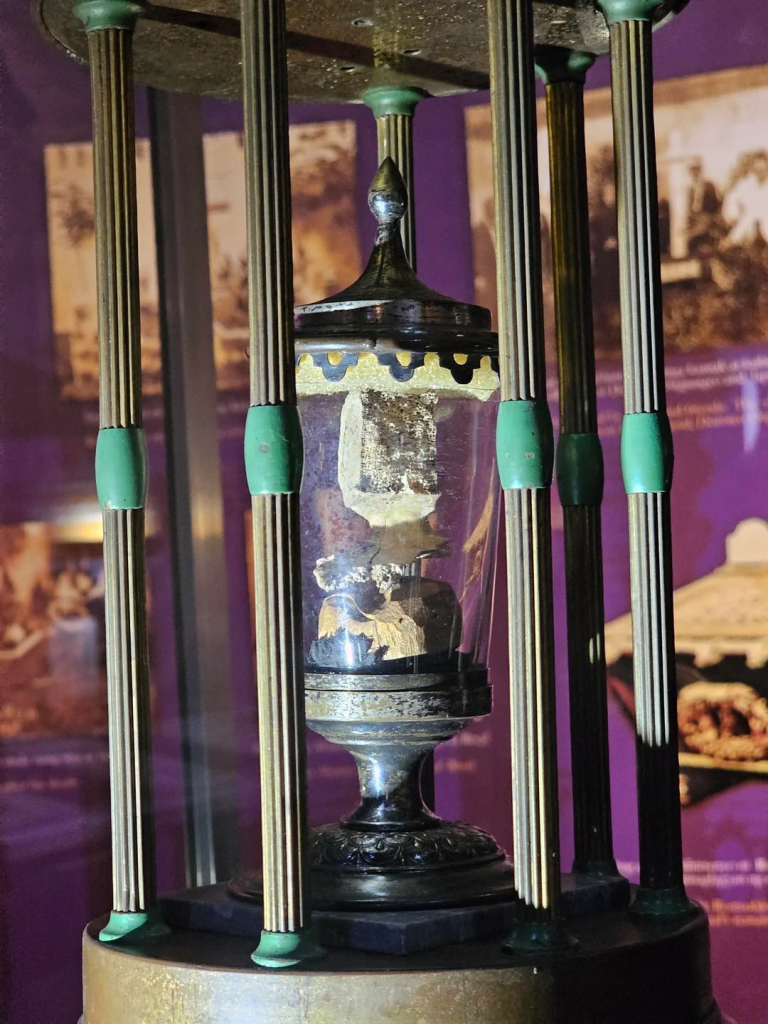
Questions persist about Rizal’s vertebra. Among them, why was it preserved? The oft-repeated claim that it was precisely where the bullet struck is unproven and, in the end, immaterial, since part of his brain was also preserved. The more curious matter is why these fragments, the vertebra and the brain, were placed in viales de peregrinación (pilgrimage vials).
Designed to move with their owner, the containment of relics in such vials, also called ampullae, reaches back to early medieval practice. The ornamented vials elevated body parts from medical specimens to relics. Among Tagalog antingeros (Villegas 2022), the vertebra is considered the most magical bone of the body, the nerve center through which life and energy flow. While rooted in esoteric belief, this resonates with modern anatomy, which recognizes the spinal cord as central to bodily function.
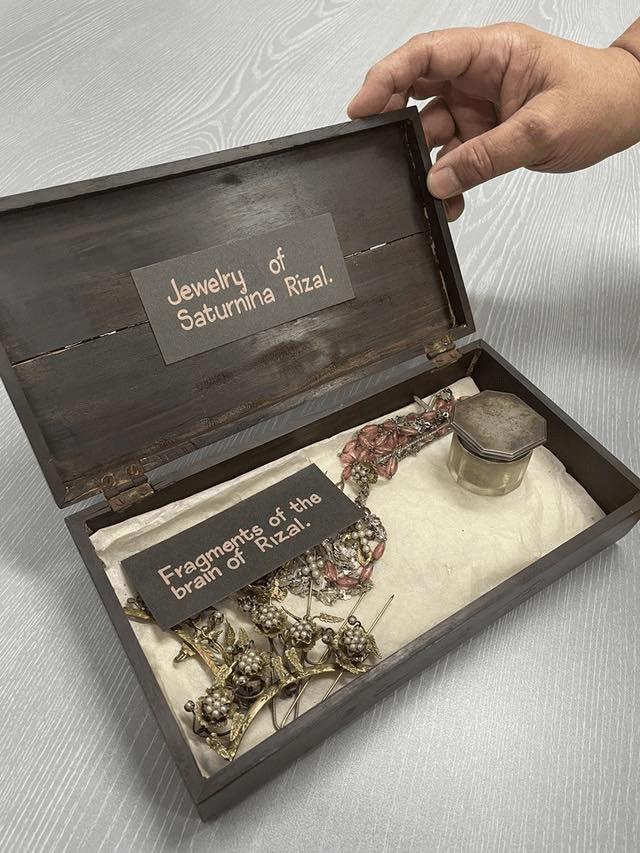
The reason Rizal’s brain was kept by his sister Saturnina (love the name!) and later donated to the Ateneo Library is easier to decode. It was placed in a jewelry box witha peineta, bodkin hairpins, ornamented with seed pearls arranged in floral motifs, alongside a rosary of coral, or glass with gilt fittings. One can imagine Saturnina and her sisters praying daily for the eternal repose of the mason Rizal’s soul and wearing the jewelry on special occasions. The aesthetics of portability in this reliquary point to the historical conditions of the time, for Rizal had no permanent resting place until 1912. Today, the reliquary is housed within its own reliquary at Fort Santiago.
Does this answer all questions? Perhaps only partially. The rest may lie in our own individual responses: why do we choose to see and behold these fragments?
 Geronimo Cristobal