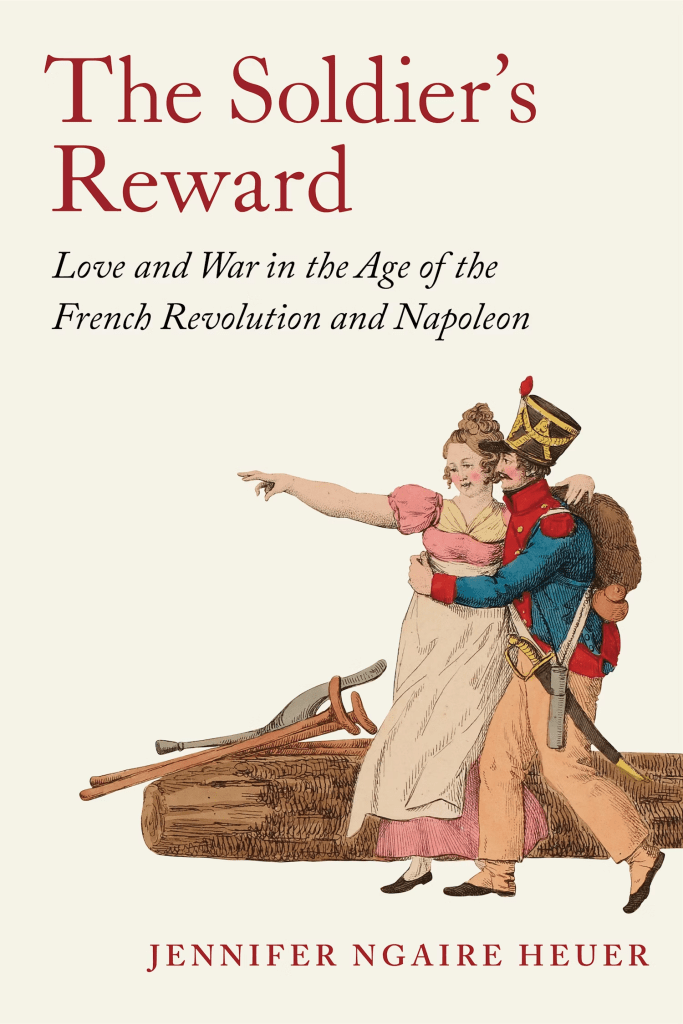
I just made a purchase request from the library for The Soldier’s Reward, drawn in by Jennifer Ngaire Heuer’s ability to unearth the deeply personal dimensions of a quarter-century of conflict. She reveals how war’s chaos was not just a matter of battlefield tactics but something that profoundly shaped the quiet rhythms of family life and love. Her study moves beyond the surface of historical events to illuminate the lives of those who fought, those who waited, and those caught in the far-reaching ripples of Revolutionary and Napoleonic France. At its heart lies a fascinating paradox: marriage as both a means to evade conscription and a reward for dutiful service. Heuer’s exploration of this tension vividly illustrates the complex interplay of war, gender, and citizenship, offering lasting insights into how intimacy and duty were renegotiated in the face of upheaval.
In a recent interview, Heuer recounts her journey into this deeply human dimension of warfare. What began as an exploration of petitions for dissolving “paper marriages”—contracts hastily arranged to dodge conscription—evolved into a broader examination of how decades of conflict reshaped the most intimate facets of life. These marriages, often strategic and mismatched, were far from romantic unions; yet, they highlight the fraught negotiations between personal agency and state control in a time of relentless war.
Heuer also reflects on Napoleon’s audacious 1810 campaign to orchestrate thousands of weddings between veterans and virtuous young women—a state-sponsored effort to knit personal narratives of loyalty and sacrifice into the national fabric. These marriages, she reveals, symbolized not just the valor of the soldier but also the shifting contours of masculinity, in which the ideal citizen was a dutiful warrior and a committed family man. Yet, such ideals were complicated by the realities of war wounds, poverty, and the discrediting of Napoleonic veterans after 1814, when the postwar order sought to domesticate martial masculinity.
The book’s breadth is remarkable, weaving military rosters, courtroom petitions, popular theater, and sentimental broadsheets into a rich tapestry of life during and after the wars. Heuer coins the term “cultural recycling” to describe how post-Revolutionary France repurposed familiar symbols and rituals, often clashing with the new political realities they were meant to serve. In doing so, she uncovers both the continuities and ruptures that defined an era of seismic change.
Through her masterful prose and archival rigor, Heuer reveals how war’s burdens fell not only on the battlefield but also in the drawing rooms, kitchens, and courthouses of France. Women emerge as active participants in this narrative—not just as stoic mothers or faithful sweethearts but as petitioners, soldiers, and rioters. Their stories, often poignant and surprising, challenge the notion that revolution and war silenced their claims to citizenship.
Heuer’s work culminates in a vivid argument: that the Revolutionary and Napoleonic Wars were not just fought with muskets and bayonets but also with letters, promises, and quiet acts of resistance. These conflicts transformed how men and women conceived of love, duty, and belonging, leaving legacies that endured long after the smoke of battle had cleared. For readers of history and humanity alike, The Soldier’s Reward offers a poignant meditation on the intimate costs—and rewards—of war.
 Geronimo Cristobal