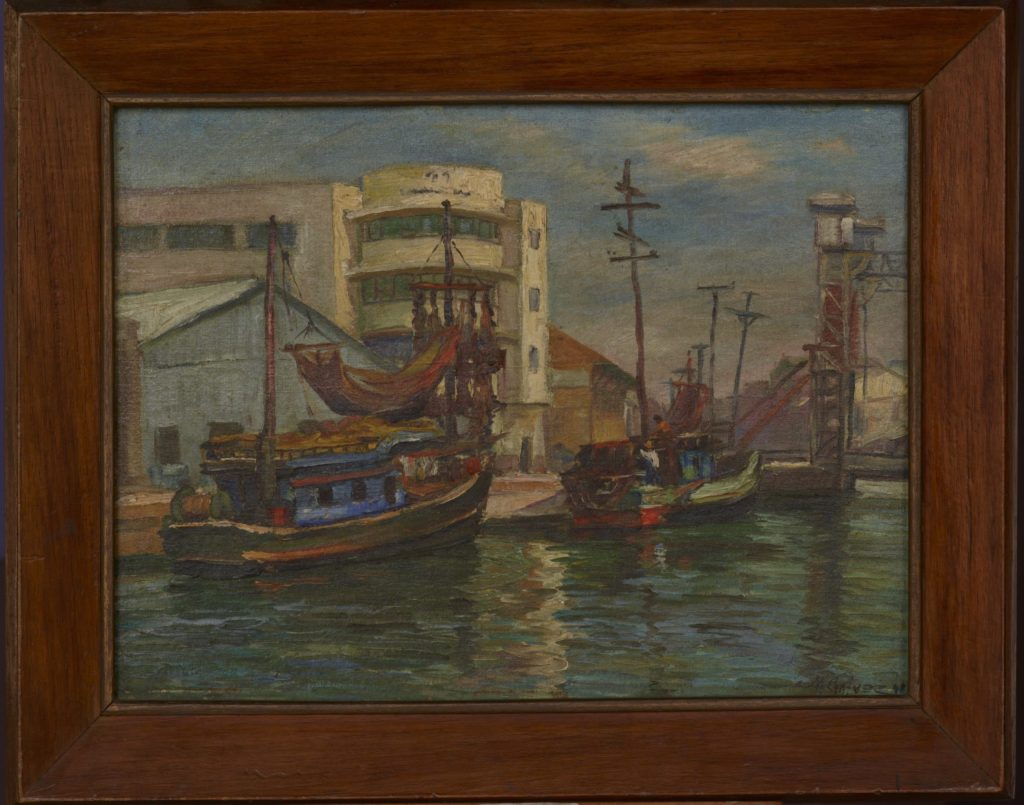
The Pasig River (1948), an oil on canvas by Miguel Galvez, captures two fishing vessels moored along the riverbank—a quiet tableau of industry and resilience. Galvez depicts Filipinos easing back into the rhythms of labor and life, just three years after the devastation of war.
The composition feels deliberate and balanced. The two boats, painted with earthy reds, blues, and browns, occupy the foreground, their forms heavy and grounded. The subtle textures of their worn hulls evoke toil and time, as if the river itself has shaped them. Above, masts and riggings slice into the sky, vertical lines contrasting with the horizontal sweep of the river’s surface. The water shimmers with muted reflections, its greenish hues suggesting a river both burdened and alive, a lifeline quietly enduring.
The background completes the picture—a soft, sunlit Manila skyline emerging behind industrial buildings and sparse telephone poles. The architecture is modest and functional, a far cry from grandeur but steady in its presence. Galvez’s brushstrokes are restrained yet assured, offering just enough detail to ground the scene without overwhelming it. The atmosphere is hushed, the palette tempered, suggesting a day poised between labor and rest.
This visual harmony reflects the river’s deeper story. Once a vital artery connecting Laguna de Bay and Manila Bay, the Pasig River held economic and cultural significance for the city. Here, its surface becomes a mirror for resilience, carrying the weight of recovery while flowing forward.
Miguel Galvez (1912-1989), born in Paombong, Bulacan, honed his skill under his uncle, Teodoro Buenaventura. In 1948, the same year he painted Pasig River, Galvez held his first solo exhibition, a landmark moment for an artist who would soon be named Outstanding Landscape Painter by San Miguel Corporation in 1950.
His oeuvre at the National Fine Arts Collection expands beyond rivers and boats: Rural Scene (Pagud Lawin) (1946), Return from the Farm (1949), Planting Rice (1951), Furniture Store (1960), Nude (1989), and Nipa Hut (undated) reflect his fidelity to rural and quotidian subjects. These works form an intimate portrait of mid-century Filipino life—simple, persistent, and beautiful.
 Geronimo Cristobal