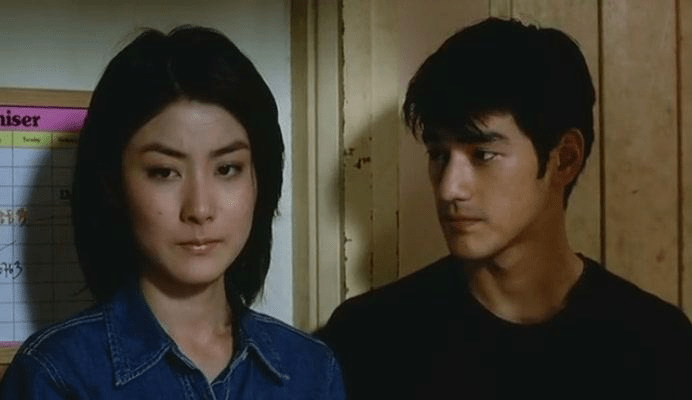
Lee Chi-Ngai’s Lost and Found (1996) is one of those delicate little films that dares to press on your heartstrings and doesn’t let go. It knows what it’s about—love, loss, and the refusal to surrender to despair—and delivers its message with an earnestness so determined that it’s almost disarming. Of course, you know where it’s going the moment you learn that Kelly Chan’s Lam has leukemia, but what keeps Lost and Found from dissolving into the tear-soaked floorboards is its light touch and occasional surreal flair. It’s sentimental, yes, but there’s an elegance here—a sense of rhythm and repose—that makes the familiar feel, if not fresh, then at least worth watching one more time.
Kelly Chan’s Lam isn’t so much a character as a collection of pretty sighs and stoic gazes. If she’s been accused of being a wooden actress, she’s wooden in precisely the right way here—a beautiful plank of a woman who looks like she’s carrying the weight of her diagnosis in every inch of her posture. Chan’s lack of expression becomes its own kind of poetry, though whether that’s deliberate or an accident of casting depends on your tolerance for actors whose best scenes are in voiceover.
Takeshi Kaneshiro is the real star, playing That Worm, a lost-and-found man who seems to specialize in reuniting people with objects they didn’t know they needed. Kaneshiro has that elusive quality—something between charm and sincerity—that pulls you through the film’s mawkish moments and makes them sing. He’s alive in every scene, playing off Lam’s stillness with a childlike earnestness that feels almost subversive in a film about a woman slowly dying. He’s a joy to watch, his energy turning what could have been a syrupy mess into something closer to whimsy.
And then there’s Michael Wong. Wong, bless him, is what happens when you cast a presence instead of an actor. He’s handsome, he’s exoticized by the script—the perfect Chinese-Scottish sailor—and he’s about as emotionally resonant as a handsome plank nailed next to Kelly Chan’s prettier one. To his credit, the script doesn’t ask much of him, and the cinematography does its best to make his brooding silence feel significant. If you squint, you might even believe it.
Lee Chi-Ngai approaches Lost and Found like a painter crafting a watercolor—soft edges, gentle transitions, and little flourishes of magic that keep the melodrama from drying up in the summer heat. There are red-billed ducks that appear as if by miracle, roses that bloom overnight, and moments of childlike wonder that make you want to forgive the film for being so resolutely earnest. Lee knows the story he’s telling, and he tells it well, but there’s a nagging sense that the film wants us to feel more than it earns. The voiceovers are serviceable, but they edge dangerously close to explaining the obvious, and you wonder whether a subtler filmmaker might have let the images speak for themselves.
Bill Wong’s cinematography deserves a standing ovation. The film looks exquisite, moving effortlessly between the cluttered chaos of Hong Kong and the windswept stillness of the Scottish highlands. Wong turns Scotland into a mythic landscape—a liminal space where time slows down and the horizon stretches just far enough to hold all of Lam’s unspoken longing. The contrast between these two worlds isn’t just visual; it’s thematic. Hong Kong is the here and now, the present that suffocates, while Scotland—with its bagpipes and mist—is the impossible elsewhere, a place that exists only in dreams.
The soundtrack, too, leans hard into its emotional cues, with Leonard Cohen’s Dance Me to the End of Love stealing the show. Cohen’s mournful croon feels like an open wound—a musical shortcut to everything the film wants us to feel. The Cantopop ballads, by contrast, are hit or miss, veering between genuine melancholy and overbaked melodrama. But when the music works, it works, and you can almost forgive the moments when it doesn’t.
Lost and Found doesn’t reinvent the wheel, but it rolls along with enough grace and conviction to keep you invested. It’s the kind of film that wears its heart on its sleeve and dares you to call it naive for doing so. Yes, Kelly Chan is wooden. Yes, Michael Wong is underwhelming. But Takeshi Kaneshiro is a revelation, and Lee Chi-Ngai’s direction elevates this terminally ill romance into something approaching art.
For all its flaws, Lost and Found has moments of genuine magic—the kind of magic that sneaks up on you and leaves you feeling a little lighter, a little sadder, and maybe even a little hopeful. It’s a film that believes in miracles, and for ninety-some minutes, it might even make you believe in them, too.
 Geronimo Cristobal