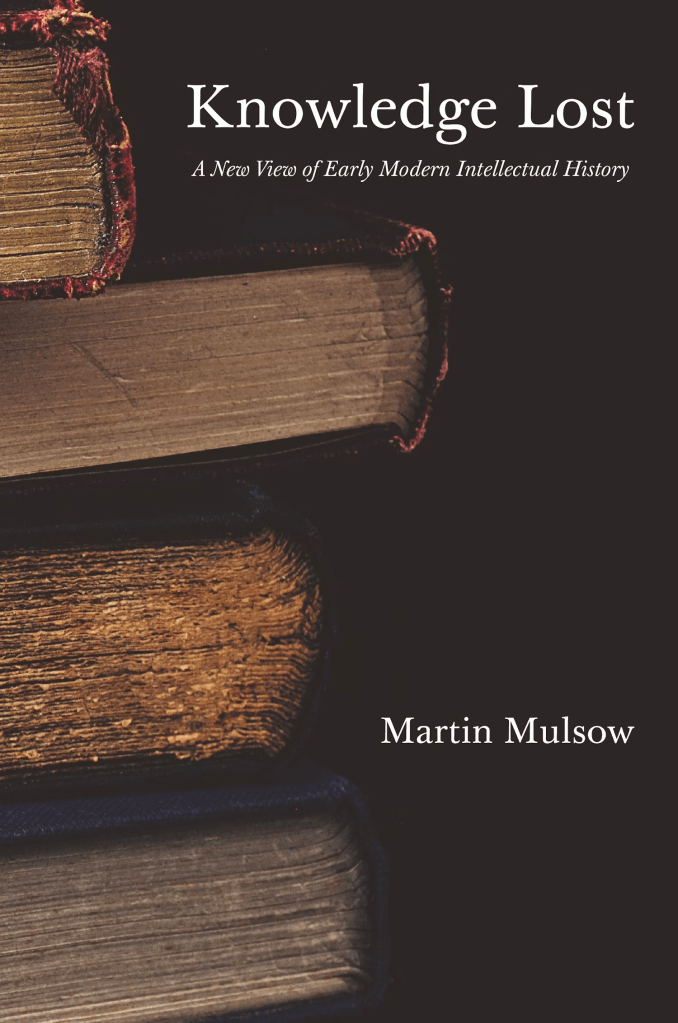
Martin Mulsow’s Knowledge Lost: A New View of Early Modern Intellectual History offers a refreshing perspective on the era’s intellectual landscape, making it a compelling read for those interested in early modern studies. Unlike the often tedious task of writing reviews, the reviewer found this book both engaging and informative, a testament to its significance and readability.
Mulsow elevates the study of clandestine literature, persecuted philosophers, and those who straddled the boundaries of orthodoxy and taste, to a new theoretical level. Departing from social history’s dominance, as seen in Robert Darnton’s pioneering works, Mulsow centers his analysis on the concept of “knowledge” itself, which he defines as “justified belief” and “organized information imbued with experiential context.” This broad definition, influenced by Max Weber and Alfred Schütz, encompasses both the subjective knowledge of individuals and institutionalized, societal knowledge, regardless of its truthfulness, since even incorrect knowledge can influence actions.
The stability of knowledge, according to Mulsow, depends not on its objective content but on its status, its relation to other knowledge, its material carriers, and the societal status of those who propagate it. Hence, knowledge can be “precarious”—ephemeral, marginalized, and vulnerable. It thrives in niches like footnotes or glosses in ostensibly orthodox works, manuscripts passed from hand to hand, or posthumously published to ensure their survival.
Mulsow identifies the carriers of “precarious knowledge” not by their social circles but by the roles authors assumed in specific situations. For instance, Hermann Samuel Reimarus and Isaac Newton were both recognized scholars who secretly authored works on religion criticism and alchemy, respectively. Mulsow views “precarious knowledge” as a direct consequence of the “fragility” of established knowledge cultures, vulnerable due to implicit factors such as ambiguities and fascinations.
Rejecting any romanticization of outsiders or radicals, Mulsow calls for a more nuanced understanding that distinguishes established positions and precarious knowledge more by their attitudes than their content. He emphasizes “pluralistic readiness” as a key characteristic of the knowledge precariat, fostering an external viewpoint that questions established discourses and allows for a multiplicity of perspectives.
This book is rich in fascinating case studies and demonstrates how eclectic theories from various sources can be fruitfully applied to historical research, suggesting its applicability beyond the early modern period. Mulsow’s work, deeply relevant to contemporary discussions on the freedom of expression and the security of knowledge, marks an important contribution to the broader academic discourse.
***
The review above is mostly a translation and paraphrasing of Martin Papenheim, Rezension zu: Mulsow, Martin: Prekäres Wissen. Eine andere Ideengeschichte der Frühen Neuzeit. Berlin 2012 , ISBN 978-3-518-58583-2, In: H-Soz-Kult, 31.10.2013, <www.hsozkult.de/publicationreview/id/reb-19165>.
The book has been translated into English as Knowledge Lost: A New View of Early Modern Intellectual History published by Princeton University Press in 2022. Hardcover, Price:, $39.95/£35.00 ISBN: 9780691208657, Published (US):
Nov 1, 2022, Published (UK):, Jan 3, 2023. 456 pages
 Geronimo Cristobal