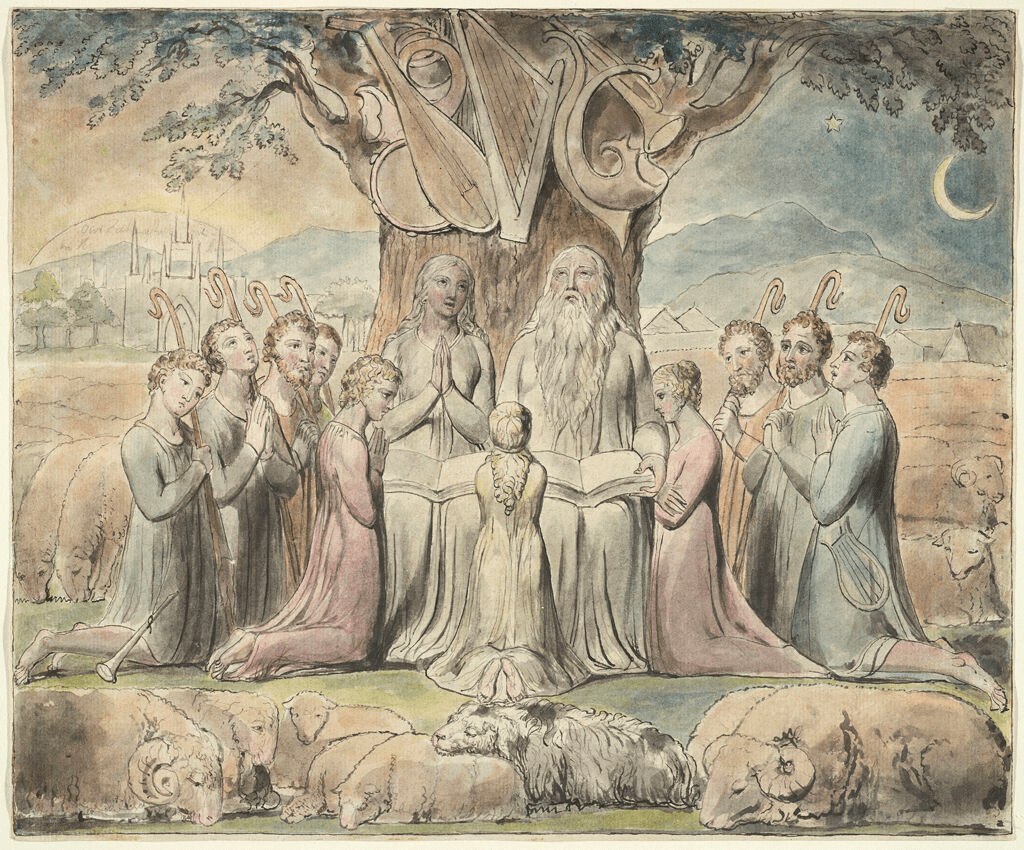
William Blake (1757 – 1827), There Was a Man in the Land of Uz (The Book of Job), 1821
This essay sets directions towards the writing of a material history of the Land of Uz, the setting of the Book of Job, by revisiting textbook historical and archaeological records of the Levant and relevant ancient Near Eastern cultures. From these accounts, I focus on the use of gems, particularly pearls, in Job 28, verses of which compare the search of wisdom to mining. I set aside questions regarding the real-world existence of Uz and instead try to formulate some preliminary commentary about its plausible socio-economic life, based on Uz’s purported locations and Job’s wealthy lifestyle. I follow Carlo Ginzburg’s example in treating chapter 28 as a material for microhistory, a thread of clues to understanding the Land of Uz, which exhibits the hallmarks of fictionalization rather than complete fiction. I expound on the fabricated historical-literary form in which accounts of the Land of Uz were written, speculating on the embellishments of its erudite author. The present form of the Book of Job is likely a kind of historical writing which entailed the partial anonymization of the people and places that is indicative of what Carol Newsom says is polyphonic authorship. This explains why despite fictionalization, references to real historical places and the anomalous mention of such items as pearls, rubies, corals, and lapis lazuli that are not native to the Levant were made in the chapter. I offer the hypothesis that this slippage is indicative of an editorial hand that sought to portray Eretz Uz as a dilated version of Eretz Israel, one that is not confined to the hostile landscape of the Levant but includes the mesolocale of vibrant port cities that surround it.
 Geronimo Cristobal