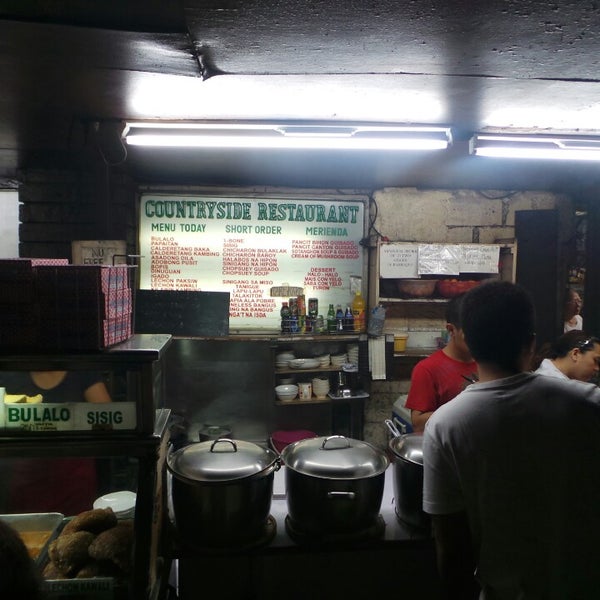
Countryside is the name of a rundown restaurant along Katipunan Extension in Quezon City. This place has since been demolished and replaced by a stripmall more befitting of the gentrified environs outside Ateneo campus. I mention this hole-in-the wall in relation to Professor Oscar Campomanes, as a testament to the impossible circumstances that gave birth to our mentorship and as a metaphor of the marginalized place of art criticism in relation to the Manila art scene. I was only 19 years old, an undergrad in UP, when I first met Oscar in an art criticism workshop held by the UST Varsitarian in 2009. Looking back, I was not the wünderkind he had led me to believe (he called me Ranciere’s wet dream). Rather, I was someone who was a loose cannon, so uninitiated into the ways of academia, I could barely put two sentences together. I knew Oscar not only as an astute academic—he was once called Manila’s last art critic—but also as a man of the world, who in the 90s, led the life I am living now as a graduate student.
Part of the reason I pursued graduate studies was because he regaled me with stories of New York, the Ivy League, details of his life as a professor both extraordinary and ho-hum, all of them fascinating to me until now. Nurtured by the San Miguel Beers and barbecued pig entrails we consumed in between conversations, our friendship deepend and I would now like to think that I got to know a side of Oscar no one else knew. But how do I speak of these conversations without censoring myself? This is a symposium and not a eulogy. But perhaps, it is a eulogy, not to a person but to a place which is no longer, that might have held traces of our conversations and presences in them. Those conversations in the Countryside were the real symposium because they involved a drinking party and a convivial discussion, which one can imagine was not unlike one held in ancient Greece.
So in talking about Oscar Campomanes, let me talk about someone else instead. Someone not Greek but Roman, whose mighty innovations in the conduct of a symposium included serving wine during and not after the banquet. Please feel free to enjoy a cold one as I spin out of control in this presentation.
In his book Historia Naturalis (circa 77-79 AD), Roman naturalist Pliny the Elder (now considered the world’s first art historian) addressed zoology, astrology, botany, and all subjects he deemed worthy of their own history, including several chapters dedicated to craftsmen, artists, and architecture. One fascinating entry in this book is one where Pliny attempts to track the origin of painting, suggesting that it began when man tried to trace his own shadow. In Chapter 5 of Book XXXV, he writes:
We have no certain knowledge as to the commencement of the art of painting, nor does this enquiry fall under our consideration. The Egyptians assert that it was invented among themselves, six thousand years before it passed into Greece; a vain boast, it is very evident. As to the Greeks, some say that it was invented at Sicyon, others at Corinth; but they all agree that it originated in tracing lines round the human shadow […omnes umbra hominis lineis circumducta].
Later, Pliny tells the now-famous story of Butades of Corinth.
It was through his daughter that he made the discovery; who, being deeply in love with a young man about to depart on a long journey, traced the profile of his face, as thrown upon the wall by the light of the lamp [umbram ex facie eius ad lucernam in pariete lineis circumscripsit].
From the mid-to-late 18th century until the early 19th century, The Origin of Painting was a mildly popular sub-genre, depicted by artists under titles such as “The Art of Painting”, “The Invention of Drawing”, and “The Corinthian Maid”.
More recently, we have Karen Knorr’s The Pencil of Nature, 1994. A work which is currently displayed at Cornell’s Herbert Johnson Museum. The title is a mixed metaphor, as it is the title of Henry Fox Talbot’s 1844-46 account of his invention of the photographic process.
When he finally finished writing Natural History, Pliny sent a copy to the future emperor Titus, writing a dedication that refers to the long nights of labor that his “thirty-six volumes and twenty-thousand noteworthy facts” have required, observing that “life properly consists of being awake” [vita vigilia est]. From these short passages, we can get a sense of what art criticism is like. First, that it involves long nights of labor and second, that the critic must be full of wonder and wakefulness to accomplish anything substantial. These are the same lessons I learned from Oscar Campomanes.
Just reading the line up of speakers for this sober, 21st century symposium, I can tell that Oscar’s voracious curiosity has brought together a range of scholars, who are awake to the world. Each connection has its own history which mobilizes a certain place (or a kind of place) as an epistemological ground for rethinking geographical, social, and aesthetic worlds often derived primarily through the worlds of thinkers and artists. As evidenced by his later works on Nissology, Oscar often figured space and time as open questions of geometry and not consequences of top-down linear thinking, works that defy dominant political, social, disciplinary, and geographical demarcations. Such sensibility explains the choice of place of our symposia-numans, Countryside was nothing pretentious, conveniently off the beaten path, and the view of Antipolo that it afforded us was framed by flickering shadows.
My natural history of Campomanes would be as Pliny the Elder’s: a means of thinking beyond the limits of our own visibilities and mortality, beyond survival and even solidarity.
One philosopher we particularly spent considerable time discussing was Jacques Ranciere, who was then the darling du jour of art criticism, who like Pliny the Elder put art and craft on the same footing and reminds us about the inextricable relationship of artistic creation and labor. Through the French philosopher, Oscar taught me and numerous others, ideas about political and aesthetic equality, and as a consequence, the view of equality of art from antiquity to the present. It is from this lesson, that I mention the classical tradition and Pliny’s interest in the natural world, with the same sense of possession as I would have when discussing any other work. As Pliny’s reflections in Natural History show us Nature in her many guises, so did Oscar’s wayward intellection gave me a model as an art critic; one who peeled off layers of philosophy to show at the core an unconscious appreciation for existing within a place. Our conversations exploded from painting and sculpture to politics and quantum mechanics. Not that I claim to be conversant in all of them but often, it is enough to misunderstand and to continue.
Like Pliny, Oscar’s first lesson to me was that places serve as teachers, through the cycle of life and of movements of planets, as in the arrivals and departures of people. The world will spark wonder through a host of strange creatures (he often spoke of the kindness of strangers) and phenomena as subatomic particles that can only be measured by probabilities or uncertainties under observation.
The second lesson is that nature offers bountiful resources for human use, and this includes human relationships. Art criticism is a constant practice of mutuality and he often warns of the risks of taking too much from people and nature.
As Pliny situates the origin of painting in a young woman’s act of tracing her departing lover’s likeness onto a wall, so too would I trace the origins of art criticism by following the footsteps of my teacher, whom I met not in a conventional classroom but at the margins of academia, at the Countryside. Our long discussions here make me think not of bucolic jungles but of future ruins. The details of those conversations may be lost to memory now, but not the feelings they continue to evoke. While Oscar was already a big name in Philippine Studies at the time I met him, he was still in the process of finishing a long and winding dissertation, which would become Figures of the Unassimilable and when I read it I was struck by a line Antonio Gramsci wrote in the Prison Notebooks 1929-1935 which he used as one of his epigrams:
The starting point of critical elaboration is the consciousness of what one really is, and is ‘knowing thyself’ as a product of the historical process to date, which has deposited in you an infinity of traces, without leaving an inventory. (Incidentally this reminds me of a Borges quote: Any life is made up of a single moment, the moment in which a man finds out, once and for all, who he is. )
As such, Gramsci continues, “it is imperative to compile such an inventory” (1930-32). For Gramsci, this process of critical self-understanding represents the starting point for the possibility of any transformative action. It is a necessary first step to any revolutionary process and, crucially, is the basis upon which this form of social transformation is not one that aims at replacing an oppressive reality with its mirror image, but one that is capable of becoming an act of liberation for both the oppressor and the oppressed. A process aimed at recovering and politicizing memory, and ‘inventing new souls’. Oscar has always been drawn to organic intellectuals because as we learn from Gramsci, they are the pivotal agents in igniting this transformative process; highlighting the link between thought and action; illuminating this infinity of traces; speaking the truth to power; imagining alternative social and political relations, and revolutionizing possibilities on the ground from within particular communities.
Our Countryside conversations were meant to recover the organic intellectual inside the art critic (Oscar and I). Our conversations precede the explosion of social media, or high-powered digital cameras integrated to a phone. Fortunately I have no more photographs of that time, just an infinity of traces, the very same kind that started the art of painting, that are captured in the shifting sands of my mind. Now these traces appear like shadows before you with words spoken from half a world away.
Ithaca, New York
May 6, 2023
 Geronimo Cristobal