Similarities and Differences in the Critiques of Power by Gramsci and Bourdieu
The following text examines the convergences and divergences in the thinking of Antonio Gramsci and another major theorist of power: the French sociologist Pierre Bourdieu, who died on January 23, 2002.
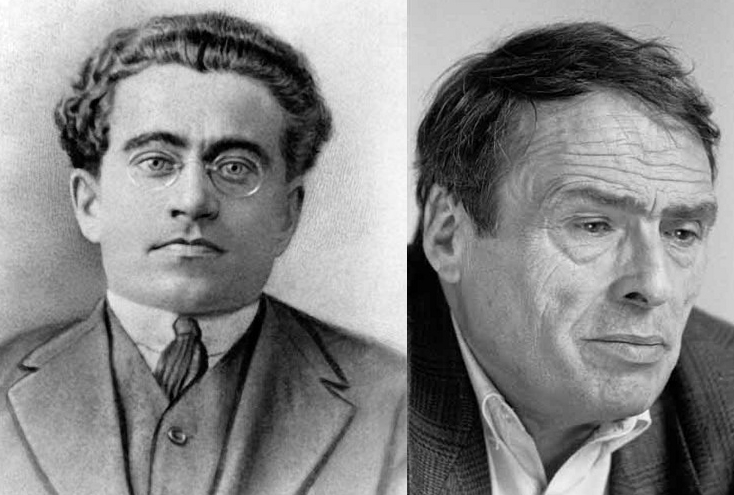
Antonio Gramsci and Pierre Bourdieu
“If Gramsci was too optimistic about questioning domination,” writes the American sociologist Michael Burawoy, “Bourdieu was too pessimistic.”[1] Burawoy argues that Gramsci did not pay enough attention to the cultural mystifications that enabled the endurance of advanced capitalism, while Bourdieu, in contrast, considered the habitual acceptance of domination so pervasive and universal that capitalist relations continuously reproduced themselves.
This assessment rests on another presupposition: that the Italian Marxist and the French sociologist share a significant conceptual terrain. Burawoy is far from alone in this view, yet systematic comparisons between the two thinkers have been surprisingly rare.
An “Optimistic” Gramsci, a “Pessimistic” Bourdieu
Néstor García Canclini noted long ago that Bourdieu refers to Gramsci only once in Distinction. He attributed this to the political climate of the 1970s, suggesting that Bourdieu avoided an explicit association with Marxism in order not to “contaminate” his sociological project. This may also explain why their respective followers have been reluctant to think the two together: academic and political resentments have obstructed a deeper dialogue.
Marxists have often criticized Bourdieu for abandoning political economy and for adopting a functionalist stance—one that explains how domination works without indicating how it might be overturned. Conversely, many in the Bourdieu school have dismissed Gramsci as merely an “ideology theorist.” Bourdieu himself avoided the term “ideology,” replacing it with the more capacious concept of habitus.
Yet ideology and habitus are linked by the very question García Canclini identified in 1984 and that Burawoy reprises today: why is domination so stable? Both thinkers argue that domination is not secured by violence and repression alone. It is reinforced through everyday practices, participation, and privilege. Gramsci called this “cultural hegemony”—the predominance of certain ways of thinking and behaving—while Bourdieu referred to such subtle forms of reproduction as “symbolic power.”
Culture, Practice, and the Reproduction of Domination
Both theorists thus locate domination in culture, broadly defined. Social order is reproduced not only through the compulsion to sell labor or through the repressive apparatuses of the military and police, but also through everyday practices, tastes, and dispositions. As Gramsci insisted, culture is not mere “encyclopaedic knowledge”; it becomes politically meaningful only when understood as practical activity. His “philosophy of praxis” aimed to grasp precisely this nexus of culture and action.
Bourdieu’s approach, for similar reasons, is often described as practice theory. He sought to demonstrate the link between seemingly personal judgments of taste and one’s position in a class structure. The “consumption of cultural goods”—from art objects to everyday items—became central to both his sociological analysis and political critique.
Both thinkers also turned to culture in the narrower, artistic sense. How do books, artworks, and popular media participate in the maintenance of domination? As Bourdieu showed empirically, “legitimate works of art are the most classifying and classifying-producing” of all cultural goods.[4] The way one engages with cultural works not only signals one’s class position but also reinforces it.
Here their diagnoses begin to diverge. Bourdieu believed cultural consumption overwhelmingly reproduced class hierarchy, particularly among the dominated classes, who oriented their practices toward upper-class norms. This is the pessimism Burawoy identifies. Gramsci, however, was more hopeful: he saw cultural and intellectual activity as capable of producing transformation. Just as the Napoleonic army’s bayonets prepared the way for an “invisible army of books and pamphlets,”[5] Gramsci believed new upheavals would be prepared through ideas and cultural struggle.
Resistance, Fields, and Historical Blocks
The theoretical and political differences become most visible in how each conceives resistance. Bourdieu argued that cultural and artistic productions affect political realities only through mediated processes within what he called the “intellectual field.” Their effects are always refracted by field-specific logics. Oliver Marchart’s analysis of the documenta exhibitions illustrates this well, showing how the shifting politics within the art field shape its broader ideological impact.[6][7]
Gramsci, by contrast, insisted on the political agency of the working class, but emphasized that power is seized not inevitably but through strategy and alliance-building. His concept of the “historical bloc” named the broad coalitions necessary for revolutionary change. Books, pamphlets, labor struggles, and party work provided the means for constructing cultural hegemony, which he saw as a prerequisite for economic and social transformation. For Gramsci, one must fight “for the tastes.”[9]
Taste, Distinction, and the Possibility of Change
Bourdieu placed little emancipatory hope in the cultural practices of the lower classes. Their tastes and aspirations, he argued, were shaped by the limits imposed on their present and future, whether in colonial Algeria or neoliberal Europe. This structural pessimism attracted criticism from Marxists and cultural theorists alike.
García Canclini, for instance, accepted Bourdieu’s constructivism but argued—based on Latin American contexts—that popular practices can also be inventive and resistant, not merely reproductive.[10] Wolfgang Fritz Haug made a similar distinction between “cultural distinction,” which stabilizes hierarchy, and “cultural differentiation,” which simply names a preference without reinforcing domination.[11] Whether such innocent practices exist in a deeply unequal world, however, remains an open question for both Bourdieu and Gramsci.
A version of this text was first published in ak – analyse & kritik, no. 573 (Hamburg, June 2012), p. 23.
Written by Jens Kastner, edited and translated into English by Geronimo Cristóbal.
Footnotes:
[1] Michael Burawoy: “The Roots of Domination: Beyond Bourdieu and Gramsci.” In: Sociology 46 (2), pp. 187-206, here p. 189. (http://soc.sagepub.com/content/46/2/187)
[2] Néstor García Canclini: “Gramsci con Bourdieu, Hegemonía, consumo y nueva formas de organización popular.” In: Nueva Sociedad, No. 71, March-April 1984, pp. 69-78.
Gramsci’s most important art and cultural theoretical writings have recently been reopened in German in a collective form: Antonio Gramsci: Literature and Culture. Gramsci Reader. Eds. on behalf of the Institute for Critical Theory of Ingo Lauggas.Hamburg: Argument 2012.
[4] Pierre Bourdieu: The subtle differences. To the critique of social judgment. Frankfurt a. M .: Suhrkamp 1987, p. 36.
[5] Antonio Gramsci: “Socialism and Culture.” In: like: Philosophy of practice. A selection. Eds. by Christian Riechers. Frankfurt a.M .: Fischer 1967, pp. 20-23, here p. 22.
[6] Oliver Marchart: Hegemony in the art field. The documenta exhibitions dX, D11, d12 and the politics of biennialisation.Cologne: Bookstore Walther König 2008, p. 13.
[7] See ibid., P. 94.
[8] Pierre Bourdieu: “Social Space and Symbolic Power.” In: like: Speech and Answer. Frankfurt aM: Suhrkamp 1992, pp. 135-154, here p. 153.
[9] Antonio Gramsci: Literature and Culture. Gramsci Reader. Eds. on behalf of the Institute for Critical Theory of Ingo Lauggas.Hamburg: Argument 2012, p. 48.
[10] Néstor García Canclini, p. 176.
[11] WFHaug: The cultural distinction. Hamburg: Argument 2011, p. 56.
 Geronimo Cristobal
Leave a comment