I wrote this article during my freshman year in college. At the time, there were very few in-depth articles about the old hotel, and it ended up being read by quite a few people and cited as a reference in some news articles. Every time I see it quoted, I feel a bit embarrassed because of some factual errors. To address that, here’s a revised version with corrections and additional information drawn from John Joseph T. Fernandez’s research, published by Lund University.

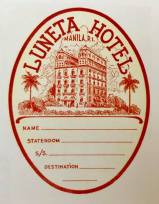
If not for the remarkable Belle Époque architecture of its façade, it would be hard to imagine that the hotel once embodied Manila’s colonial elegance in a more refined era. Built in 1910, the six-story structure stood prominently at the intersection of Calle San Luis (now T.M. Kalaw) and Calle Alhambra in Ermita, Manila. It faced the unfenced Bermuda grass lawns of Luneta Park. Initially surrounded by blocks of bahay na bato and warehouses, its immediate vicinity changed in the 1930s with the construction of the University Apartments on the adjacent lot. Although the Philippines had been under Spanish rule for over three centuries, the hotel’s miniature grandeur felt foreign. Today, it is alternately referred to as Belle Époque, French Renaissance, or—mistakenly—Art Deco, a style that emerged in subsequent years.
A little background on the Belle Epoque and French Renaissance:
Between the Franco-Prussian War and World War I, 1871- 1914, much of Europe enjoyed a period of peace, prosperity, optimism, rapid developments in science and technology, and relative political stability. It was “the beautiful era,” a golden age, a time best characterized by the expression joie de vivre (from the title of a book by Émile Zola). With this prosperity and the ascension of the Third Republic in France, La Belle Époque also sponsored a remarkable renaissance in the visual arts. Impressionism laid the groundwork in the 1870s and 1880s in works by Monet, Renoir, and Sisley. By the 1890s, such Postimpressionist masters as Cézanne, Matisse, Gauguin, and Toulouse-Lautrec had found their patrons. These artists were the vanguard of modernism in painting, a new freedom within the medium that inspired similar experimentation in all of the arts.
Paris hosted the World’s Fair in 1889 with its great exclamation mark, the newly constructed Eiffel Tower serving as the beacon in a world of new possibilities. Georges-Eugène Haussmann’s redesign of Paris was nearly complete. By then, the Moulin Rouge and the Folies Bergère also were open for business. Hosting another World’s Fair in 1900, Paris seemed, indeed, the place to be. To be sure, there were less salutary aspects of this period: the Dreyfus Affair exposed the era’s deep-seated anti- Semitism, which would have catastrophic consequences later in the 20th century. While French imperialism, especially in Africa, brought new riches to the wealthy, the working classes remained largely impoverished. Anarchists began to toss bombs, a practice that continued right up to the advent of the Great War.
In the Philippines, with the American Occupation in full swing, urban planning and architecture served the needs of secular education and public services. Upon the invitation of then Commissioner to the Philippines, William Cameron Forbes, prominent American Architect Daniel H. Burnham, assisted by young architect Pierce Anderson, came to the Philippines in 1904 for a six-week visit to survey and prepare a development plan for Manila and the future summer capital of Baguio.
Burnham‟s recommendation of the establishment of a government center with street radiating from it, the cleaning of canals, the construction of a bay shore boulevard from Manila to Cavite, and the development of parks and open spaces for recreational activities was approved on June 20, 1906.
Burnham provided a site for Manila Hotel, Army and Navy Club, the Philippine General Hospital and the Post Office between Jones and Macarthur bridges. While he devised the plan, most of the structures were designed and built by his successors, William Parsons, who served as consulting architect at the Bureau of Public Works from 1905-1914. Other well-known American architects who eventually helped shape the country‟s urban landscape were George Fenhagen and Ralph Harrington Doane.4
The new civilian government in the Philippine thus generated an array of building types that required new architecture. Structures for government programs included public schools, sanitariums, universities, city halls, and municipal hospitals. Neo- classical-inspired government buildings served as an ideal medium for creating convincing metaphors of powers and colonial omnipresence.
Some of these American built structures are still standing like monuments for the architects who designed them. To name a few, The Uy-chaco building, the first and only Art Nouveau high rise in the Philippines, which is located at the corner of Quintin Paredez st. and Escolta. In 1902 The Insular Ice Plant and Cold Storage was built. It was considered as the first large building to be erected by the Americans. Its massive brick masonry was fashioned in the Neo-classical style with low relief false arches. William E. Parson famous works were the Normal School (1914), the Women‟s Dormitory of the Normal School (1914), The Philippine General Hospital (1910), The Manila Hotel (1912), The University Hall of the University of the Philippines in Padre Faura (1913), The Army- Navy Club (1909), the YMCA Building (1909), the Elk‟s Club (1911), The Manila Club (1908) and the Paco Station (1914). His works was a clear translation of Neoclassicism into a new hybrid of colonial tropical architecture.
During the reign of Neoclassicism in Philippine architecture, a new architectural style emerged, introduced by Filipino architects who had been educated in Europe and trained in the École des Beaux-Arts tradition.
In the 1920s, the Art Deco style swept the nation, marking a departure from the Neoclassical Beaux-Arts tradition. Second-generation Filipino architects, such as Andrés Luna de San Pedro, Pablo Antonio, and Juan Nakpil, returned to the Philippines after gaining foreign education and exposure to trends in Europe and America. These architects initiated a shift away from Parisian Beaux-Arts sensibilities and embraced the Art Deco aesthetic. The zenith of this style was exemplified by Juan Arellano’s Metropolitan Theatre (1931), which featured Filipinized architectural details such as Philippine flora motifs, bamboo banister railings, carved banana and mango ceiling reliefs, and batik mosaic patterns.
Complementing Art Deco aesthetics was the Neo-Castillian (or Spanish Mediterranean) style, popular among the upper class. Andrés Luna de San Pedro championed this style among the elite, particularly with his design of the Perkins House, located along Dewey Boulevard.
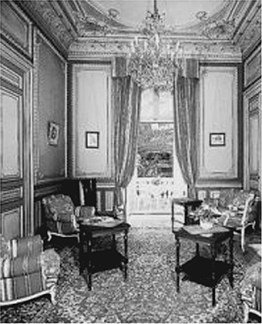
The residential architecture and interior design of the extant Tomas Mapúa house on Taft Avenue stands as a proud testament to Tomas Mapúa’s virtuosity in 1930s Philippine Art Deco. During this period, streamlined modern architecture in the Philippines emerged as a precursor to the International Style, with Filipino architects adapting their designs accordingly.
Notable examples from this era include Andrés Luna de San Pedro’s lavish Crystal Palace, Pablo Antonio’s Far Eastern University, Fernando Ocampo’s FEATI University, and Juan Nakpil’s Manila Jockey Club. Juan Nakpil’s Capitol Theatre, with its distinctive Ziggurat-inspired top, as well as Pablo Antonio’s Ideal and Lyric Theatres, further exemplify this trend. Antonio Toledo’s Cebu Custom House also reflects the Art Deco aesthetic. The streamlined Art Deco style of the 1930s is perhaps best captured by the Jai-Alai Building, designed by Wuderman and Becket, and Luis Araneta’s Times Theatre, both showcasing the sleek, modern lines characteristic of the period.
The outbreak of World War II reached the Pacific in December 1941. The ensuing battle for liberation caused immense destruction, leaving Manila in ruins and many irreplaceable architectural treasures damaged. As reconstruction efforts began after the war, a frenzy of building activity emerged. Houses and other structures were hastily erected to address the severe housing shortage, with “fly-by-night” contractors dominating the scene. Attempts were made to resurrect the grandeur of pre-war buildings using photographs from magazines, resulting in a hodgepodge of architectural styles—false-fronted makeshifts blending classic elements with varied interpretations of early pre-war modern architecture.
The construction of the Luneta Hotel occurred during a relatively peaceful period. The pacification of the islands and the promise of progress under a new colonial master were in full swing. Earlier, iconic structures such as the Manila Hotel and Army and Navy Club (now also a hotel) had been built.
Around this time, Escolta saw the rise of new commercial buildings and arcades, including the Art Nouveau Uy-Chaco Building. Nearby, northwest of the hotel across Luneta and Mehan Gardens, stood the Neo-Classical Insular Ice Plant and Cold Storage. The design of the Ice Plant was alternately attributed to Andrés Luna de San Pedro or to an American architect under William Parsons. However, research revealed it was designed, built, and owned by Spanish architect-engineer Salvador Farre, who also designed the Montalban Dam.
The Luneta Hotel itself may have been constructed in 1918 or 1920, when the use of reinforced concrete introduced by the Americans enabled the rise of taller buildings. A property title from Manila City Hall dated 1915 makes no mention of the structure, but a 1922 mortgage, later paid off in 1931, suggests it was completed in the early American period. The hotel first appeared in Rodenstock’s Manila City Directory in 1919, listed under “Manila hotels,” with J.L. Burchfield as proprietor and F.M. Lozano as general manager. It was also featured in the 1920 Yearbook of the Philippine Islands.
The Luneta Hotel was known for serving both American and Filipino-style breakfasts, including tinapa and longganisa, a novelty for foreign guests at the time. I once wrote that President Dwight Eisenhower had praised the hotel’s beauty, but this was a mistake. Eisenhower stayed at the Manila Hotel, and the beauty he described referred to Luneta Park, not the hotel. However, the Luneta Hotel holds its own historical significance, favored by merchant marine officers and sailors for its proximity to Manila Harbor. In 1937, it housed participants of the XXXIII International Eucharistic Congress held at Luneta Park.
During World War II, the hotel’s history turned darker. An unofficial account suggests it became a brothel and a site of wartime atrocities, though I was unable to confirm this when asked by members of the Heritage Conservation Society in 2015. A veteran’s account described the hotel as a “gleam of hope” during the bombardment, later transformed into a “purgatory of pleasures” for soldiers facing death. While the building survived the war, it never fully recovered.
After the war, the property passed through various owners. In 1953, Agustin and Rosalia (née Farre) sold it to Lednicky, who later sold it to Toribio Teodoro, owner of the Ang Tibay shoe company. By 1972, the hotel was listed in the Associated Hotels of the Philippines Directory as the Luneta Park Hotel, owned by Cecilia Dayrit, Teodoro’s daughter. During the Marcos era, the Panlilio family acquired the hotel and briefly used it as a costume museum. A 1983 renovation attempted to recapture its former glory, and the National Historical Institute included the hotel in its proposal for the preservation of historical structures, presented to UNESCO. However, the proposal was not approved. After the EDSA Revolution, the Presidential Commission on Good Government mistakenly sequestered the property, believing it belonged to Imelda Marcos, though documents confirmed the Panlilios’ ownership. In 1998, the Luneta Hotel was declared a National Historical Landmark.
The Luneta Hotel boasted 60 rooms with private baths, two suites, telephones in all rooms, a restaurant, a coffee shop, and spacious lanais. Its façade featured gargoyles in the form of lions, crocodiles, griffins, and other mythical creatures as decorative supports for balconies adorned with filigreed railings, adding lightness to the solid concrete. Its most distinctive architectural elements included the French-style mansard roof, full-length dormer windows, and classical ornamentation.
The Luneta Park was renovated in 1972, but the hotel’s condition continued to decline. The Belle Époque architectural wave did not survive into the postwar period, leaving the Luneta Hotel as a rare outlier. To me, the hotel remains a monument to an era when elegance and attention to detail defined architecture—when windows were more than functional openings but jewels complementing a luxurious frame. Today, the hotel would likely be considered a boutique establishment, catering to travelers overflowed from the nearby Manila Hotel. The Luneta Hotel remained operational until shortly after the EDSA People Power Revolution in 1986.

Rather than the cost of maintaining the heritage structure, as I previously wrote, it was the controversial ownership of the Luneta Hotel that ultimately led to its closure. In 2004, while preparing a paper for an essay writing competition sponsored by BluPrint Magazine, I had the chance to closely inspect the hotel. What I found was a romantic relic reduced to a mere shadow of its former grandeur. From the barricaded front entrance, I could see the grand staircase in an advanced state of disrepair.
All the glass windows were shattered, and everything inside seemed either damp or brittle. Comparing it to newer hotels of similar capacity, I reflected on the elegance and burloloy for which Filipino culture is known. It struck me how we had abandoned anything ornate or decorative in favor of a misguided embrace of minimalist design—an aesthetic that, in this context, seemed more like an excuse for business establishments to adopt cost-saving, utilitarian architecture at the expense of artistry and heritage.
Not being an architecture critic or writer, I turned to my brother, who was studying architecture at UP Diliman at the time. He explained that the gargoyles adorning the building were not mere decoration but functional elements designed to direct rainwater away from the walls, helping to preserve the façade’s appearance. Upon closer inspection, I noticed that these gargoyles were distinctly local in design. A conservation research paper later identified them as Anito motif gargoyles, inspired by Philippine mythology and religious beliefs.
This revelation highlighted two important points: first, the gargoyles were not just burloloy but served a practical purpose; and second, their design was not entirely foreign but rooted in local cultural and spiritual traditions. The Luneta Hotel, therefore, stood as a testament to a uniquely Filipino interpretation of architectural elements, blending functionality with artistry and cultural identity.
I was struck by the growth on the roof of the upper floors—not just small plants, but small trees, perhaps even bearing fruit like guavas. At that time, these were the only signs of life in the building. Following the demolition of the Jai-Alai Building and the YMCA earlier in the decade, rumors circulated that the Luneta Hotel was also slated for demolition. The only thing that spared it from the wrecking ball was its sequestration by the PCGG, effectively placing it under government ownership. Years later, and somewhat mysteriously, the true owners surfaced with a deed and title to the property.
Perhaps living in a tiny Quezon City apartment with six family members made me reflect on how “the era of beauty was way past my generation.” The remnants of once-beautiful buildings seemed to me like “extravagant gravestones,” an image I drew from Cemeterio del Norte. The irony, as I noted in an earlier article, was that despite predating any other structure in the area, the Luneta Hotel seemed out of place amid the skyscrapers that now surrounded it, depriving it of the sunlight it once commanded. Before another building rose on the site of the University Apartments, I noticed how the side of the hotel facing the bay would turn golden when struck by the sun at high noon. I wrote that “the gem still sparkles as if there wasn’t wartime or demolition, but inside, the staircases and ballrooms have crumbled.”
When fire ravaged the building in 2003, few wrote about it. This was before the age of social media—there were no petitions or rallies to save it. Those efforts typically emerged only when demolition was already underway. At the time, many remarked that Manila had already “died” after World War II. In my earlier piece, I regret comparing the city to a “beautiful corpse,” but it is in buildings like the Luneta Hotel that we catch a fleeting glimpse of its once vibrant and beautiful life.
…
P.S. A year before it reopened, I received an email from representatives of the new owners announcing that the hotel would undergo renovation. I was ecstatic at the news. When the Luneta Hotel was finally restored and reopened in 2014, after 28 years of being shut, I made sure to visit. I sat there, enjoying a slice of cake and a cup of coffee, savoring the moment and the revival of a piece of Manila’s history.
Reference
1.”La Belle Époque: France and the Rise of Modernism,” Washington and Lee University, June 25-30, 2017, http://my.wlu.edu/office-of-lifelong-learning/alumni-college/la-belle-epoque.
1. John Joseph T. Fernandez, “Methods and Strategies in the Rehabilitation of the Luneta Hotel – Rehabilitation and Adaptive reuse,” (Sweden: Lund University, 2014), http://www.hdm.lth.se/fileadmin/hdm/alumni/papers/CMHB_2008b/19_PHI_John_Fernandez_-_Luneta_Hotel.pdf
 Geronimo Cristobal
Leave a comment